Correction (July 21, 2026): The original headline treated Twin Rivers Unified's 49.7% all-status row as a measure of the district's own schools. A later revision substituted the verified 30.4% non-charter rate but still mislabeled the CDE scopes as district-operated, authorizer-total and authorized-charter views, and it did not display a correction notice. CDE defines the rows only as all schools regardless of charter status, non-charter schools and charter schools. This version uses those definitions throughout. The verified rates and counts reported below are unchanged.
In the California Department of Education's non-charter aggregate for Twin Rivers Unified↗ET, 7,308 of 24,033 eligible students were chronically absent in 2024-25. That is 30.4%.
Twin Rivers ranked seventh among California's 59 districts with at least 20,000 eligible students on the same non-charter basis.
The Rate Remained Above Its Pre-Pandemic Level
Twin Rivers' non-charter rate was 17.2% in 2018-19. It reached 48.6% in 2021-22, then fell to 35.8% in 2022-23, 31.7% in 2023-24 and 30.4% in 2024-25.
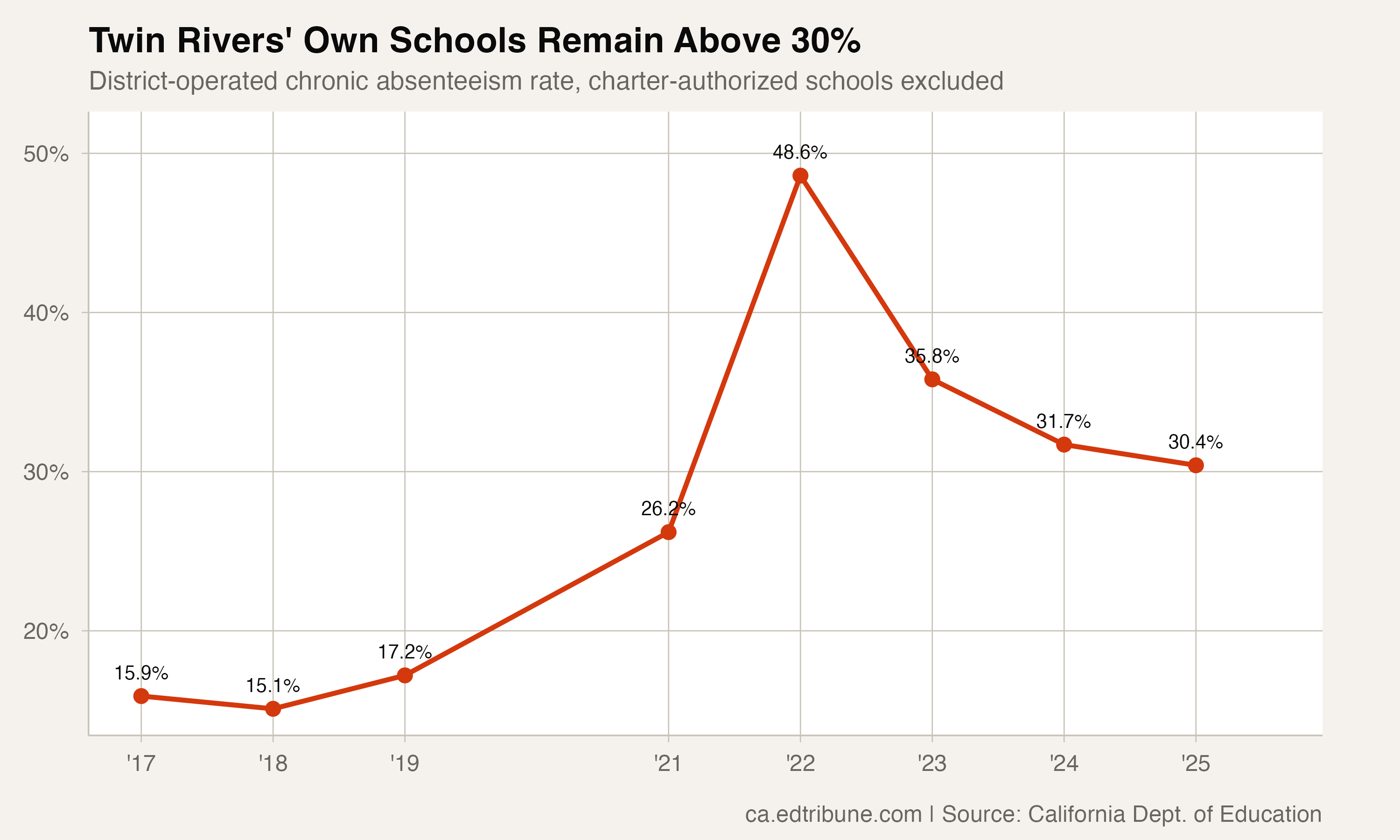
The latest rate was 18.2 points below the 2021-22 peak but 13.2 points above 2018-19. It was also 10.9 points above California's 2024-25 non-charter rate of 19.5%.
California did not publish a 2019-20 chronic absenteeism file. CDE also advises caution when comparing pandemic-era years because reporting conditions changed; those qualifications appear on its chronic absenteeism data page.
The Charter Scope Changes the Aggregate
CDE's official file structure defines Charter School = All as all schools regardless of charter status, No as all non-charter schools and Yes as all charter schools.
For Twin Rivers in 2024-25, the all-status row reported 24,528 chronically absent students out of 49,331 eligible students, or 49.7%. The non-charter row reported 7,308 out of 24,033, or 30.4%. The charter-only row reported 17,284 out of 25,421, or 68.0%.
These rows establish how the rate changes with the charter filter. They do not identify who operates or authorizes a school, or explain why the charter and non-charter aggregates differ.
Who is missing school
The same CDE file structure defines a chronically absent student as one absent for at least 10% of the days the student was expected to attend. Several Twin Rivers student groups had higher rates than the district's 30.4% non-charter overall rate.
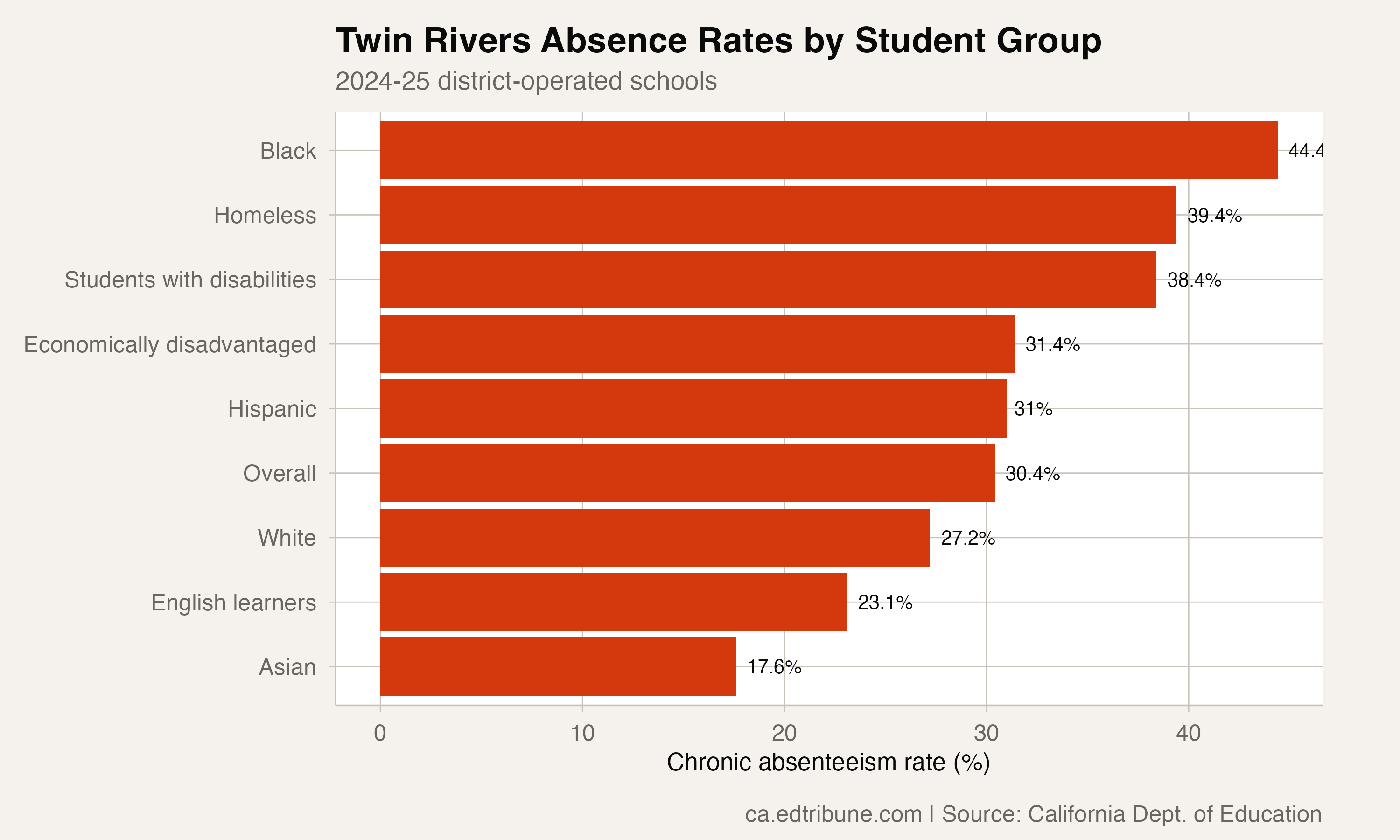
Black students in the non-charter aggregate had a 44.4% chronic absenteeism rate. Students experiencing homelessness were at 39.4%, and students with disabilities were at 38.4%. Economically disadvantaged students were at 31.4%, Hispanic students at 31.0%, white students at 27.2%, English learners at 23.1% and Asian students at 17.6%.
Asian students were below 20%, so the data do not support a claim that every listed subgroup exceeded that threshold. The aggregate rates also do not show that subgroup status caused an individual student's attendance outcome.
Still high in Sacramento County
Twin Rivers was higher than six selected Sacramento County peers on the non-charter basis.
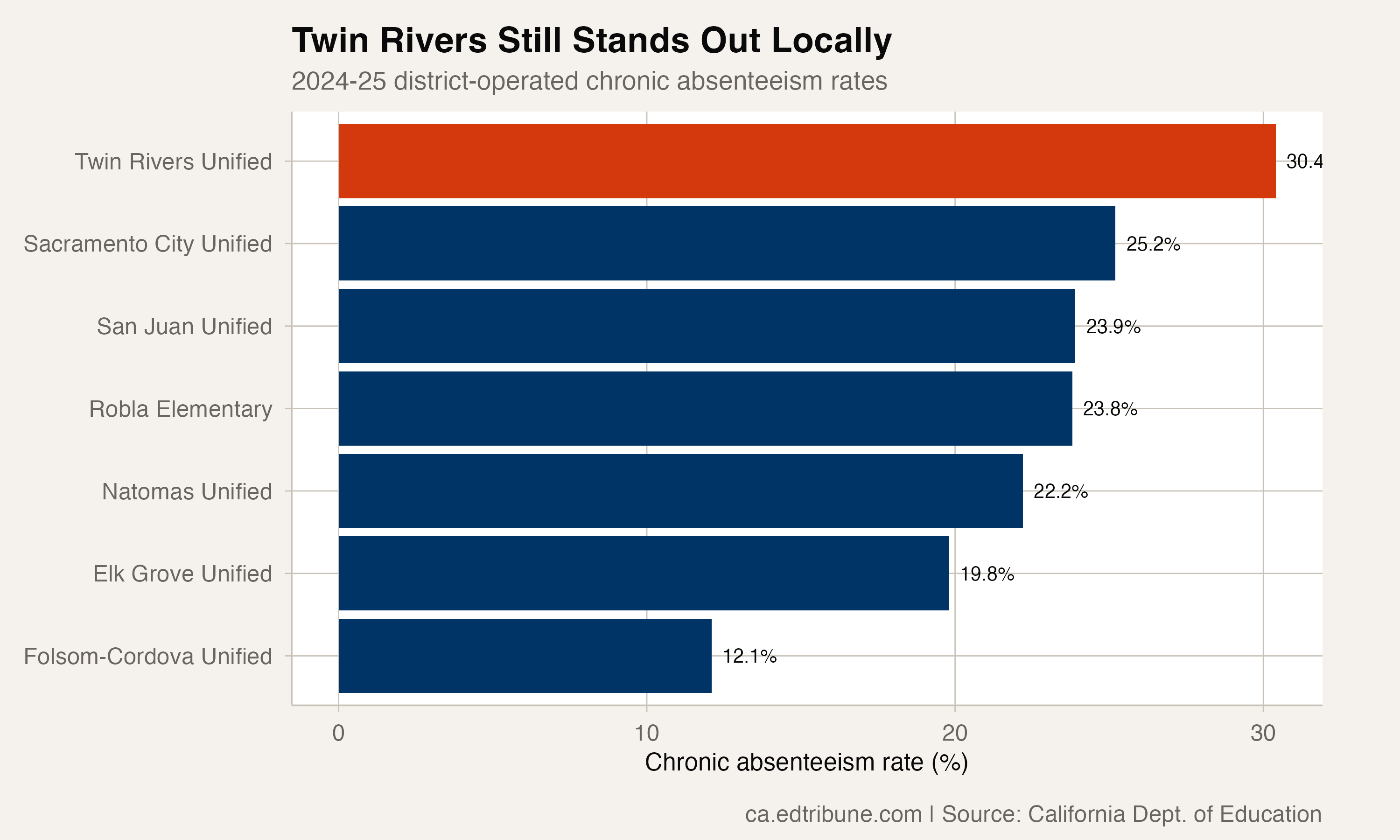
Sacramento City Unified↗ET was at 25.2% in 2024-25. San Juan Unified↗ET was at 23.9%. Robla Elementary↗ET was at 23.8%. Natomas Unified↗ET was at 22.2%. Elk Grove Unified↗ET was at 19.8%. Folsom-Cordova Unified↗ET was at 12.1%.
Twin Rivers' 30.4% rate was 18.3 points higher than Folsom-Cordova's rate and 5.2 points higher than Sacramento City's. Among Sacramento County districts in the file, only Sacramento County Office of Education had a higher non-charter rate: 40.1% on an eligible enrollment of 1,279.
What the numbers can and cannot say
The data establish the size, trend, subgroup pattern, and peer ranking of the attendance problem. They do not explain the cause by themselves.
Unresourced: This article does not attribute Twin Rivers' attendance levels to a specific district policy, transportation pattern, housing condition or intervention strategy. The statewide aggregate file cannot test those explanations.
The supported conclusion is narrower: Twin Rivers' 2024-25 non-charter chronic absenteeism rate was 30.4%, seventh highest among the 59 California districts meeting the article's 20,000-student threshold and still above its 2018-19 level.
Detailed code that reproduces the analysis and figures in this article is available exclusively to EdTribune subscribers.
Discussion
Sign in to join the discussion.
Loading comments...