Correction (September 30, 2026): An earlier version of this article compared Bakersfield City with other districts using the state's authorizer totals, which add students at charter schools a district authorizes. Counting only the schools each district runs, Modesto City Elementary's drop is 31.1 points, not 29.7, and Hayward Unified's is 27.3 points, not 26.5, placing it behind Cotati-Rohnert Park Unified at 27.8. The top-10 chart changed accordingly. Bakersfield City authorizes no charter schools, so its own figures and its first-place ranking are unchanged. We also removed a statement that the district does not publish descriptions of its attendance work, which we had not confirmed.
In 2021-22, more than half of Bakersfield City School District↗ET's students were chronically absent. The rate hit 51.6% -- a number that means most classrooms could not count on seeing the same faces two days in a row. Three years later, the rate is 18.9%.
That 32.7-point drop is the largest chronic absenteeism improvement of any California district with at least 5,000 students. It is not a statistical artifact of a tiny district where a few students moving changes the numbers. Bakersfield City enrolls 29,733 students across dozens of schools in Kern County. This is a genuine, large-scale turnaround.
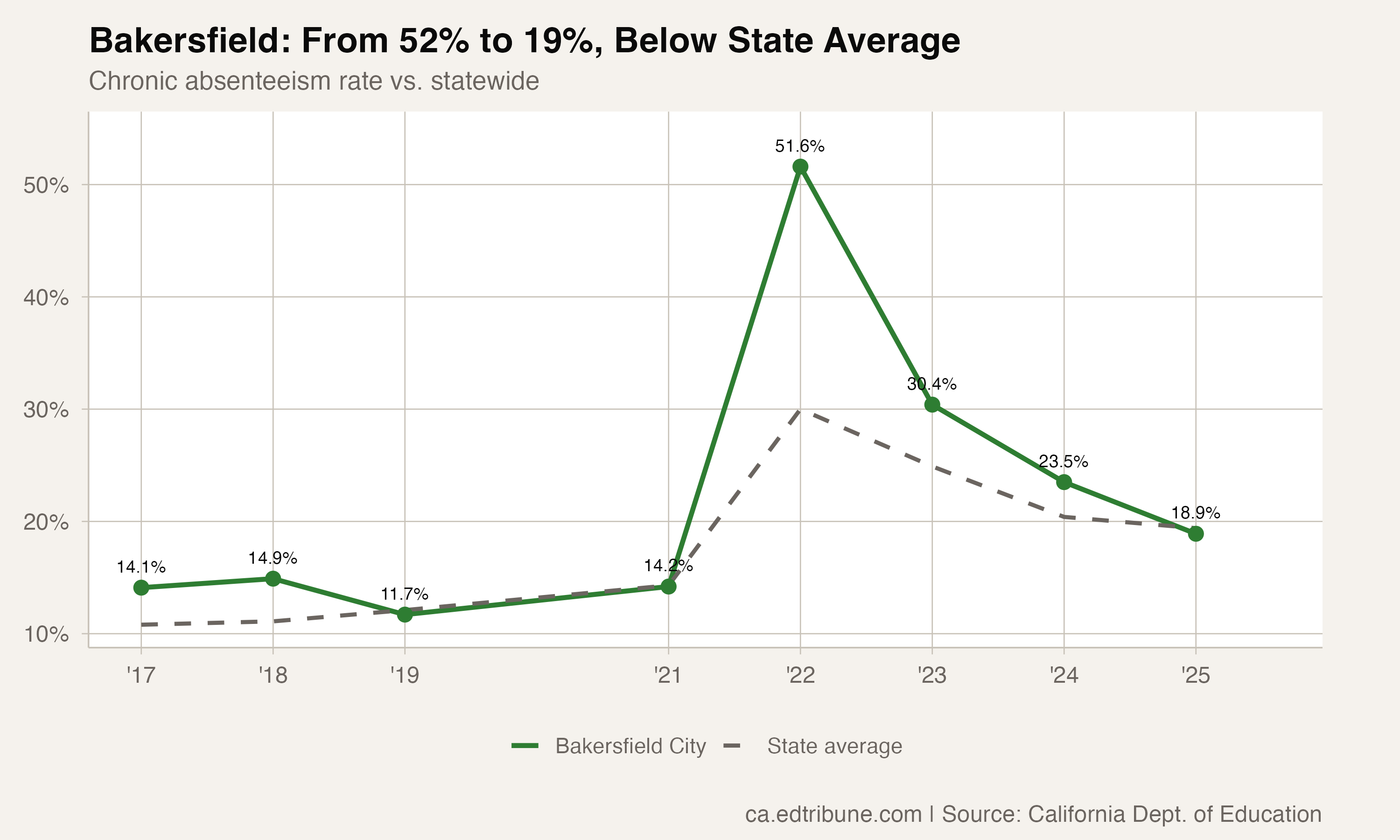
More striking: Bakersfield's current rate of 18.9% is now below the state average of 19.4%. A district that was once 21.6 points worse than the state average is now half a point better.
The recovery timeline
Bakersfield's improvement was not gradual. It came in dramatic, front-loaded chunks.
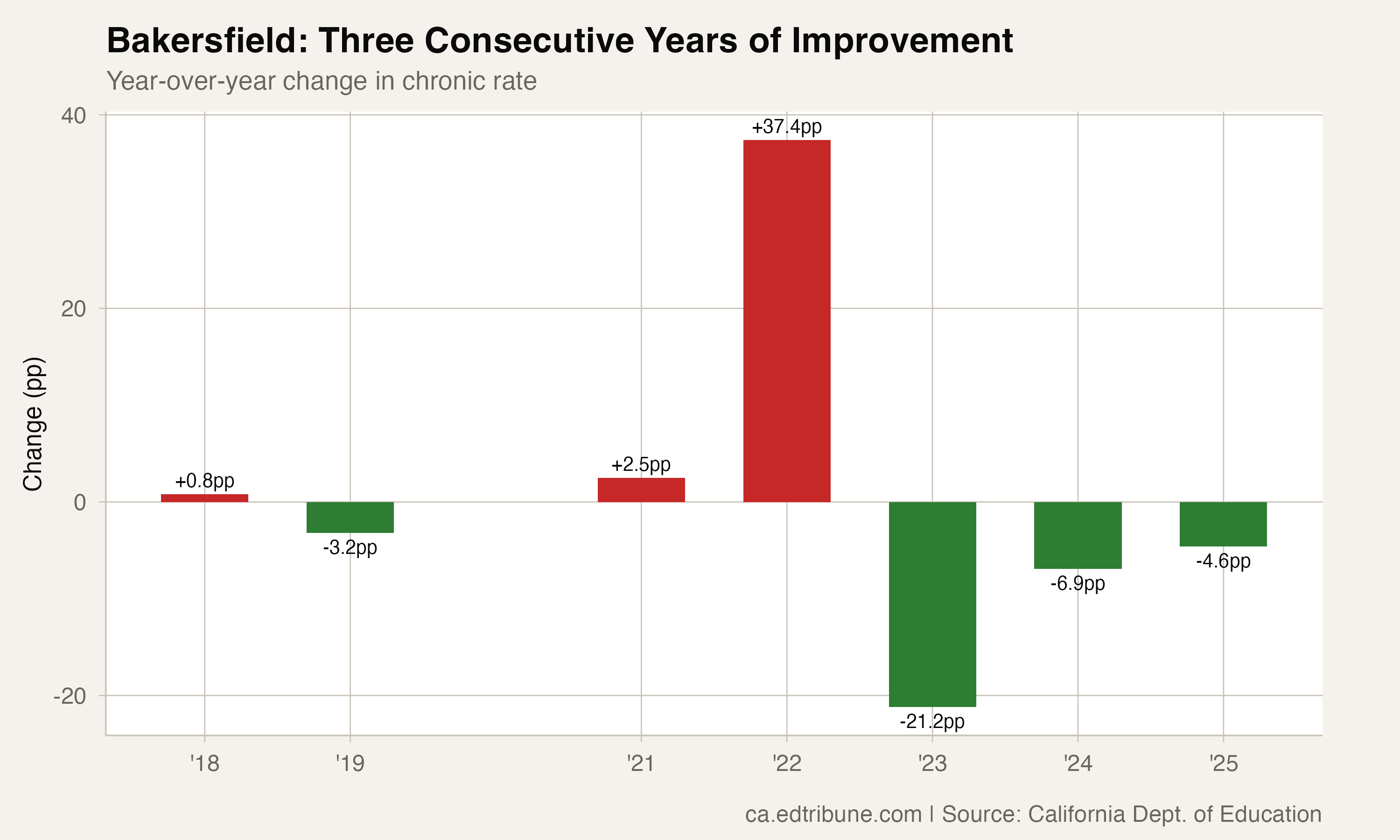
From the 2022 peak to 2023: -21.2 percentage points. From 2023 to 2024: -6.9 points. From 2024 to 2025: -4.6 points. The initial improvement was massive, and while the pace has slowed -- as expected -- each successive year has still produced meaningful reductions.
The pre-COVID rate in Bakersfield was 11.7% in 2018-19. The current 18.9% is still 7.2 points above that baseline, so recovery is not complete. But the trajectory suggests continued improvement is plausible.
How Bakersfield compares
Among the 266 California districts with at least 5,000 students in the schools they run, Bakersfield's 32.7-point improvement from the 2021-22 peak leads the state.
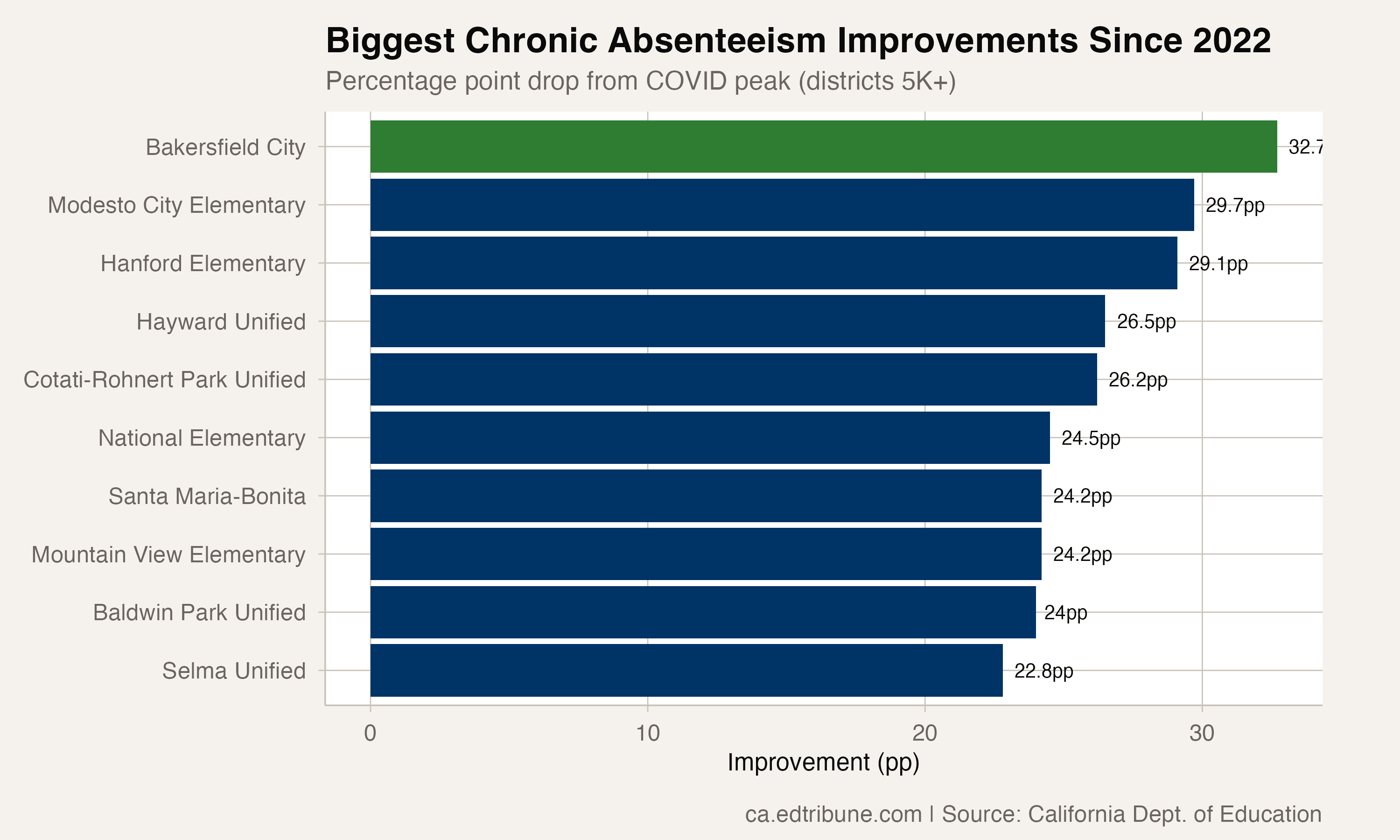
Modesto City Elementary↗ET is second at 31.1 points. Hanford Elementary↗ET improved 29.1 points, Cotati-Rohnert Park Unified↗ET 27.8 and Hayward Unified↗ET 27.3. The top improvers span the Central Valley, the Bay Area, and Southern California, a sign that the turnaround is not limited to one region or demographic profile.
What the top improvers share is harder to identify from data alone. Some, like Bakersfield and Santa Maria-Bonita, serve majority-Hispanic, high-poverty populations in agricultural regions. Others, like Cotati-Rohnert Park in Sonoma County, serve more mixed demographics. Most started from very high 2021-22 rates, which left them the most room to fall.
Bakersfield in context
Bakersfield City is an elementary district (K-8) serving the urban core of Bakersfield, the seat of Kern County. About 83% of its students are Hispanic, and the district is high poverty. It does not include the surrounding suburban areas, which are served by separate districts like Panama-Buena Vista, Rosedale, and Greenfield.
The Kern County context matters because chronic absenteeism has a stronger correlation with poverty and housing instability than with school quality. Bakersfield's recovery suggests that community-level barriers can be overcome with sustained effort, even in a high-poverty district.
Kern County is also one of California's agricultural centers, with a significant migrant and seasonal worker population. School attendance in agricultural communities is historically difficult to maintain during harvest seasons, making Bakersfield's year-round improvement more notable.
The unanswered how
The state's data show what happened but not how. The improvement could reflect systematic home visits, restart effects as schools returned to full in-person operations, community-level changes in employment and housing, improved data collection that inflated the 2022 peak, or some combination.
Without internal district reporting, the data cannot distinguish between districts that actively improved and districts that passively benefited from communities returning to pre-pandemic routines.
What the data do establish: a Kern County district of 29,733 students, majority-Hispanic, high-poverty, in an agricultural region where chronic absenteeism is supposed to be intractable, cut its rate by 33 points and landed below the state average. Somewhere in those schools on the south side of Bakersfield, something worked.
Detailed code that reproduces the analysis and figures in this article is available exclusively to EdTribune subscribers.
Discussion
Sign in to join the discussion.
Loading comments...