Correction (July 21, 2026): The original article said San Francisco Unified's overall chronic-absence rate had fallen every year after 2021-22, but it fell to 22.7% in 2023-24 and then rose to 23.9% in 2024-25. It also described charter_status == "No" as excluding only independent-study or online charters; California defines the filter as all non-charter schools. This version adds the omitted year, reports the charter scopes directly and removes causal explanations the aggregate file cannot test.
In the non-charter schools of San Francisco Unified School District↗ET, 54.6% of Black students were chronically absent in 2024-25. The Asian-student rate on the same basis was 7.1%, producing a 47.5-point gap.
Hispanic students reported a 37.5% rate, while white students reported 14.7%.
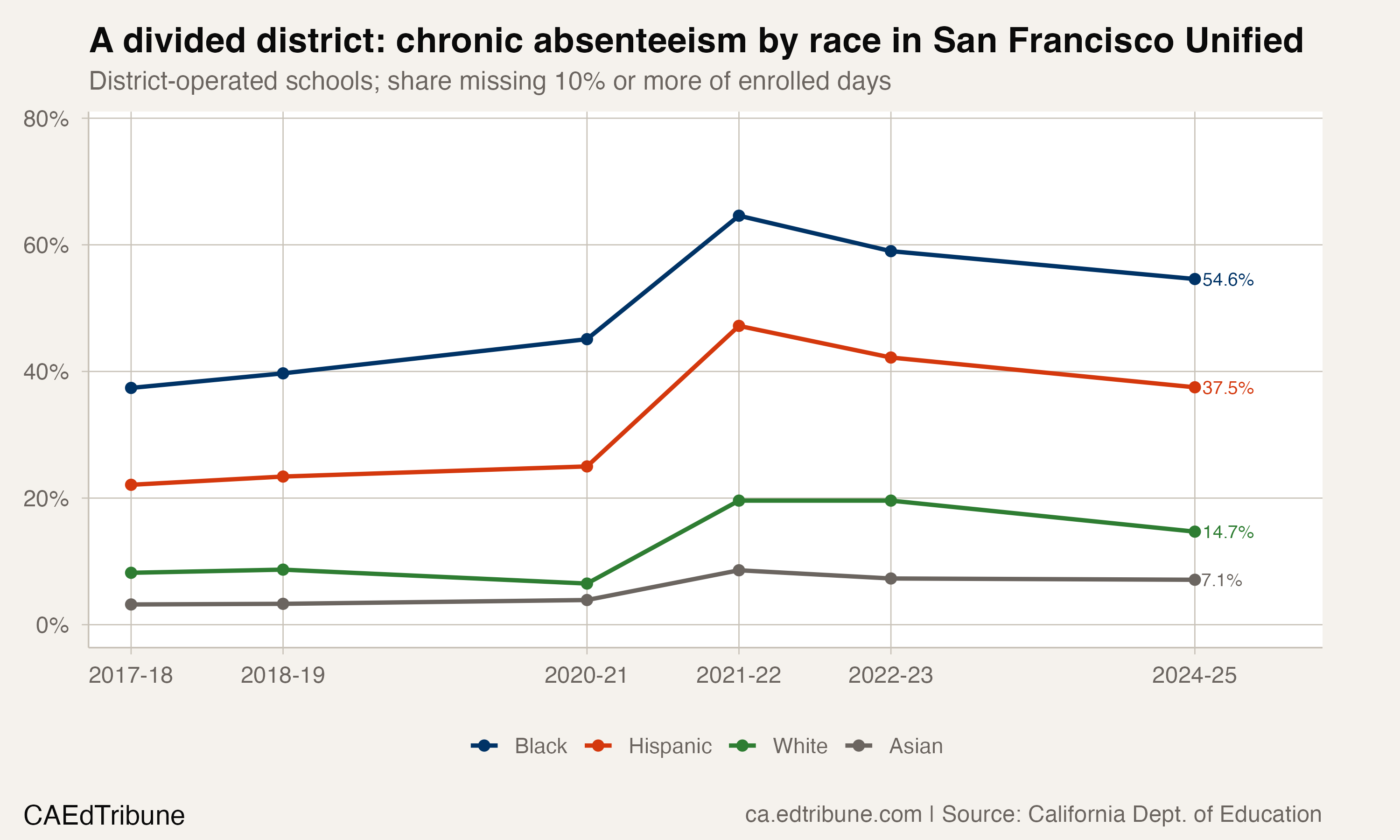
The Gap Narrowed From Its Peak, Then Edged Up
The Black-Asian gap reached 56.0 points in 2021-22. It fell to 51.7 in 2022-23 and 47.1 in 2023-24, then widened 0.4 point to 47.5 in 2024-25. The latest gap remained 8.5 points below the 2021-22 peak.
The Black-student rate followed a similar shape: 64.6% in 2021-22, 59.0% in 2022-23, 53.7% in 2023-24 and 54.6% in 2024-25. The Asian-student rates were 8.6%, 7.3%, 6.6% and 7.1%.
These group rates do not show that race itself caused an individual student's attendance outcome. The file does not cross-classify these figures with housing, transportation, school assignment or other proposed explanations.
The Overall Rate Rose in the Latest Year
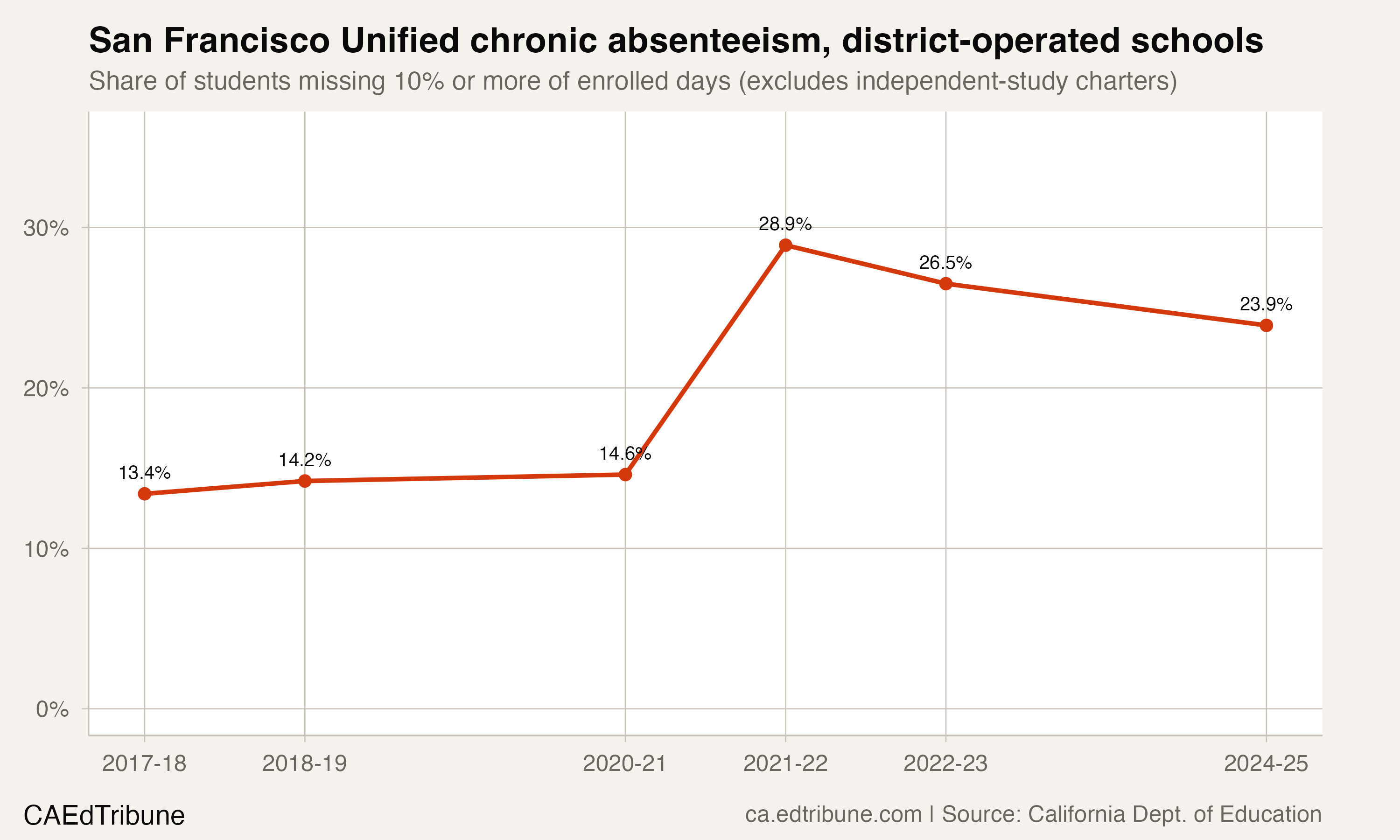
San Francisco Unified's non-charter rate was 14.2% in 2018-19 and peaked at 28.9% in 2021-22. It fell to 26.5% in 2022-23 and 22.7% in 2023-24 before rising 1.2 points to 23.9% in 2024-25.
The latest rate was 9.7 points above 2018-19 and 5.0 points below the 2021-22 peak.
California's non-charter rate fell from 25.4% in 2022-23 to 19.5% in 2024-25, a 5.9-point decline. San Francisco Unified fell 2.6 points over the same two-year span and ended 4.4 points above the state.
California did not publish 2019-20 absenteeism data and recommends caution with cross-year comparisons because of pandemic-era reporting changes. Those qualifications appear on the California Department of Education chronic absenteeism data page.
The Charter Scope Changes the Result
This analysis selects charter_status == "No" and dass_status == "All". California's official file structure defines the charter selection as all non-charter schools in the aggregate.
For San Francisco Unified in 2024-25, the row including all charter statuses reported 28.8%. The non-charter row reported 23.9%, and the charter-only row reported 54.2%. The all-status rate was 4.9 points above the non-charter rate.
Those aggregate rows establish a scope difference. They do not identify which instructional model, attendance rule or school practice produced it.
Second Among 22 Large Counties
Among 22 California counties with at least 50,000 eligible students in the 2024-25 non-charter row, San Francisco ranked second at 24.2%.
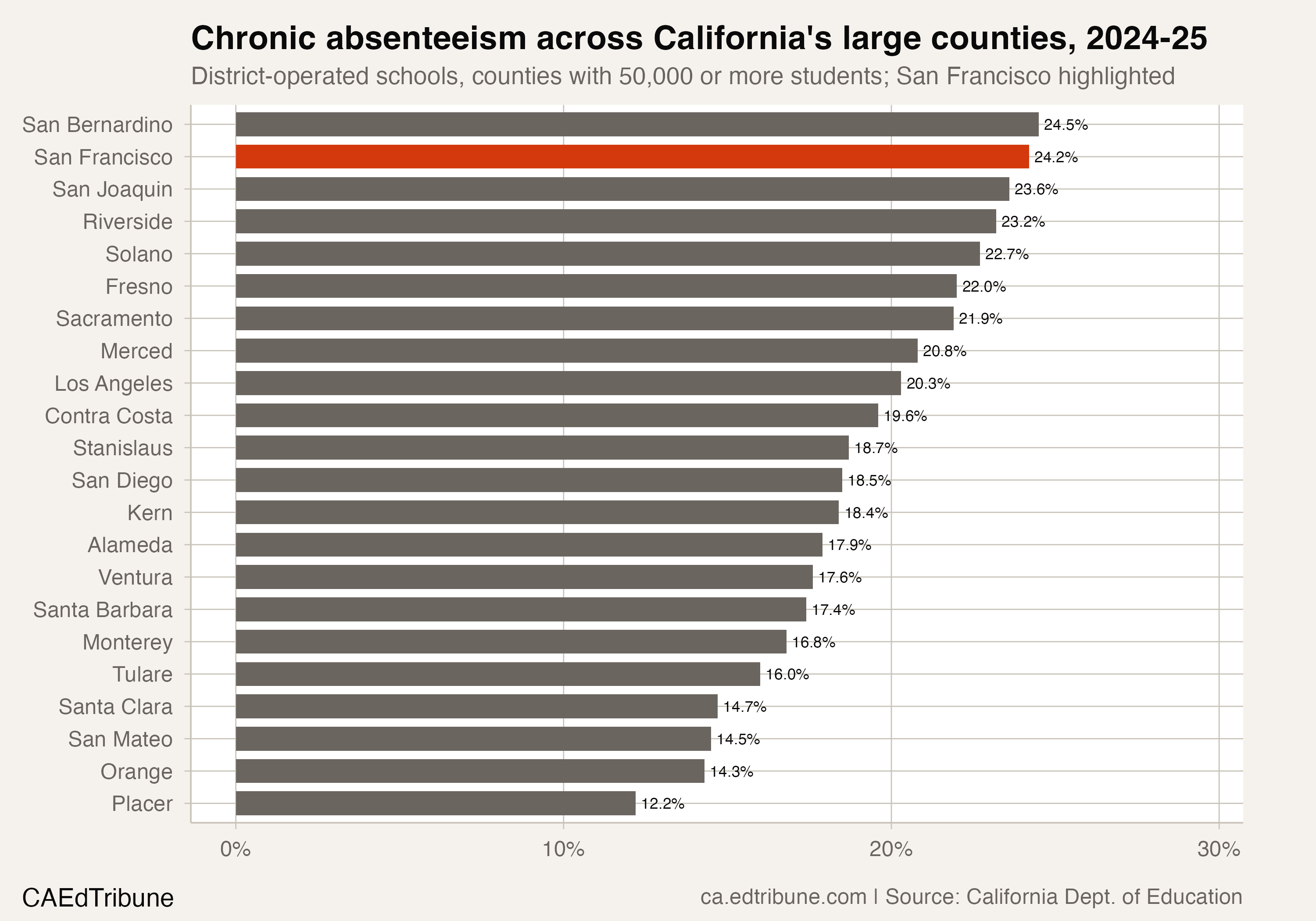
San Bernardino ranked first at 24.5%, and San Joaquin ranked third at 23.6%. Across all 22 counties, the range ran from 12.2% to 24.5%.
The county rate and the San Francisco Unified district rate are different aggregates: 24.2% for the county and 23.9% for the district. They should not be used interchangeably.
Detailed code that reproduces the analysis and figures in this article is available exclusively to EdTribune subscribers.
Discussion
Sign in to join the discussion.
Loading comments...