Correction: An earlier version of this article stated that students who are currently homeless were 13.1 points above their 2019 rate of 21.8%. The 2018-19 baseline was 25.0%, placing the current rate 9.9 points above it. The article has been updated.
In a state where chronic absenteeism improved for every student group last year -- overall, for every race, for economically disadvantaged students, for students with disabilities -- one group went backward.
Foster youth chronic absenteeism rose from 37.0% to 37.3% in 2024-25, a 0.3 percentage point increase. It is the only subgroup in California where the rate moved in the wrong direction.
That fraction of a point matters because of what it represents: the state's most vulnerable students are the only ones not benefiting from three years of statewide attendance recovery.
A trajectory apart from every other group
Foster youth have had the highest chronic absenteeism rate of any tracked subgroup since California began reporting DASS-disaggregated data. The trajectory is stark.
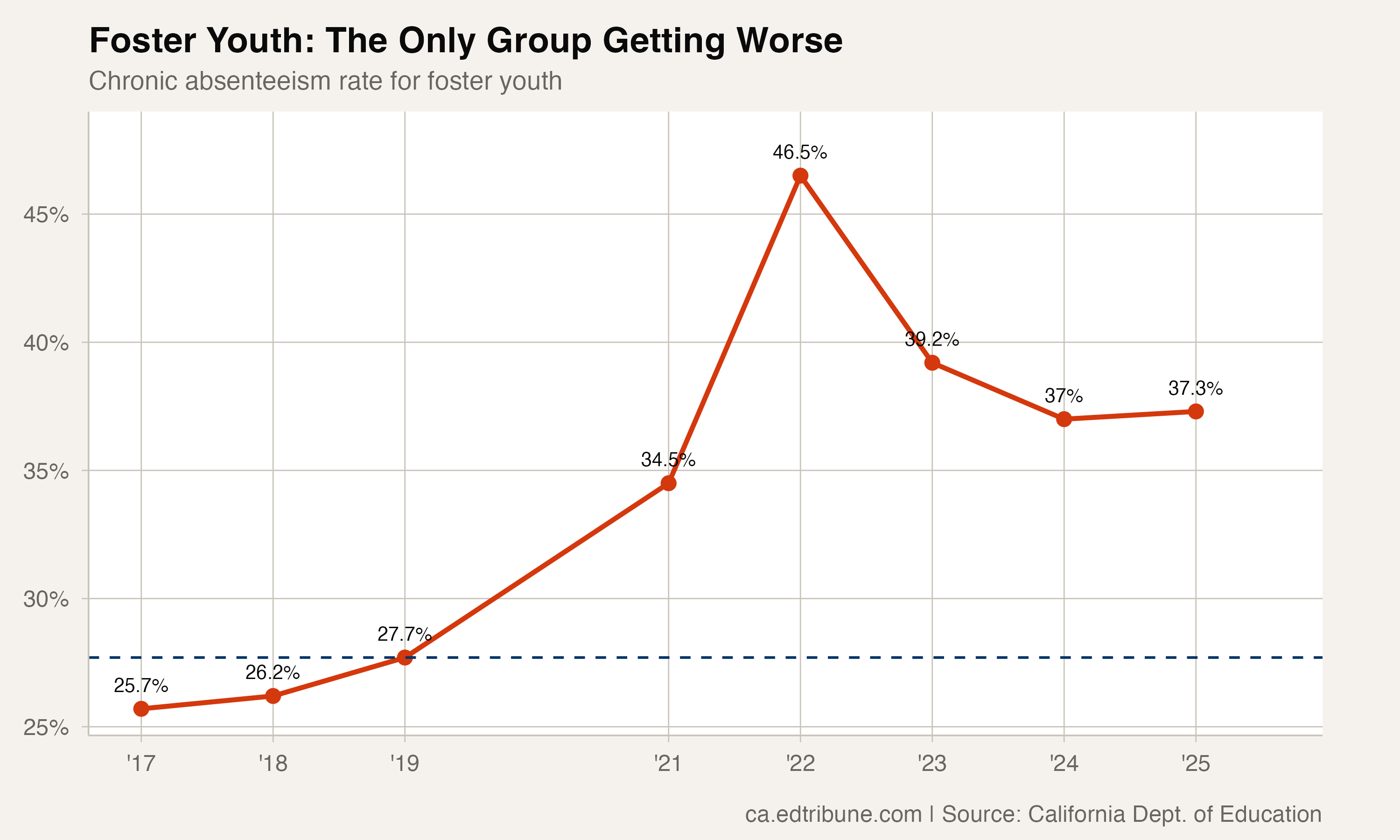
Before the pandemic, foster youth were at 27.7% -- already more than double the overall state rate of 12.1%. COVID drove them to 46.5% in 2021-22, meaning nearly half of all foster youth were chronically absent. The rate fell in 2023 and 2024, suggesting partial recovery, then ticked up again in 2025.
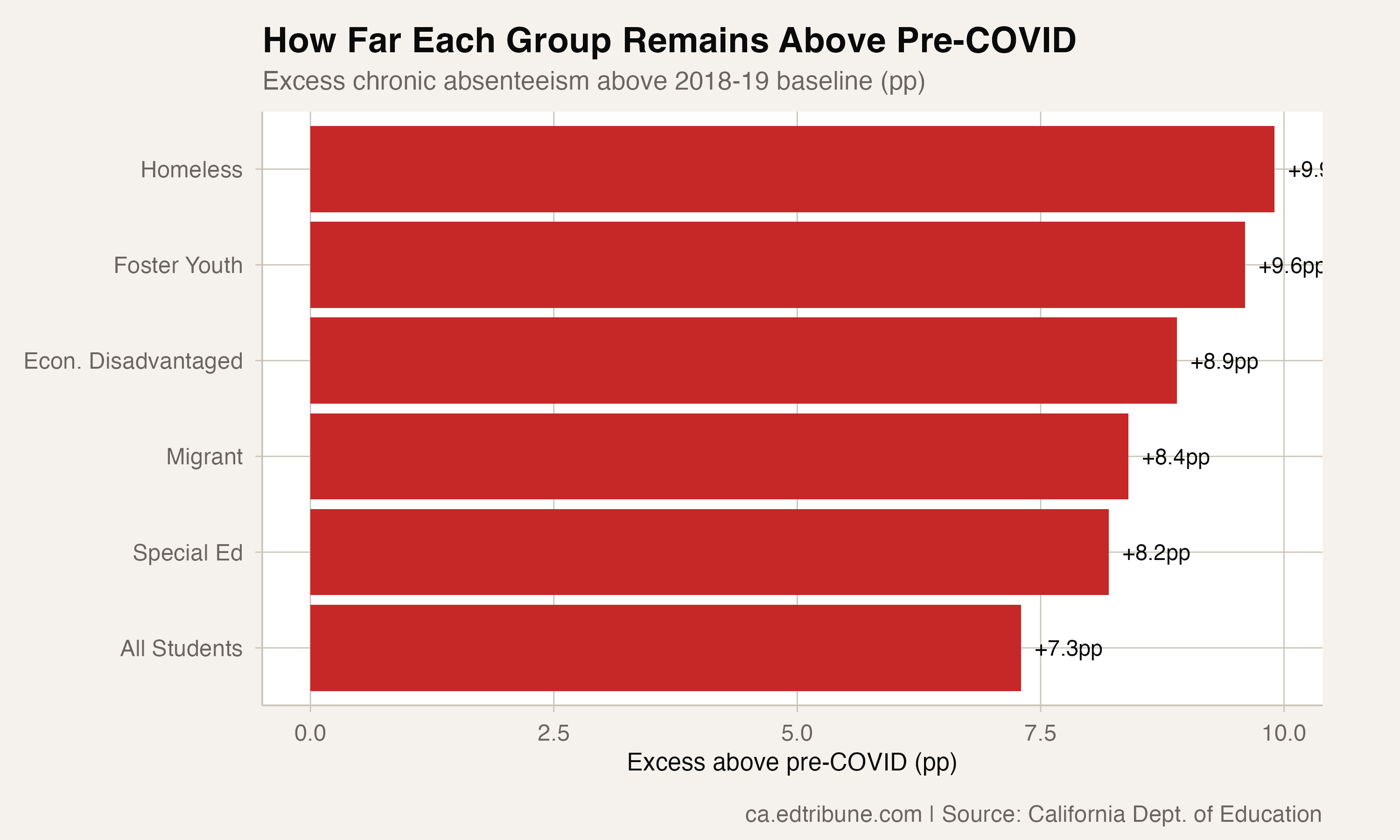
The current 37.3% rate is 9.6 percentage points above the pre-COVID baseline. No other subgroup is as far from where it started. Students who are currently homeless are 9.9 points above their 2019 rate (34.9% vs 25.0%), but they at least improved last year. Foster youth did not.
How foster youth compare to other vulnerable groups
Foster youth now sit at the top of California's chronic absenteeism hierarchy, above students who are currently homeless, students with disabilities, and economically disadvantaged students.
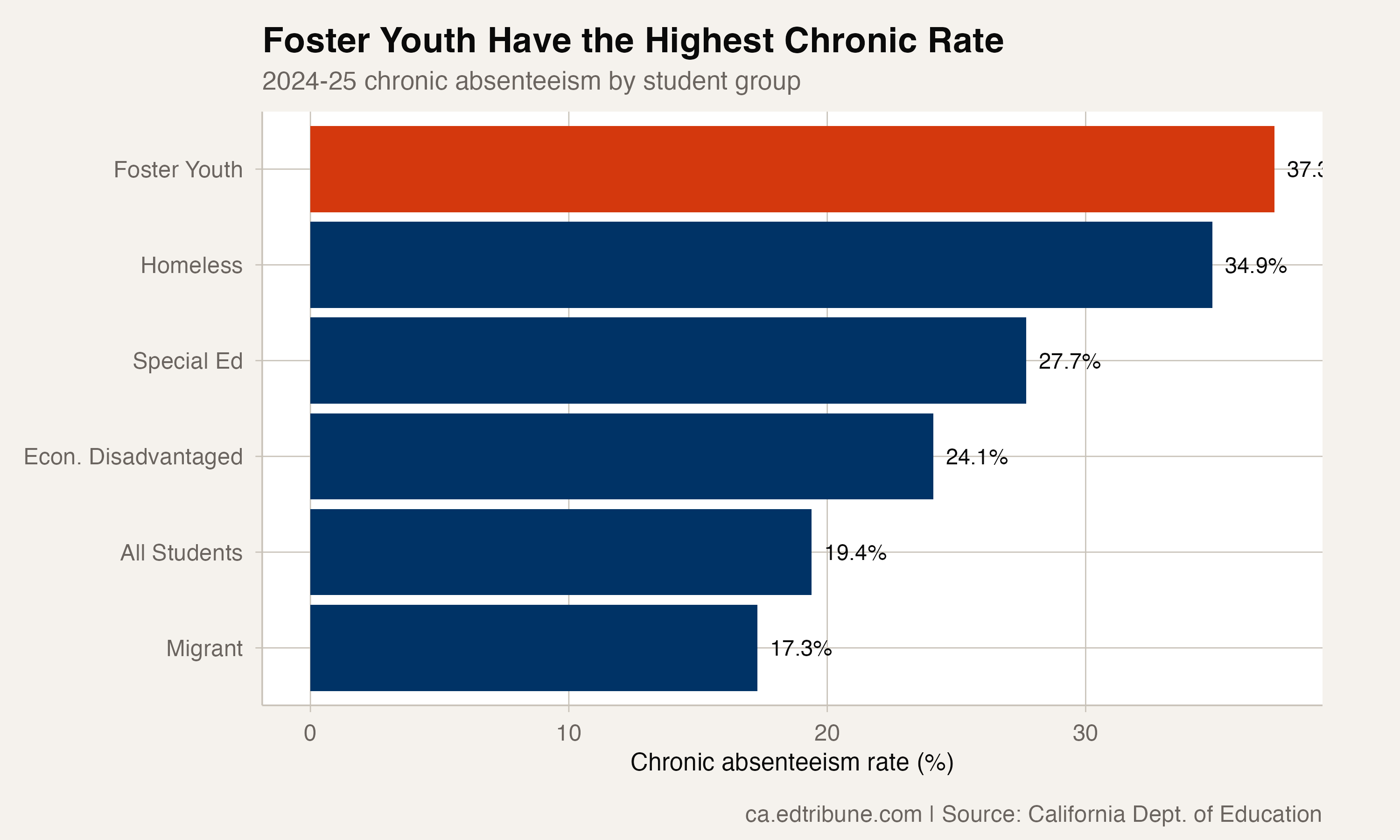
The ordering: foster youth at 37.3%, homeless at 34.9%, special education at 27.7%, economically disadvantaged at 24.1%, all students at 19.4%. Migrant students, at 17.3%, are actually below the state average.
The divergence in 2024-25
What makes 2024-25 alarming is not the rate itself but the direction. Every other subgroup improved.
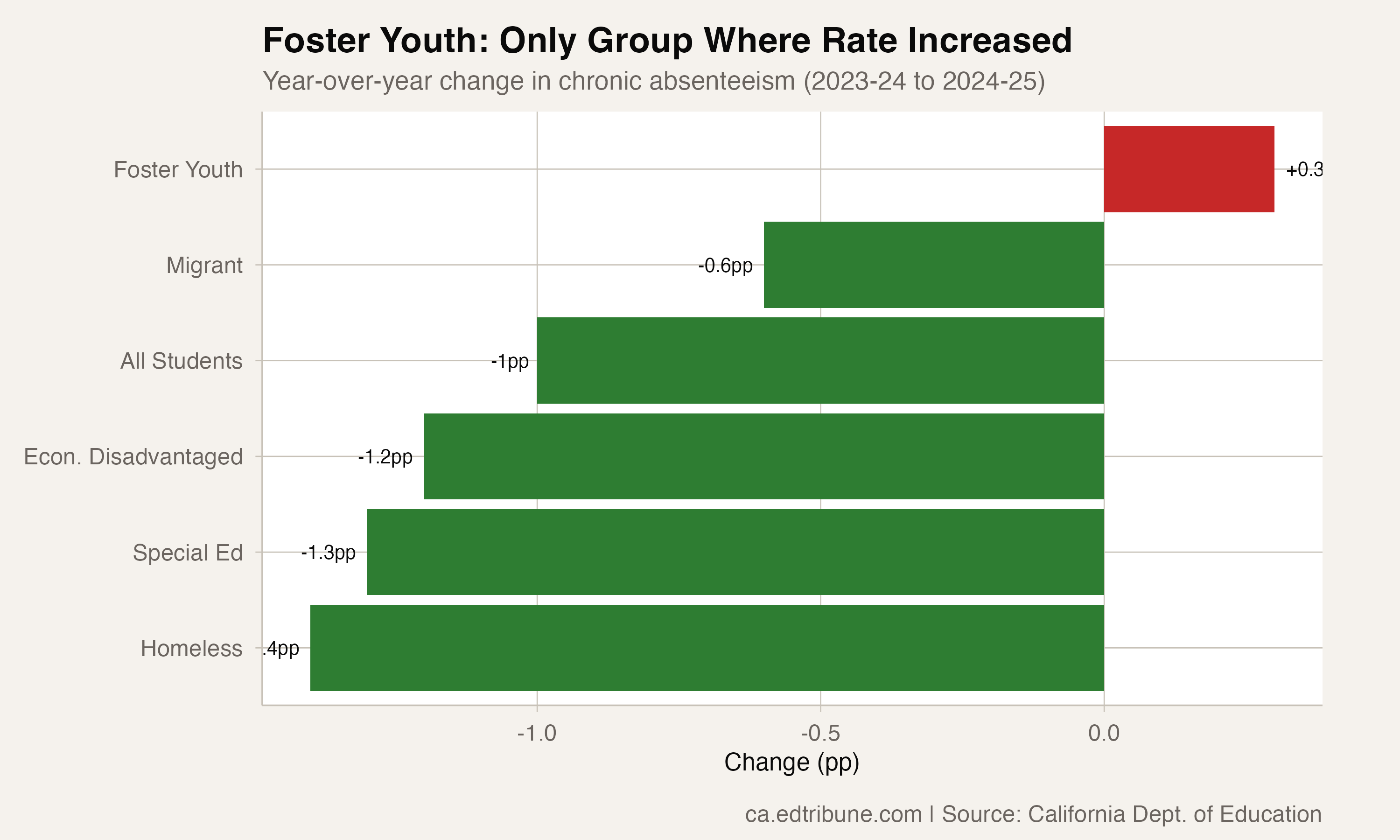
Special education students improved 1.3 points. Students who are currently homeless improved 1.4 points. Economically disadvantaged students improved 1.2 points. Even migrant students, a small and mobile population, improved 0.6 points. Foster youth moved +0.3 in the wrong direction.
13,278 students
Behind the percentage is a count: 13,278 foster youth were chronically absent in 2024-25. That number has fluctuated between 12,500 and 19,500 over the past eight years, driven by changes in both the foster care population and the chronic rate. The count peaked at 19,514 in 2021-22 -- nearly 20,000 students in state care who were routinely missing school.
The current count is lower than the peak, primarily because the foster care population has decreased. But a shrinking denominator paired with a rising rate means the problem is concentrating: a higher share of a smaller population is disengaged.
Why foster youth are different
The barriers to school attendance for foster youth are structurally distinct from those facing other subgroups. Placement changes -- moving from one foster home to another -- trigger school changes. A 2023 report from the California Department of Social Services found that foster youth average 2.3 placement changes per year, each potentially disrupting school enrollment, transportation, and social connections.
Courts, case worker meetings, and therapy appointments pull foster youth out of class during the school day. Unlike a dentist appointment that a parent schedules around school, these are institutional obligations imposed on children by the system that is supposed to serve them.
California's AB 490 requires that foster youth remain in their school of origin when possible, and AB 854 funded foster youth liaisons at every school district. But implementation varies widely. In districts where the liaison position is an add-on to someone's existing job, rather than a dedicated role, foster youth attendance tends to be worse.
The 10-point gap from everyone else's recovery
Between 2022 and 2025, the overall state chronic rate fell 10.6 percentage points (30.0% to 19.4%). Foster youth fell 9.2 points (46.5% to 37.3%). Smaller improvement, larger starting point -- the gap between foster youth and the state average barely budged, moving from 16.5 points to 17.9 points.
For foster youth to reach their pre-COVID rate of 27.7%, they would need to improve 9.6 percentage points -- essentially matching the entire improvement the state achieved over three years. Given that their rate increased rather than decreased in 2024-25, that timeline is difficult to project.
The 13,278 foster youth currently chronically absent are children whose relationship with school is mediated by a court, a caseworker, and a placement agency. A phone call home goes to a foster parent who may have had the child for three weeks. An attendance incentive arrives at a school the student may leave next month. For these students, the barrier to attendance is not motivation -- it is the machinery of the system that is supposed to protect them, pulling them out of class to serve its own schedule.
Detailed code that reproduces the analysis and figures in this article is available exclusively to EdTribune subscribers.
Discussion
Sign in to join the discussion.
Loading comments...