Correction: An earlier version reported that DASS schools accounted for 9.5% of all students who were chronically absent using the sum of the DASS Yes and No rows as the denominator. Those rows exceed the published DASS=All total, so that denominator was not valid. Using the published total, the corrected 2024-25 share is 9.7%, and the 2022-25 range is 8.3% to 10.9%.
Continuation schools in California exist for students who have already fallen behind -- credit-deficient, over-age, or pushed out of comprehensive high schools. Community day schools serve students expelled or on probation. Alternative education programs catch everyone else the traditional system could not hold. California groups all of these under a designation called Dashboard Alternative School Status, or DASS.
In 2024-25, 56.4% of students at DASS schools were chronically absent. At non-DASS schools -- the traditional system -- the rate was 18.4%.
That 38-percentage-point gap is the single largest structural divide in California's attendance data, wider than any racial gap, any poverty gap, or any geographic gap.
A gap that dwarfs all others
The DASS-vs-traditional divide is not new. In 2021-22, when California's overall chronic absenteeism peaked at 30%, DASS schools were at 62.6% and non-DASS schools at 29.0% -- a 33.6-point gap. As the state recovered, the gap actually widened. Non-DASS schools improved 10.6 points over three years. DASS schools improved just 6.2 points.
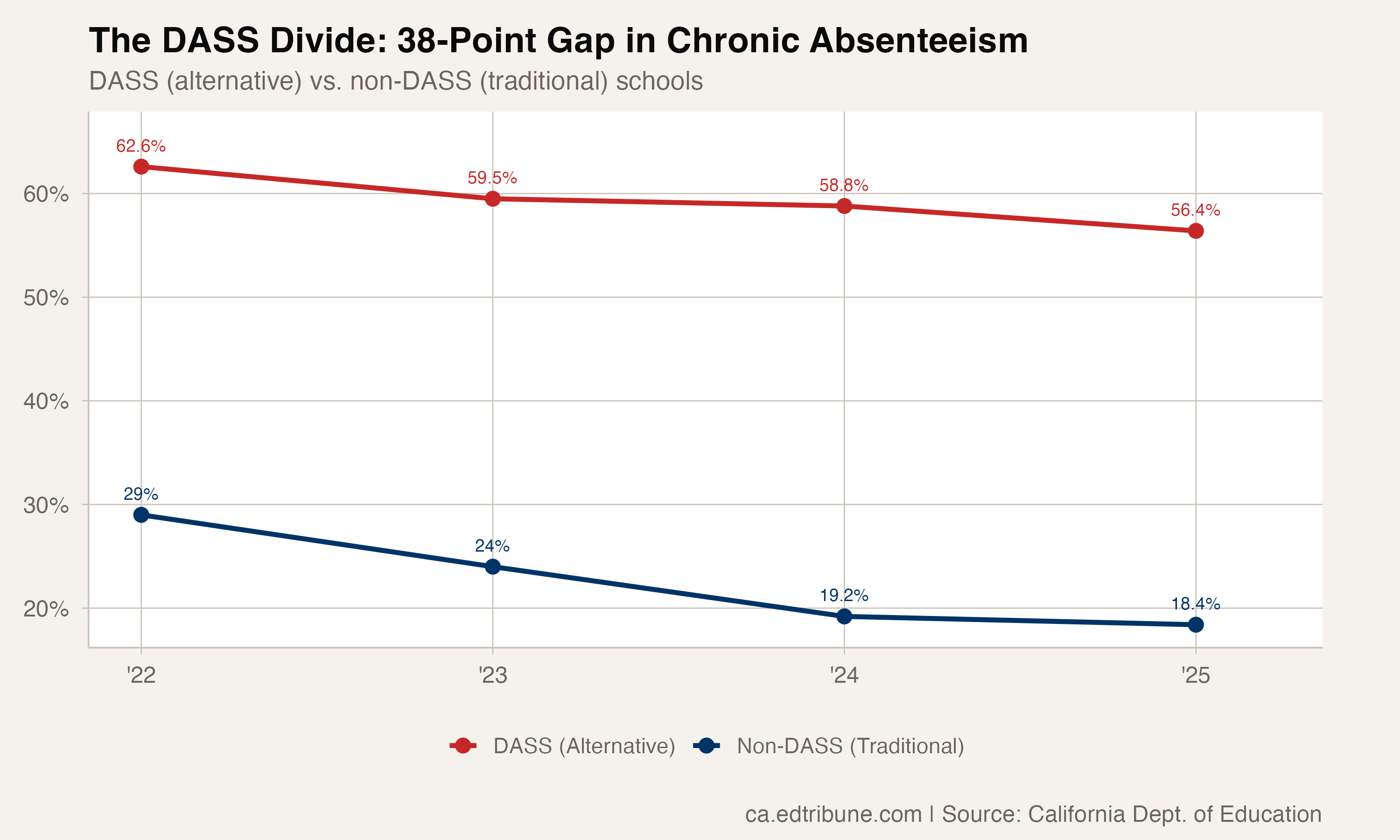
The result: a gap that grew from 33.6 to 38.0 percentage points between 2022 and 2025. Recovery has been slower for the schools serving the students most at risk of disengagement.
The gap cuts across every subgroup
The DASS divide is not a composition effect. It does not disappear when you control for demographics. Every student subgroup shows a massive gap between DASS and non-DASS schools.
Migrant students at DASS schools: 58.0% chronic absenteeism. Migrant students at non-DASS schools: 16.8%. A 41.2-point gap. English learners at DASS schools: 59.3% versus 20.3% at traditional schools -- a 39-point gap. Even Asian students, the group with the lowest overall chronic rate in California, have a 42.6% rate at DASS schools compared to 7.9% at non-DASS schools.
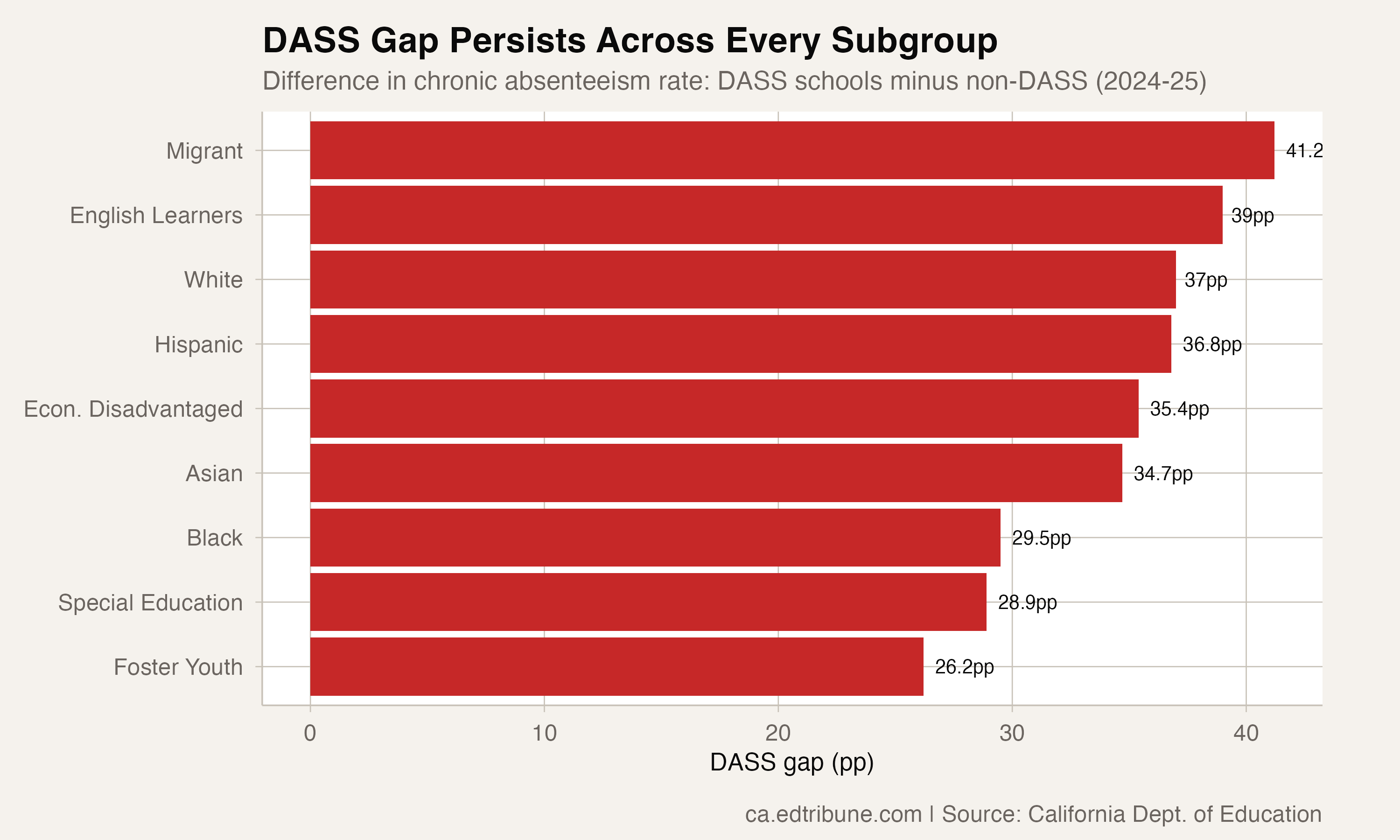
Foster youth -- already the group with the highest overall chronic rate -- show a narrower but still dramatic gap: 61.0% at DASS versus 34.8% at non-DASS, a 26.2-point spread. The narrowing here likely reflects that foster youth face severe attendance barriers regardless of school type, compressing the gap from above.
197,000 students, 111,000 chronically absent
DASS schools enrolled 197,519 students in 2024-25, roughly 3.3% of California's student population. Of those, 111,395 were chronically absent. That means DASS schools account for 9.7% of all chronically absent students in the state despite enrolling just 3.3% of students -- a nearly three-to-one overrepresentation.
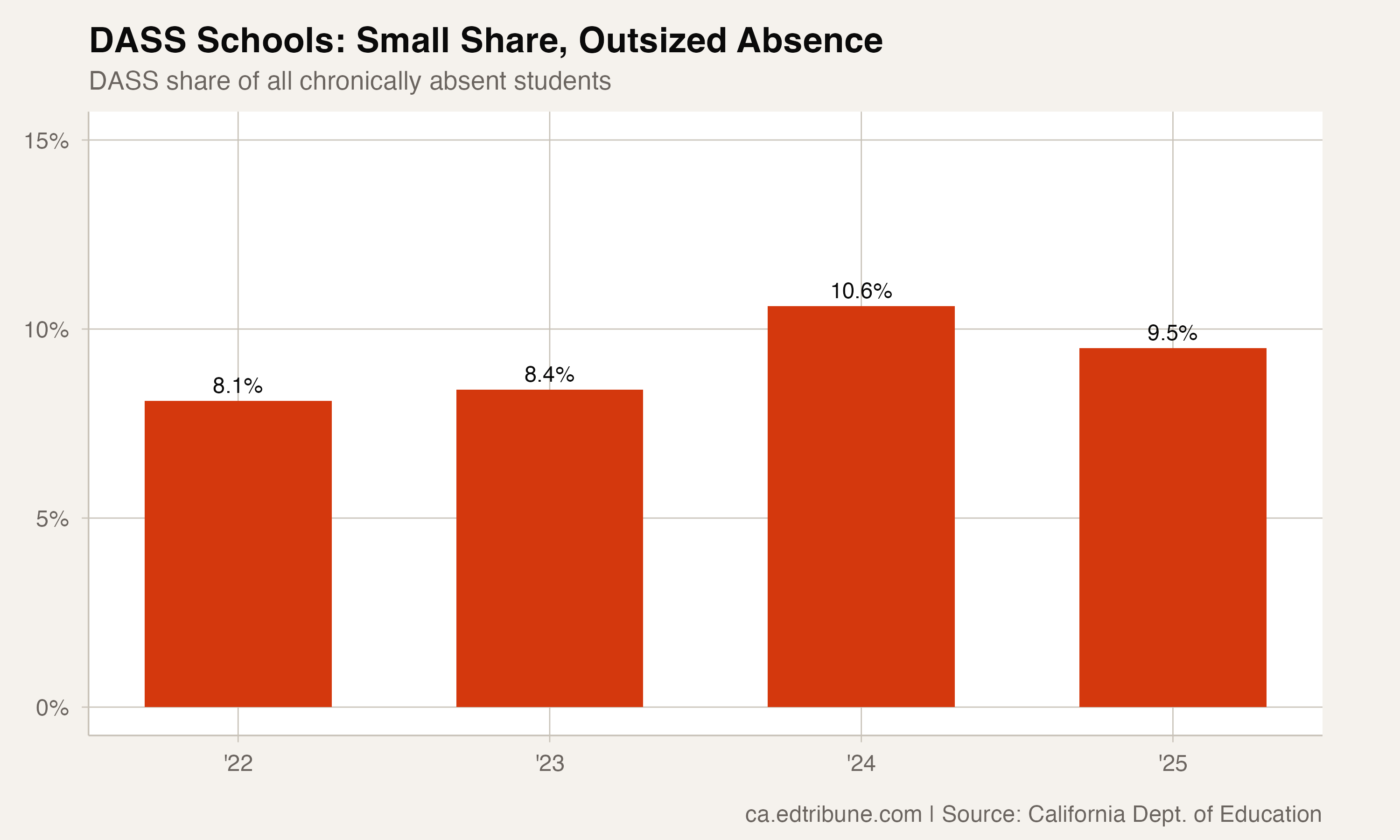
The share has fluctuated between 8.3% and 10.9% since 2022. The peak came in 2023-24, when DASS enrollment temporarily expanded while non-DASS attendance improved.
Intervention or warehouse?
The question the data raises but cannot answer: are DASS schools providing meaningful intervention for students who would otherwise drop out entirely, or are they serving as repositories for disengaged students who have been given up on?
The answer is almost certainly both. Continuation schools keep students enrolled who would otherwise disappear from the system. A student attending a continuation school at 60% attendance is still more connected than a student who has dropped out. But a 56.4% chronic rate suggests that for more than half of DASS students, even the alternative system is not producing regular attendance.
California does not publicly report whether DASS students eventually transfer back to comprehensive schools, earn diplomas at comparable rates, or transition to post-secondary education. Without outcome data, it is difficult to know whether the DASS designation is a bridge back to engagement or a holding pattern.
Why the gap matters for state goals
California's goal of cutting chronic absenteeism 50% by 2030 applies statewide, not just to traditional schools. With DASS schools contributing 9.7% of all chronically absent students, their 56.4% rate is an anchor dragging on the state average. Improving DASS schools by even 10 percentage points would remove roughly 20,000 students from the chronically absent count.
But targeting DASS schools also means targeting the students who have already been sorted out of the mainstream -- those with higher rates of housing instability, justice system involvement, and credit deficiency. A continuation school on the edge of a Sacramento strip mall, serving students who aged out of their comprehensive high school, does not respond to the same interventions as an elementary school with a PTA and a carpool lane. The 38-point gap is not just a measurement. It is the distance between two school systems operating under the same state seal.
Detailed code that reproduces the analysis and figures in this article is available exclusively to EdTribune subscribers.
Discussion
Sign in to join the discussion.
Loading comments...