Correction (September 30, 2026): An earlier version of this article used the state's combined figures for Delano Union Elementary, which include students at charter schools the district authorizes but does not run. In the schools the district runs, 4,547 students were counted in 2024-25, not 6,421; the 2021-22 rate was 28.4%, not 27.7%; and the 2024-25 rate was 5.4%, not 5.3%. The yearly drops were 14.2, 5.3 and 3.5 points, not 15.0, 4.1 and 3.3. The earlier version also said Delano had fallen below its pre-pandemic rate; it has not, and is 1.8 points above its 2018-19 rate. We also replaced a statewide median, a count of unrecovered districts, a claim about the state's 2030 goal and a description of other low-absence districts that were not drawn from the state's data. The charts and text have been updated.
Delano sits in the southern San Joaquin Valley, north of Bakersfield on Highway 99, surrounded by grape vineyards and the legacy of Cesar Chavez's farmworker movement. The town's elementary school district, Delano Union Elementary↗ET, ran schools serving 4,547 students in 2024-25. About 86% of them are Hispanic, and 88% are from low-income families.
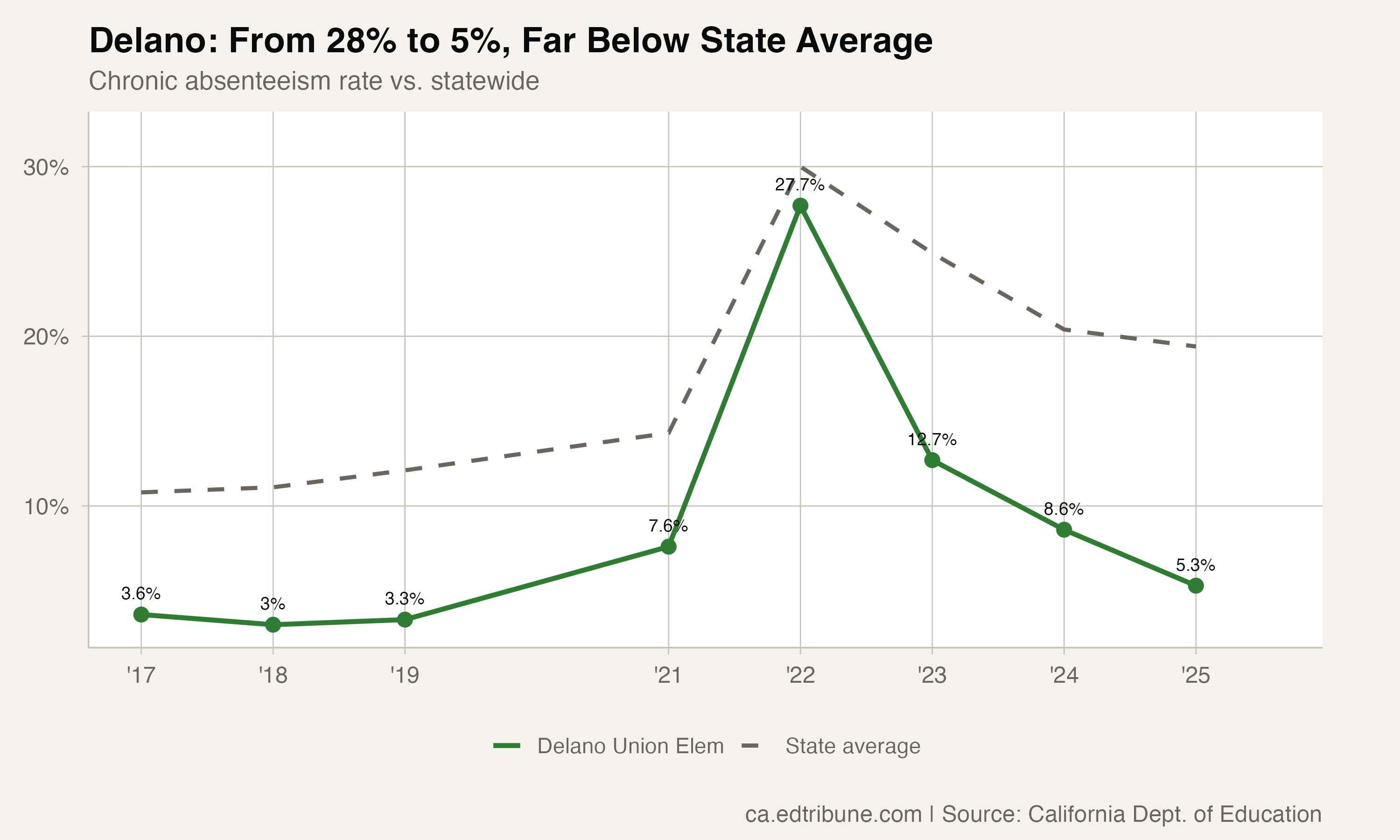
In 2024-25, the schools Delano Union Elementary runs posted a 5.4% chronic absenteeism rate. That is not a number you see often in California anymore.
The statewide rate is 19.4%. Among the 543 districts with at least 1,000 students, the median is 17.7%. Only 18 of them were at or below Delano's rate, and Delano stands out even in that group: in each of the other 17, fewer than half of students come from low-income families, and the highest share is 41%.
The trajectory
Before the pandemic, Delano's rate ran between 3.0% and 3.6%, already remarkably low. It rose to 28.4% in 2021-22, close to the statewide surge. What happened next is what sets Delano apart.
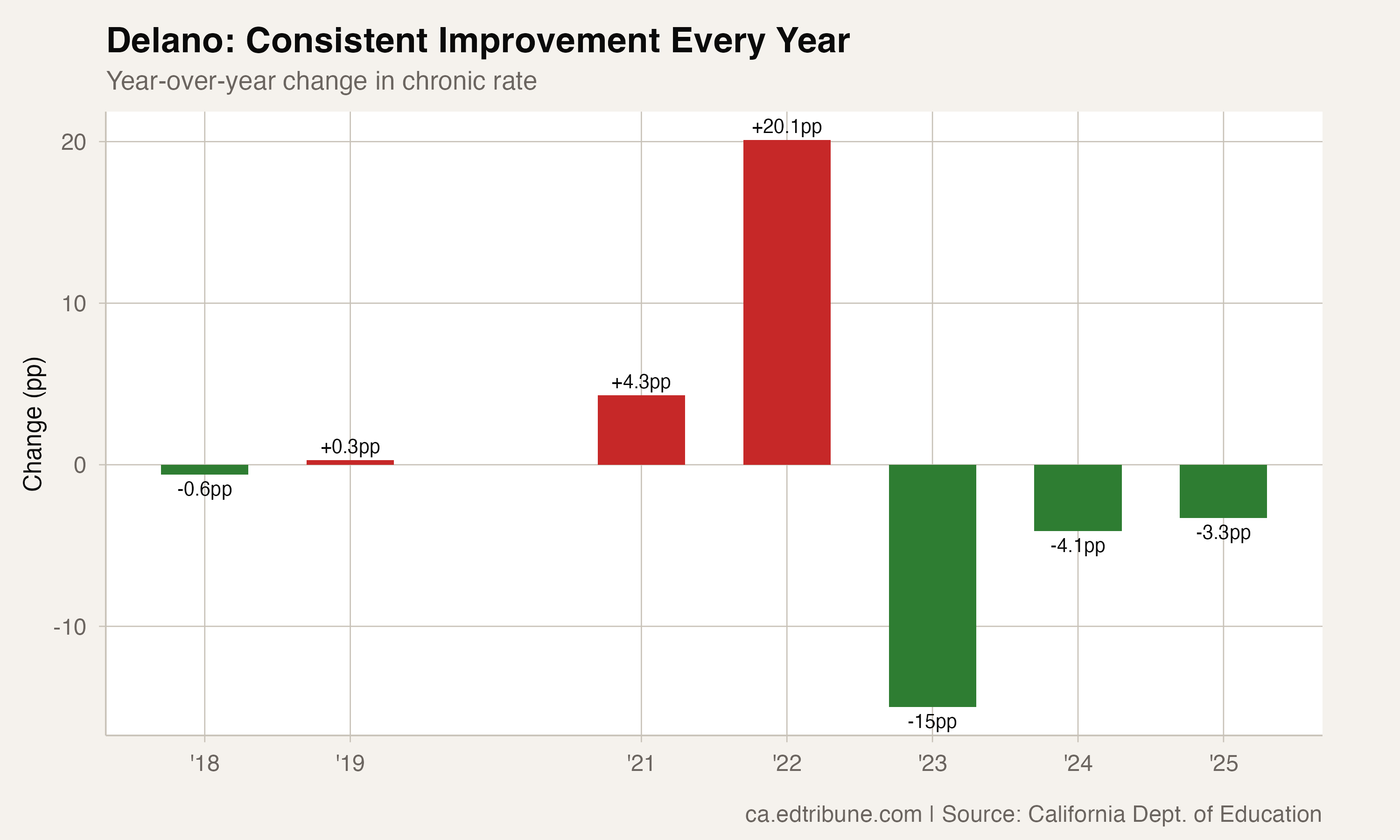
From 2021-22 to 2022-23, the rate fell 14.2 percentage points. It fell another 5.3 points the next year and 3.5 points in 2024-25. Three straight years of decline have brought the district within 1.8 points of its 2018-19 rate of 3.6%. It is not all the way back, and it is far closer than the state as a whole.
Standing out in Kern County
Among the nearby Kern County districts below, Delano's rate is the lowest by a wide margin.
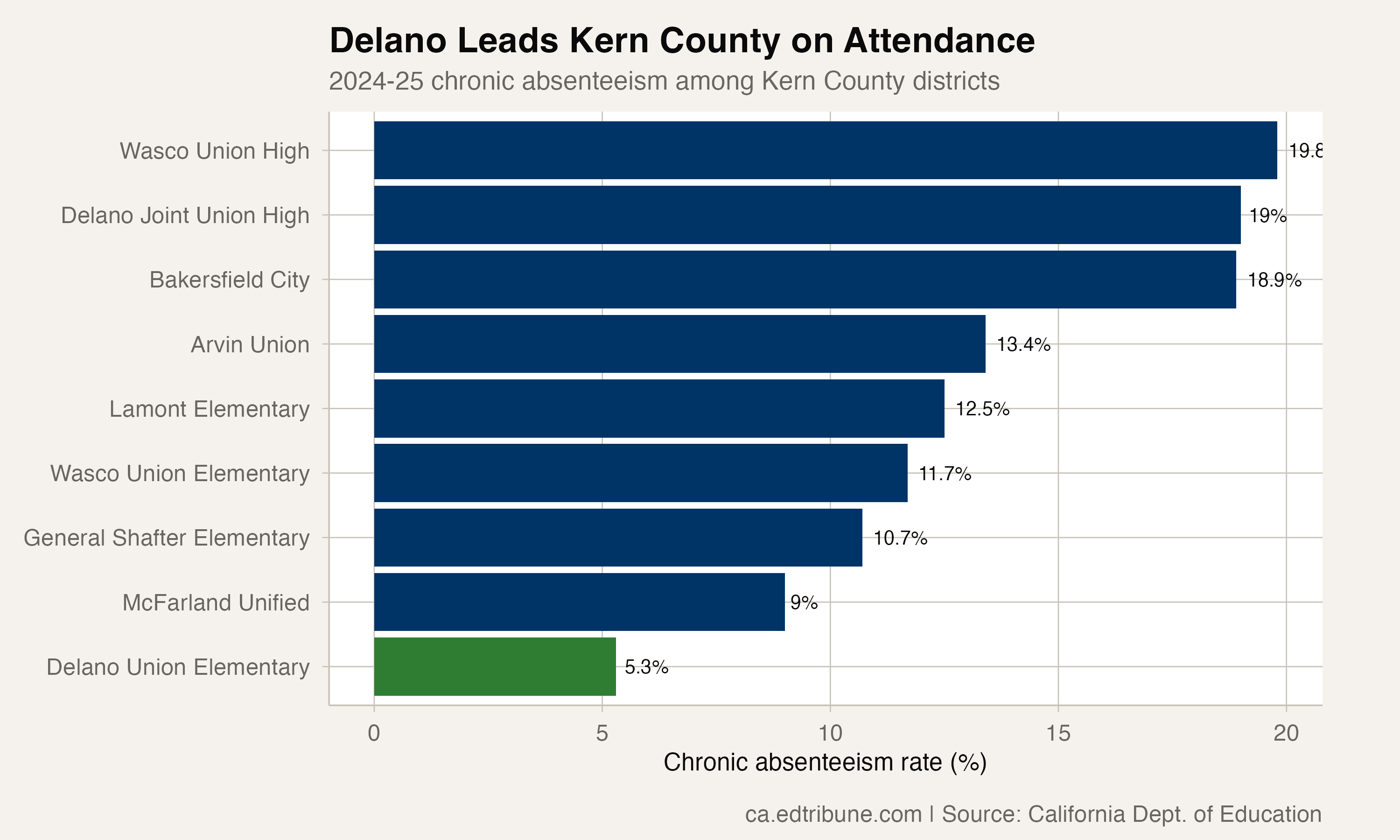
McFarland Unified↗ET, also a small agricultural district, is at 9.0%. Wasco Union Elementary↗ET is at 11.7%. Bakersfield City↗ET, which has its own notable turnaround story, is at 18.9%. Delano's neighboring high school district, Delano Joint Union High↗ET, is at 19.0%, about three and a half times the elementary rate.
The elementary-to-high-school gap within Delano itself is striking. Students who attend school reliably through eighth grade at Delano Union Elementary may encounter a different attendance pattern when they move on to the high school district. Whether the elementary district's approach carries into the high school years could determine whether Delano's students keep their attendance habits.
Why Delano matters
Delano Union Elementary matters not because of its size, since its schools are too small to move state averages, but because of what it shows. A high-poverty, majority-Hispanic school district in an agricultural community can post a chronic absenteeism rate of 5.4%. The demographics that go with high chronic absenteeism statewide do not decide outcomes at the district level.
That challenges an assumption behind much attendance policy: that high-poverty communities cannot reach low chronic absence rates. Delano shows they can. Down Highway 99, Bakersfield City, serving a similar population at more than six times the scale, cut its rate from 51.6% to 18.9%. The San Joaquin Valley, often cited as the center of California's educational challenges, is also producing clear evidence that those challenges are not permanent.
Detailed code that reproduces the analysis and figures in this article is available exclusively to EdTribune subscribers.
Discussion
Sign in to join the discussion.
Loading comments...