Correction (September 30, 2026): An earlier version of this article gave Twin Rivers Unified's 2024-25 chronic absenteeism rate as 49.7%. That figure was the state's authorizer total for the district, which adds students at charter schools Twin Rivers authorizes. In the schools the district runs, the rate was 30.4%, seventh among districts with at least 20,000 students. Hesperia Unified's rate in its own schools is 34.8%, not 34.1%. The sentence now names Hesperia and Hemet Unified, the two districts that size with the highest rates. The statewide figures were not affected.
California's attendance recovery has slowed to a crawl. The state cut chronic absenteeism from 30.0% in 2021-22 to 24.9% in 2022-23 and 20.4% in 2023-24. Then the latest year delivered only one more point of improvement.
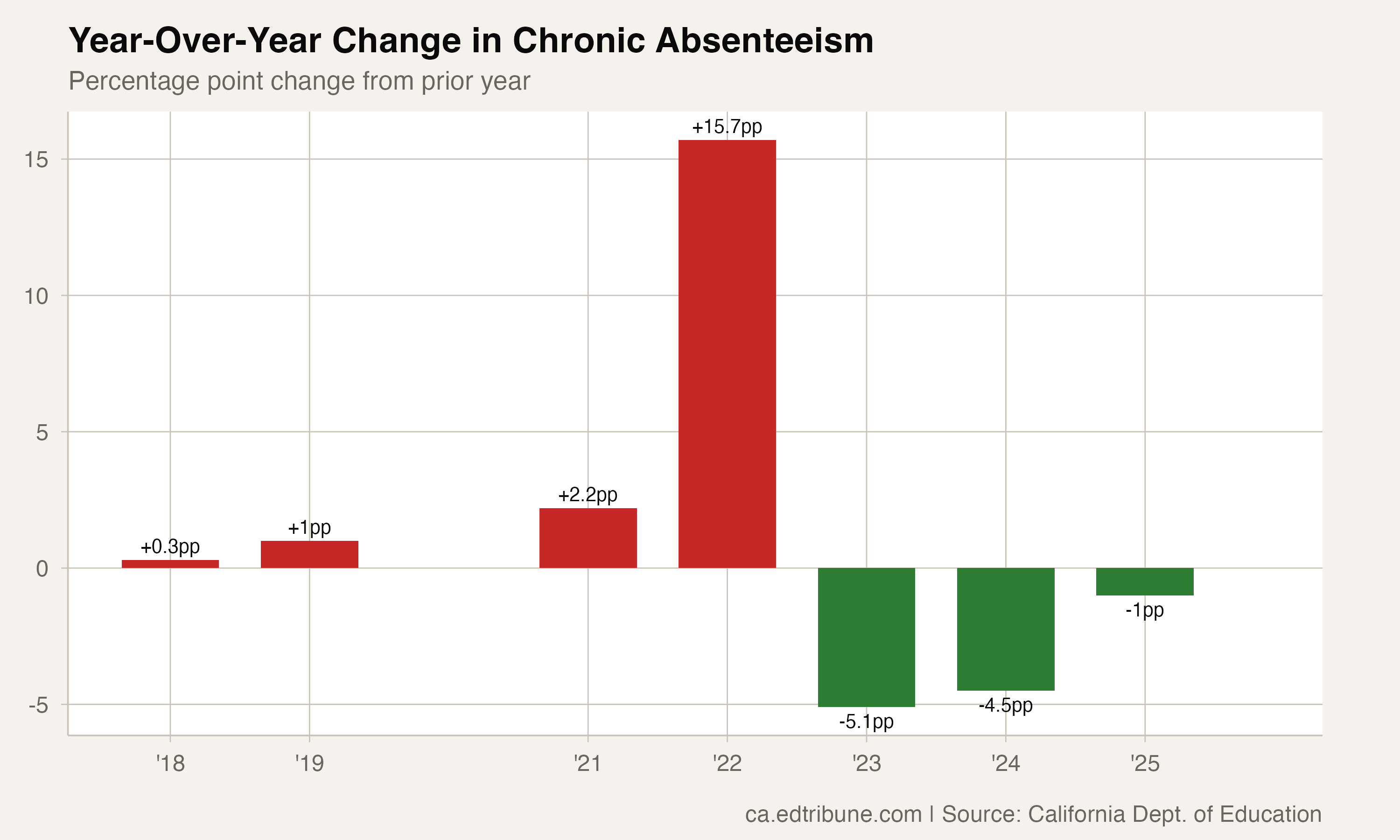
The state's chronic absenteeism rate -- the share of students missing more than 10% of school days -- fell to 19.4% in 2024-25. That is meaningfully better than the 30% peak of 2021-22, when nearly 1.8 million students were chronically absent. But the pace of improvement has collapsed. After dropping 5.1 percentage points in 2022-23 and 4.5 points in 2023-24, the rate fell just 1.0 point last year.
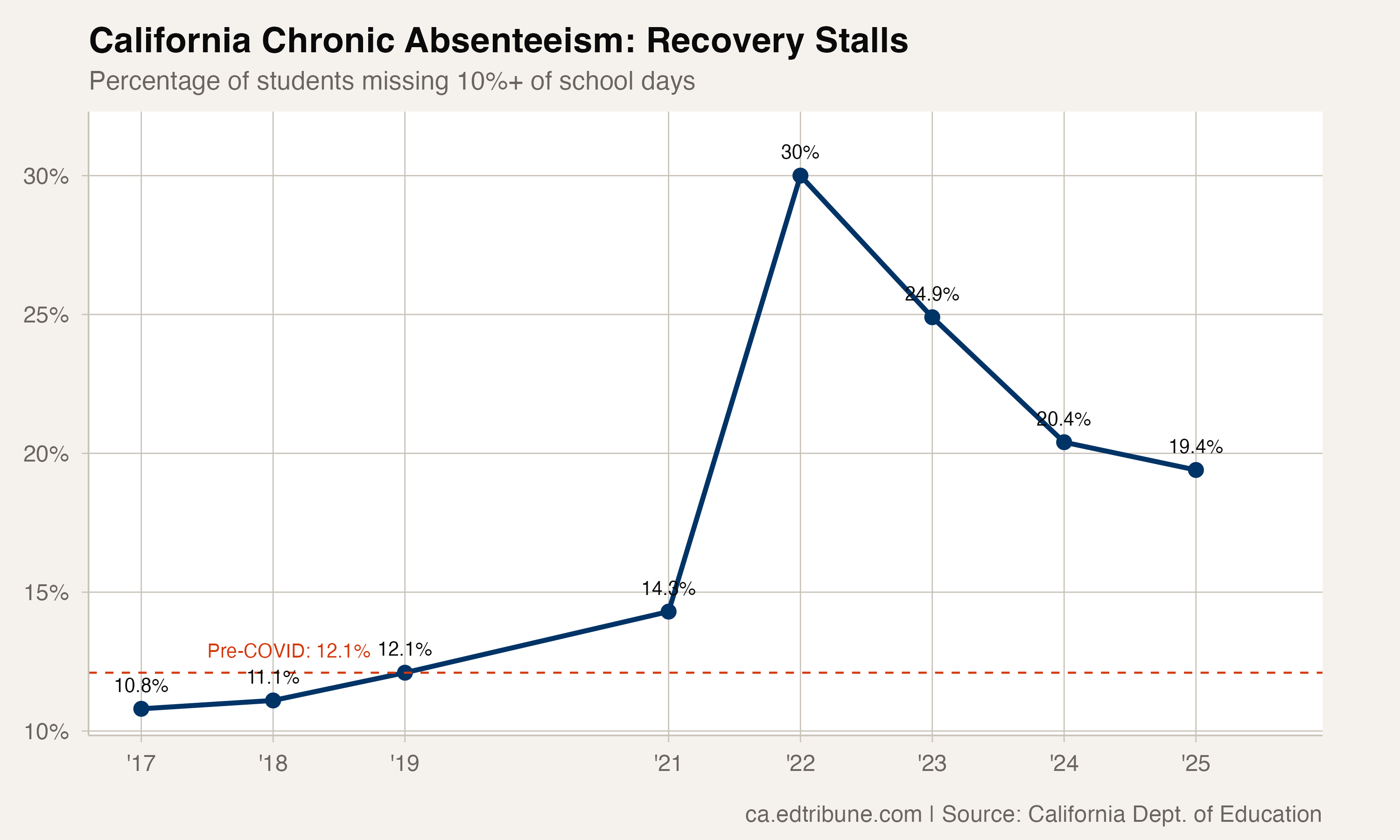
At that latest pace, California would need about eight more years to return to its pre-pandemic baseline of 12.1% -- and that assumes the recovery does not flatten further.
The numbers behind the plateau
Three figures define where California stands.
The first: 1,143,668 students were chronically absent in 2024-25. That is 387,718 more than the 755,950 who were chronically absent in 2018-19, a 51% increase in the population of students who routinely miss school.
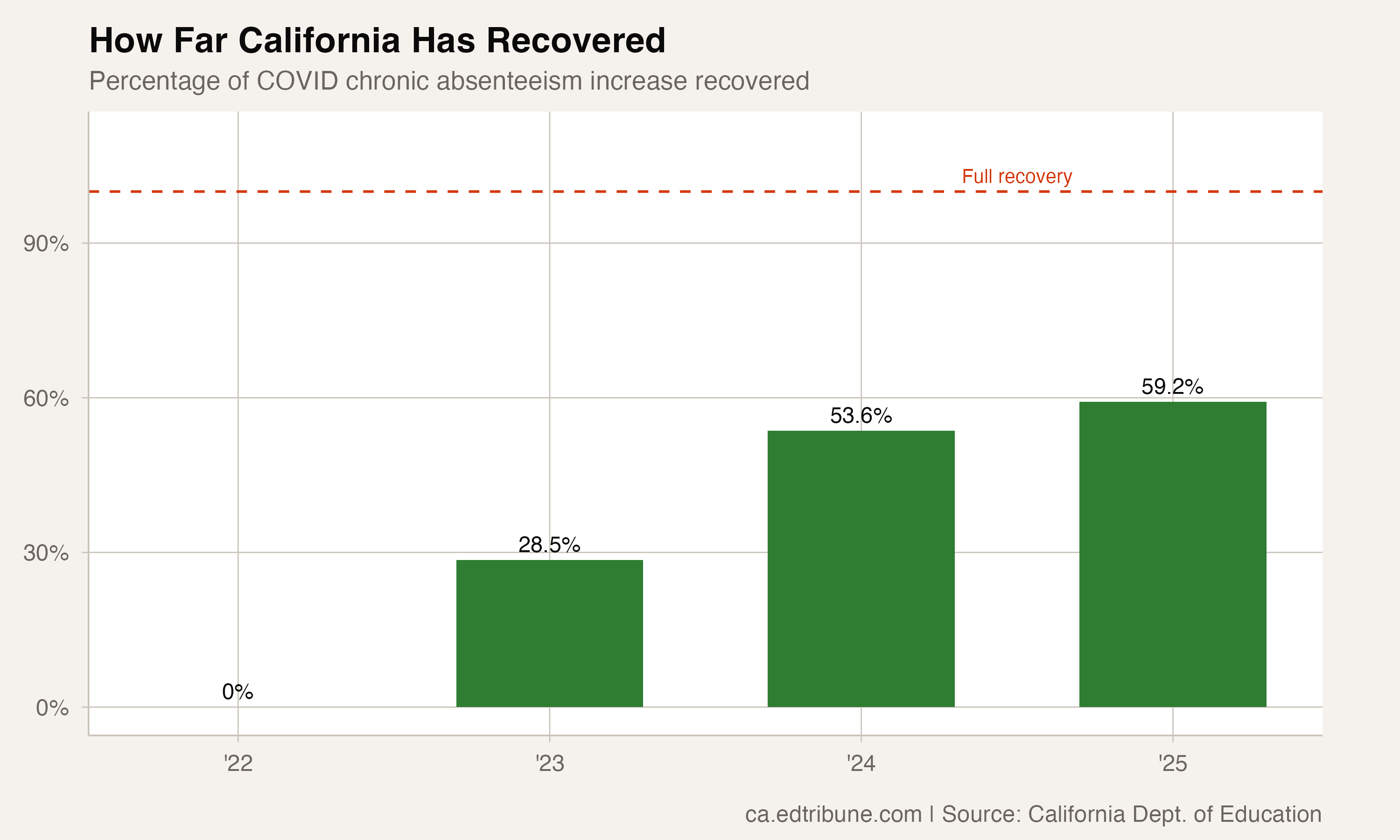
The second: the state has recovered 59.2% of the COVID-era increase. That sounds respectable until you consider the trajectory. The first year of recovery clawed back 28.5% of the gap. The second year brought the cumulative total to 53.6%. The third year added just 5.6 percentage points of progress.
The third: year-over-year improvement went from -5.1 points to -4.5 points to -1.0 point. The improvement is not just slowing -- it is approaching zero.
Why California's crisis hits the budget
California is one of just six states that funds schools based on Average Daily Attendance rather than enrollment. Every absence directly reduces a school's revenue. A student who misses 20 days in a 180-day school year costs their school roughly 11% of the per-pupil funding attached to that seat.
With 1.14 million students chronically absent, the aggregate fiscal exposure runs into the billions. The Legislative Analyst's Office has estimated that chronic absenteeism costs California schools approximately $2.7 billion annually in lost ADA funding. Among districts with at least 20,000 students in the schools they run, Hesperia Unified↗ET at 34.8% and Hemet Unified↗ET at 33.8% have the highest rates, and with them some of the steepest attendance-linked pressure.
The 2030 goal looks unreachable
California committed to cutting chronic absenteeism 50% by 2030, from the 30% COVID peak to 15%. At 19.4%, the state has covered most of that distance in three years. But reaching 15% requires another 4.4 percentage points of improvement, and the most recent year delivered just 1.0.
The state's $4.1 billion community schools investment, reaching roughly a quarter of public schools, was designed in part to address attendance barriers. A new Attendance Recovery program under SB 153 allows schools to recover up to 10 days of ADA funding per chronically absent student starting in 2025-26 -- a financial incentive for intervention. But only 14 districts statewide have begun billing Medi-Cal for student behavioral health services despite $4 billion in available funding. None of these programs appears in the attendance data, so they describe what the state is attempting rather than explain why the rate changed.
What the count reveals
Even as the rate improves, the raw number of chronically absent students tells a different story. In 2017-18, 702,531 students were chronically absent. By 2024-25, that number had grown to 1,143,668 -- an increase of 63% that reflects both the rate increase and enrollment fluctuations.
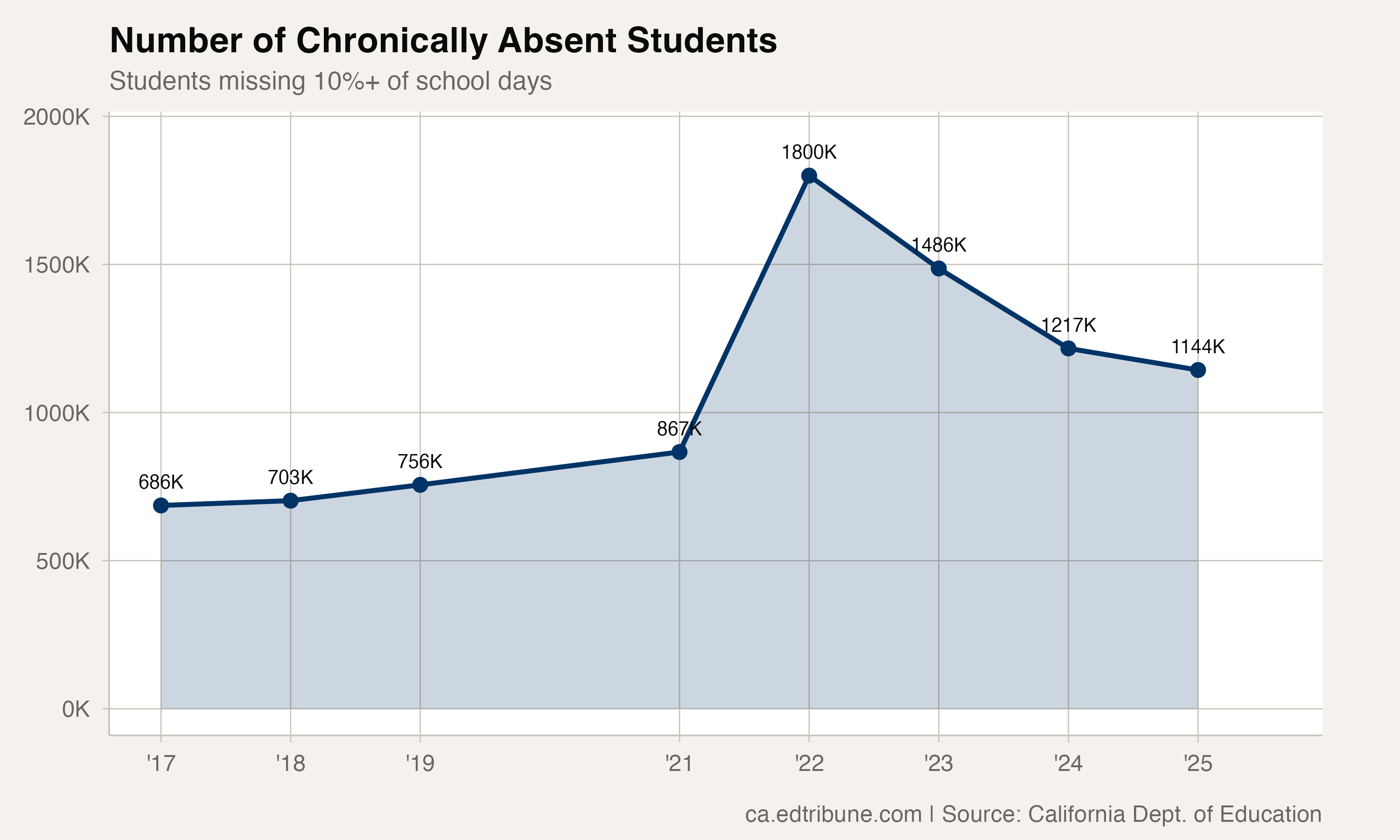
The count peaked at nearly 1.8 million in 2021-22 and has fallen by 656,067 since. But in absolute terms, California has 441,137 more chronically absent students than it did in 2017-18. The count is declining, but from a level so elevated that even meaningful percentage improvements leave a massive number of students disengaged.
What the plateau shows
The data can show the stall, but not the reason for it. California moved quickly from the 2021-22 peak to a lower chronic absenteeism rate, then slowed sharply before reaching either the 15% policy goal or the 12.1% pre-pandemic baseline.
California's ADA funding structure means the state has a stronger financial incentive than most to solve this problem. But the latest one-point improvement makes the next phase look slower than the first. The 1.14 million students still chronically absent in 2025 are the measure of what remains.
Detailed code that reproduces the analysis and figures in this article is available exclusively to EdTribune subscribers.
Discussion
Sign in to join the discussion.
Loading comments...