Correction: An earlier version divided by the sum of the eight named race rows, rather than the published statewide chronic-absence total. The eight rows sum to 1,130,536; the published total is 1,143,668, leaving a 13,132-student gap and 98.9% coverage. Using the published total, Hispanic students account for 64.6% (739,261), white students 15.5%, and Black students 8.0%. The gap is reported without assigning a cause.
In the Central Valley, in the Inland Empire, in East Los Angeles, in the agricultural towns from Delano to Salinas, the story is the same: Hispanic students are absent at rates far above their white peers, and they are absent in numbers that dwarf every other group.
Of the 1,143,668 students in California's published statewide chronic-absence total in 2024-25, the eight named race rows account for 1,130,536. Hispanic students account for 739,261 -- or 64.6% of the published total. The eight rows cover 98.9%, so subgroup shares are lower bounds. White students account for 15.5%. Black students, despite having the second-highest chronic rate, make up 8.0% of the published total because their share of total enrollment is much smaller.
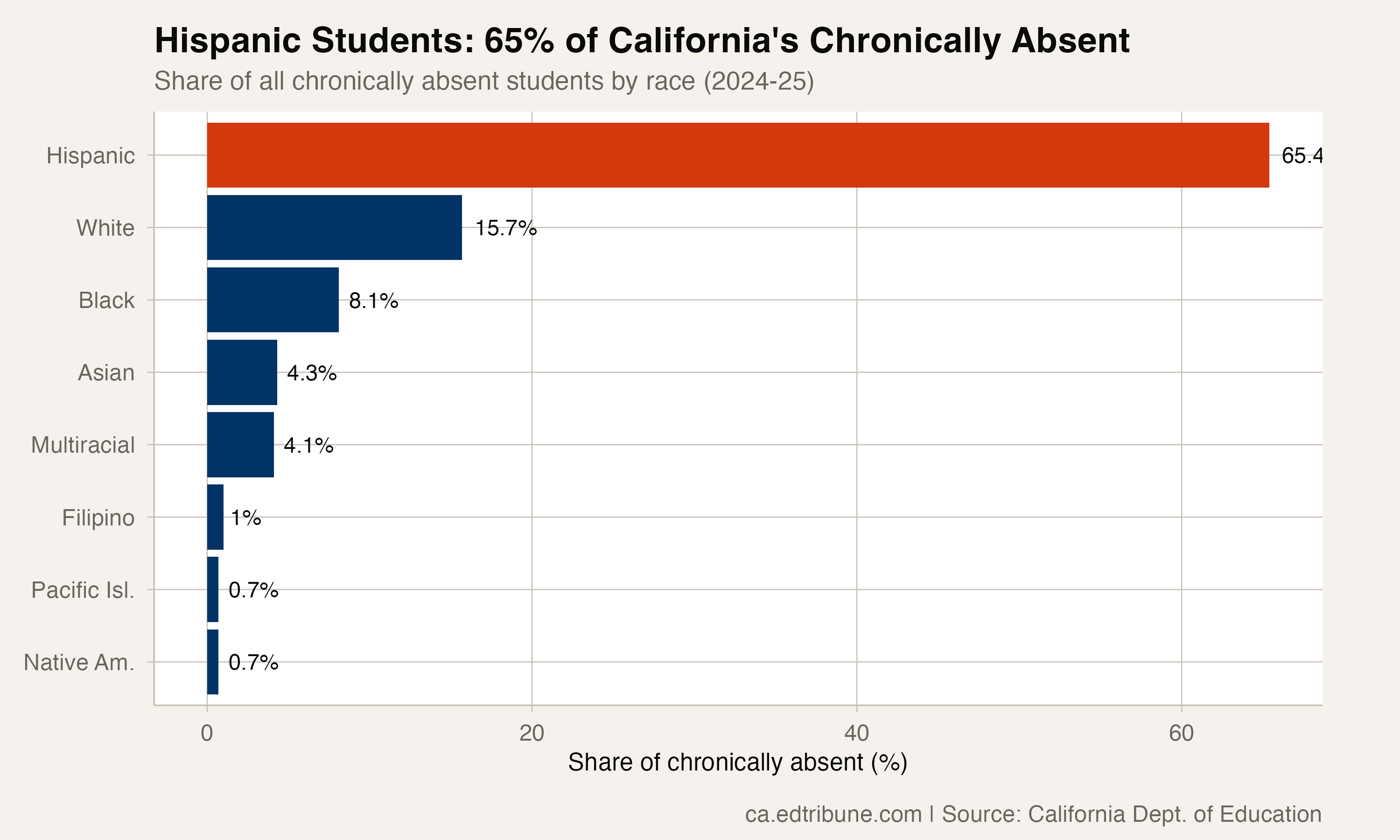
The disproportionality is significant. Hispanic students make up roughly 56% of California's enrollment but 64.6% of its published chronic absenteeism -- about an 8-percentage-point overrepresentation. Any serious statewide attendance recovery strategy is, by arithmetic, primarily a strategy for Hispanic students.
A gap that doubled
The Hispanic-white chronic absenteeism gap was 2.0 percentage points in 2016-17. By 2018-19, it had grown to 3.5 points. COVID pushed it to 12.2 points in 2021-22 -- the largest single-year widening of any racial gap in the state.
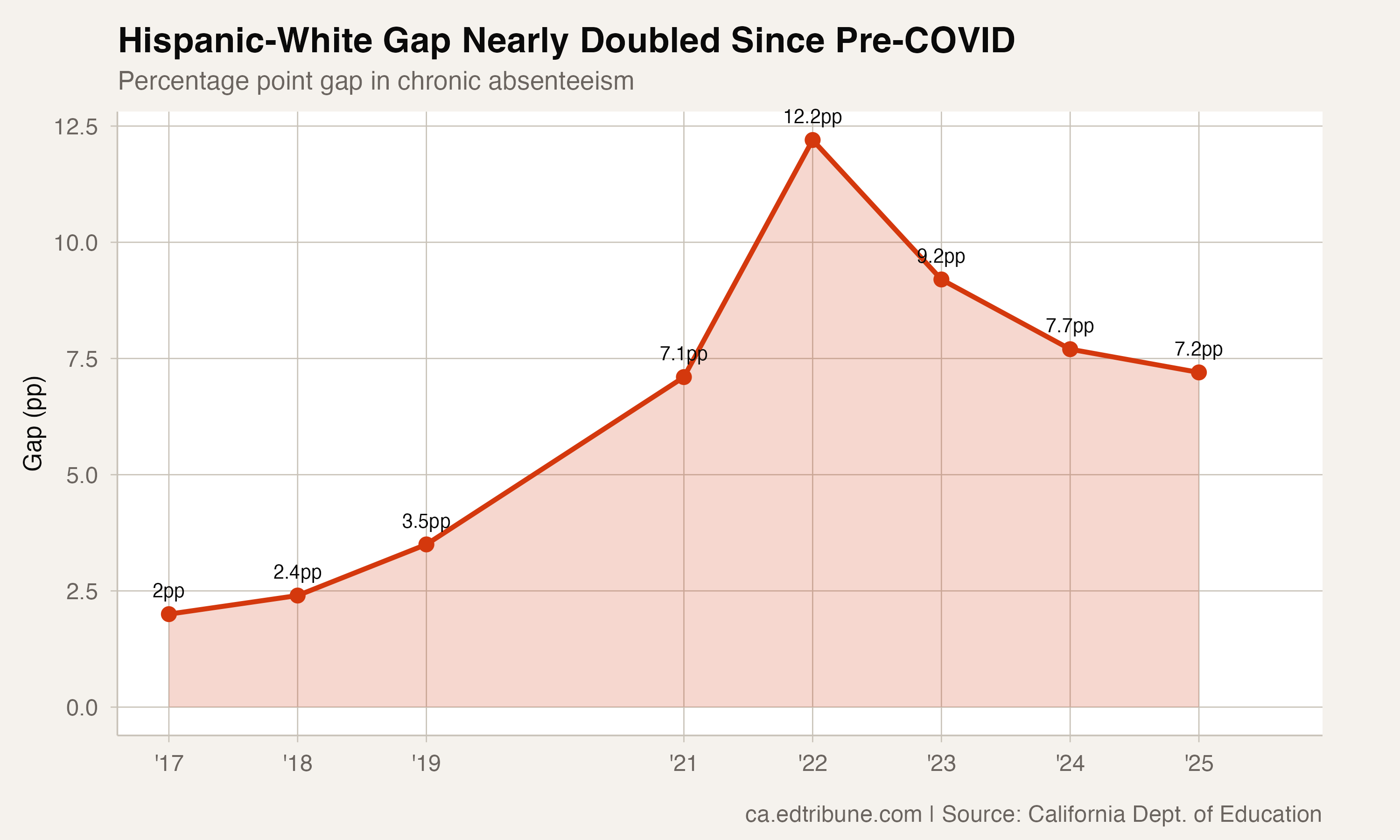
Three years of recovery have narrowed the gap to 7.2 points -- better than the peak, but still more than double the pre-COVID level. The gap has narrowed primarily because Hispanic rates fell faster than white rates in absolute terms (down 13.1 points from peak vs. 8.1 for white students). But the starting points are so different that the proportional improvement is similar.
At 22.3%, Hispanic chronic absenteeism is 7.2 points above the white rate of 15.1%. More than one in five Hispanic students is chronically absent.
Volume and rate converge
Hispanic students occupy a unique position in California's attendance data: they have both a high chronic rate AND the largest population. Most groups with high rates -- Black students at 31.3%, Native Americans at 31.6% -- are small enough that their high rates produce modest absolute numbers. Hispanic students' 22.3% rate applied to the state's largest enrollment group produces 739,261 chronically absent students.
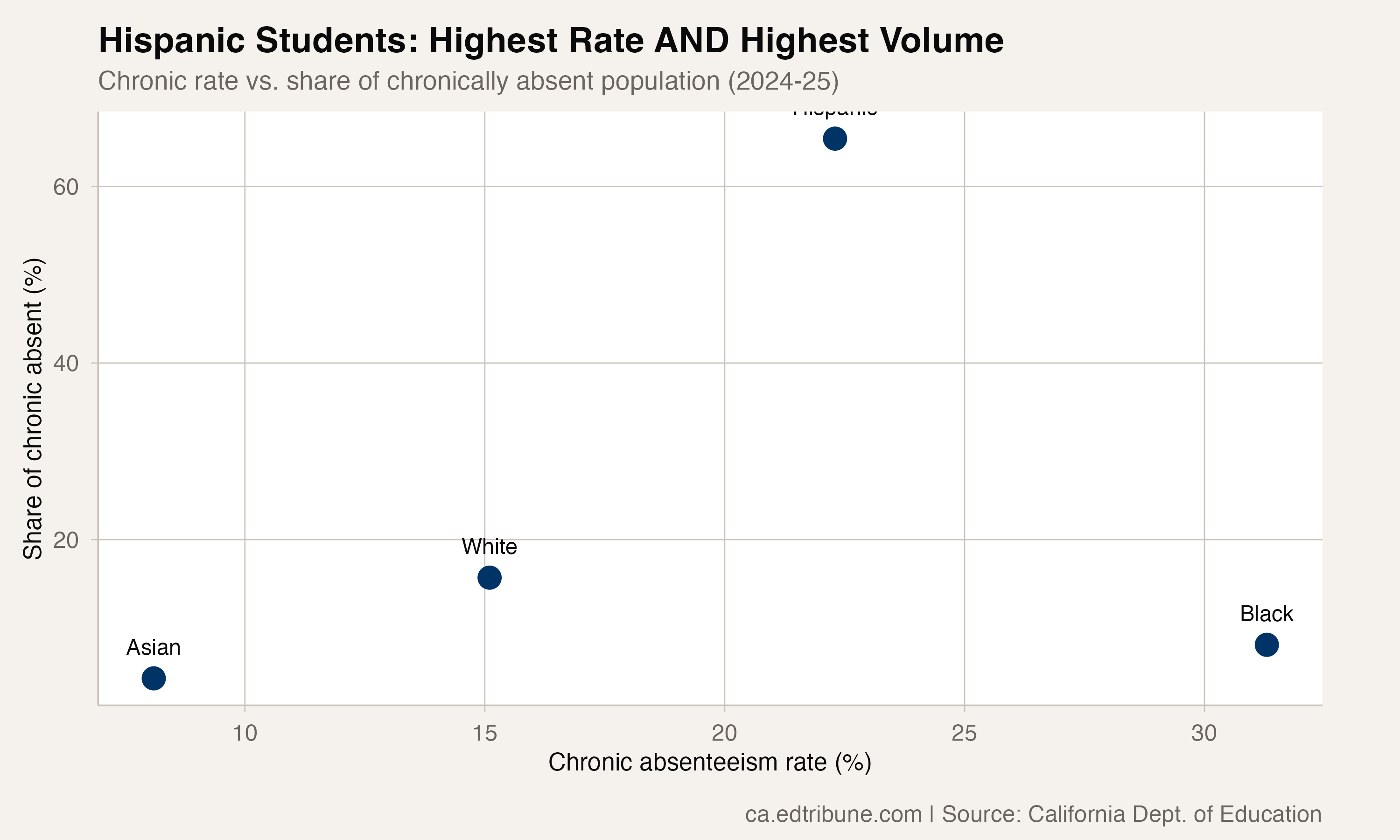
This means California cannot meaningfully reduce its overall chronic absenteeism rate without reducing Hispanic chronic absenteeism specifically. If Hispanic rates fell to the current white rate of 15.1%, approximately 238,000 fewer students would be chronically absent, and the statewide rate would drop roughly 4 percentage points. That alone would nearly close the remaining gap to the state's pre-COVID baseline.
The structural barriers
The disproportionate burden on Hispanic students connects to structural factors that attendance interventions alone cannot address.
Transportation: California's school bus access rate of fewer than 9% falls hardest on families without reliable vehicles. In agricultural communities where parents start work at dawn, getting children to school on time requires logistical choreography that breaks down when a car won't start or a shift changes.
Employment patterns: The California Budget & Policy Center has documented that low-wage workers in agriculture, food service, and retail -- industries with high Hispanic employment -- are less likely to have paid sick leave or flexible schedules, making it harder to manage a child's illness without an absence.
Language barriers: Parents with limited English proficiency may be less likely to engage with school attendance notification systems, not because of indifference but because the communications arrive in a language they do not read. California's Attendance Recovery program requires translated materials, but implementation varies by district.
Immigration enforcement: The post-2024 increase in immigration enforcement actions near schools has introduced fear as an attendance barrier. While there is no statewide data isolating this effect, several Central Valley districts have reported increased absences following publicized enforcement actions.
The 2030 math
California's goal of cutting chronic absenteeism in half by 2030 implies reducing the state rate from its 2022 peak to the target. The state is at 19.4%. Closing the remaining 4.4 points will require disproportionate improvement among Hispanic students simply because they are the majority of the chronically absent population.
The arithmetic is blunt: 739,000 chronically absent Hispanic students are not a subgroup footnote. They are the headline. From the grape fields around Delano to the warehouses of the Inland Empire to the apartment complexes of East Los Angeles, the families navigating work schedules, car trouble, and immigration anxiety are the families California's attendance recovery must reach -- or it will not reach its target.
Correction (August 20, 2026): An earlier version put the Hispanic share of California enrollment at roughly 55% and the resulting overrepresentation at about 10 percentage points. Computed from the published counts and rates, the enrollment share is 56.2% and the overrepresentation is 8.4 points. The finding is unchanged: Hispanic students are a larger share of the state's chronic absenteeism than of its enrollment.
Detailed code that reproduces the analysis and figures in this article is available exclusively to EdTribune subscribers.
Discussion
Sign in to join the discussion.
Loading comments...