The number tells one story. The rate tells another. Both are true, and both are alarming.
The chronic absenteeism rate for California's students who are currently homeless dropped from 46.1% at its COVID peak to 34.9% in 2024-25 -- an 11.2-point improvement. Progress.
The count of chronically absent students who are currently homeless rose from 56,199 in 2016-17 to 102,268 in 2024-25 -- an 82% increase that set a new all-time high. Crisis.
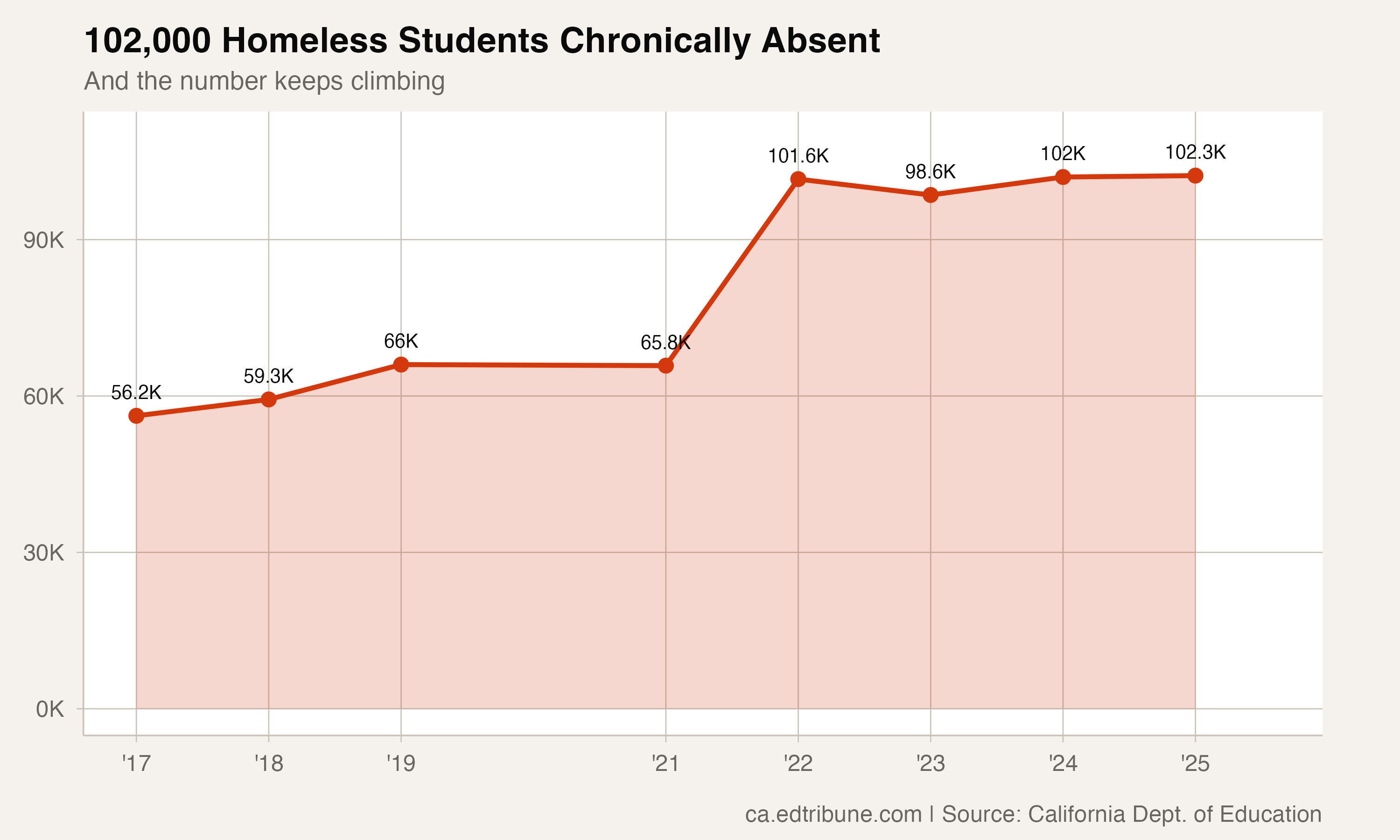
Both numbers are right because the denominator changed. California's student who is currently homeless population has grown faster than the chronic rate has fallen, meaning more students are identified as homeless than in any previous year. Even with a lower percentage chronically absent, the absolute number keeps climbing.
Falling rate, rising floor
At 34.9%, students who are currently homeless have the second-highest chronic absenteeism rate of any student group in California, trailing only foster youth at 37.3%. The rate was 21.8% in 2016-17. It climbed steadily before COVID, accelerated during the pandemic, and has been falling since -- but remains 9.9 percentage points above its pre-COVID level of 25.0%.
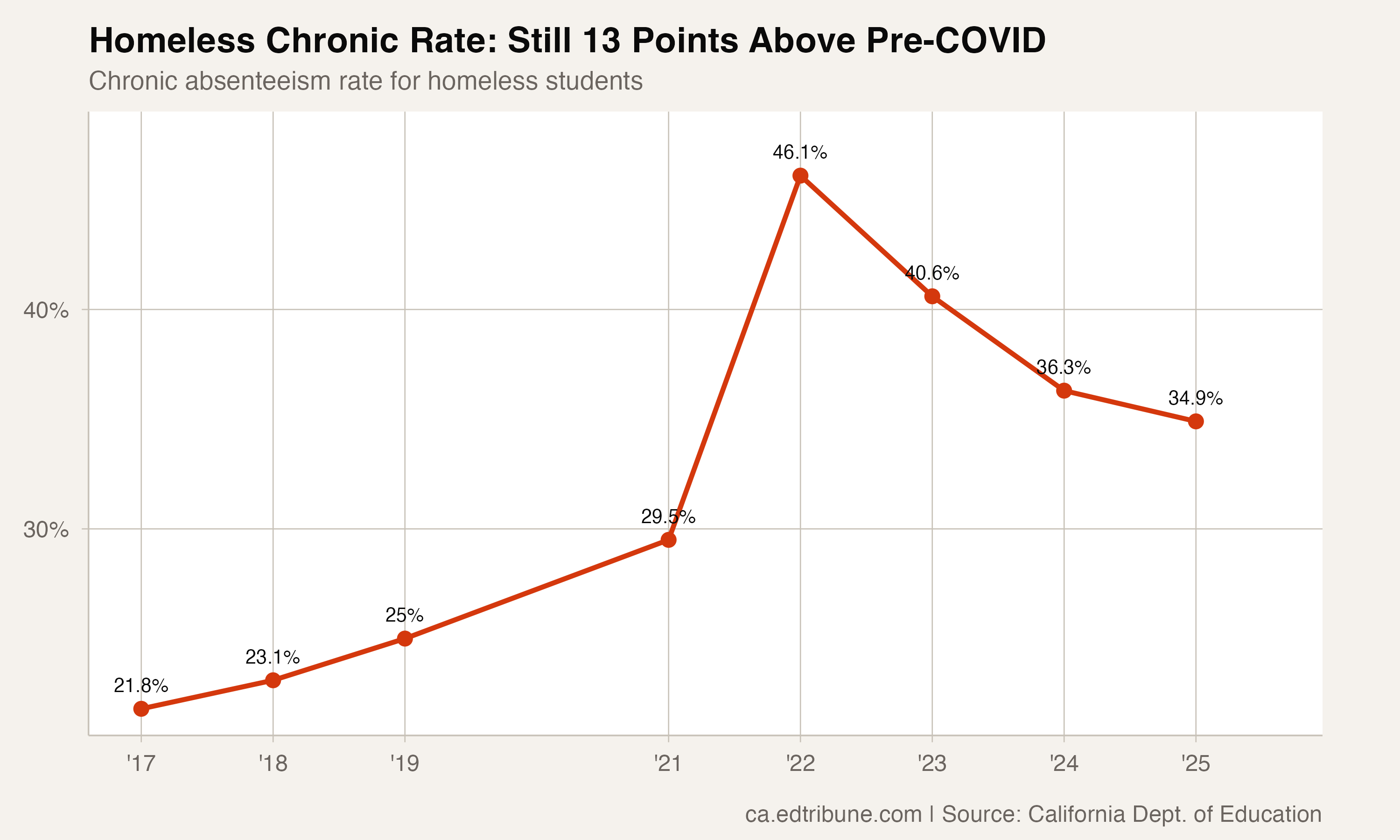
The pre-COVID rate was already among the worst of any subgroup. Returning to that level would still mean one in four students who are currently homeless missing more than 10% of school. The baseline itself was a problem.
The rate-count divergence
The most striking feature of the data is how rate and count have decoupled since the pandemic. The rate peaked in 2022 and has fallen for three consecutive years. The count peaked in 2024 and has barely budged.
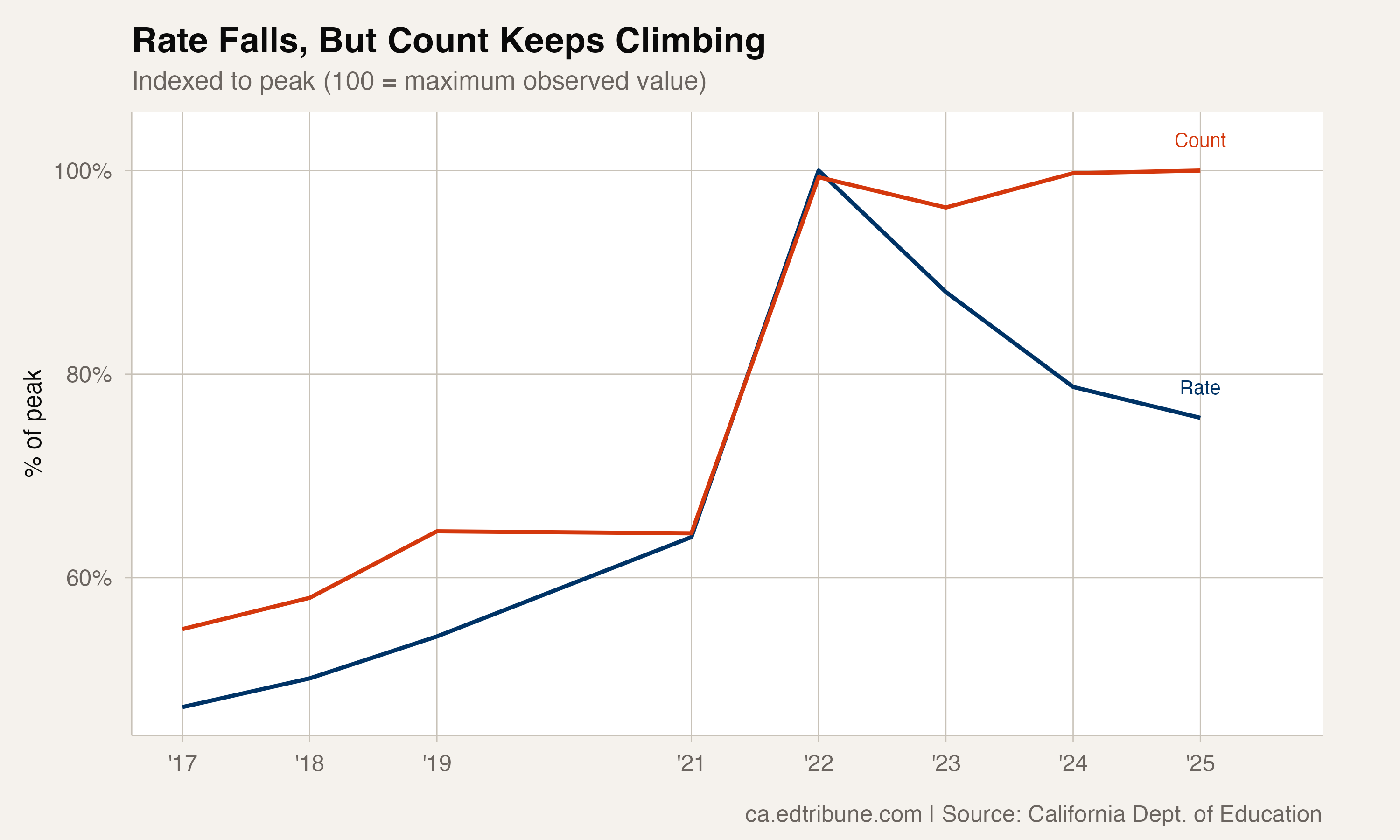
In 2021-22, 101,601 students who are currently homeless were chronically absent at a 46.1% rate. In 2024-25, 102,268 are chronically absent at a 34.9% rate. The rate improved 11.2 points. The count increased by 667 students. More students are homeless, and even though a smaller share of them are chronically absent, the total number keeps growing.
This pattern means California's housing crisis and its attendance crisis are no longer separate policy problems. They are the same problem.
102,000 students in context
To grasp the scale: 102,268 chronically absent students who are currently homeless is more than the total enrollment of Sacramento City Unified (43,994), San Juan Unified (54,663), or Elk Grove Unified (66,553). It is roughly equivalent to the entire student population of Fresno Unified plus Stockton Unified.
These students are distributed across the state but concentrated in the highest-cost regions. Los Angeles County, Orange County, San Francisco, and the Bay Area -- the places where housing costs are highest and shelter capacity is most strained -- carry disproportionate shares of student who is currently homeless populations.
The McKinney-Vento Act defines students who are currently homeless broadly: not just those living on the street, but those doubled up with other families, living in motels, or staying in shelters. California's high housing costs mean many families who are technically housed are one emergency from homelessness, and the children in those families cycle in and out of the designation.
The policy response
California has invested heavily in addressing student homelessness. The Homeless Children and Youth Education Program funds McKinney-Vento liaisons in every district. AB 1806 (2024) expanded eligibility for transportation assistance. The state's community schools initiative explicitly targets housing instability as a barrier to attendance.
But these programs operate downstream of the housing market. As long as California has the highest housing cost burden in the nation -- where the median home price exceeds $750,000 and the average rent consumes more than 30% of household income for most families -- the pipeline of students into housing instability will continue.
A McKinney-Vento liaison in Los Angeles County described the daily calculus: a mother in a motel on Figueroa decides whether to wake her three children at 5:30 a.m. for a bus ride to a school of origin 40 minutes away, or let them sleep and miss another day. Multiply that decision by 102,268 families, every morning, across a state where the median rent consumes a third of household income. The attendance data is just the residue of those mornings.
Detailed code that reproduces the analysis and figures in this article is available exclusively to EdTribune subscribers.
Discussion
Sign in to join the discussion.
Loading comments...