Correction: An earlier version of this article stated that 133,973 charter students were chronically absent in 2024-25. On the same basis as the traditional count, the figure is 156,280. The article has been updated.
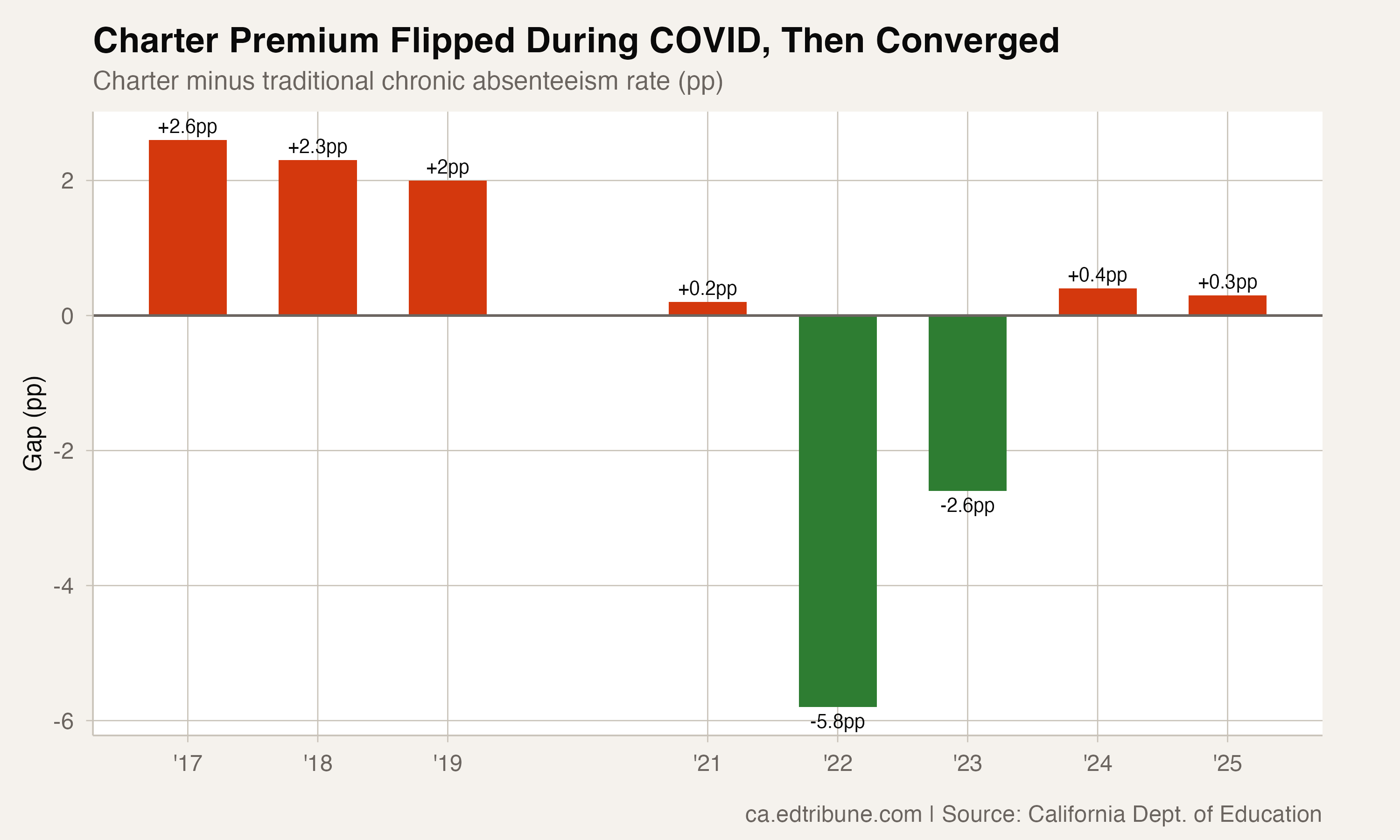
For years, California's charter schools had a chronic absenteeism problem. In 2016-17, charter chronic rates ran 2.6 percentage points higher than traditional public schools: 13.4% versus 10.8%. The pattern held through 2019, with charters consistently worse on attendance.
Then the pandemic flipped the relationship entirely.
In 2021-22, at the peak of California's attendance crisis, charter schools posted a chronic rate of 25.0%. Traditional public schools: 30.8%. Charters were 5.8 percentage points better -- a reversal of the pre-COVID pattern that no one predicted.
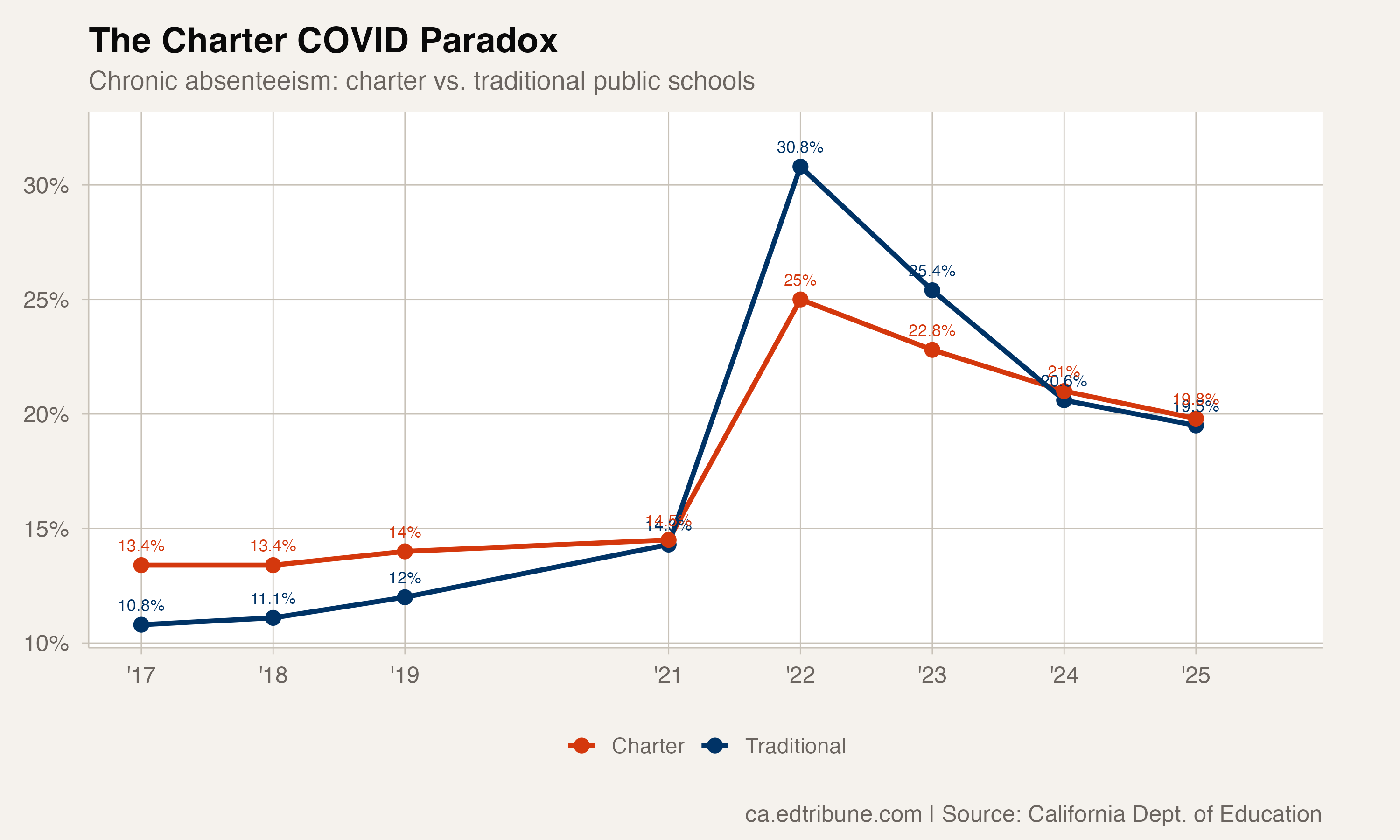
By 2024-25, the two sectors have converged: charters at 19.8%, traditional at 19.5%. The gap is 0.3 percentage points -- statistically negligible.
The three-act story
The charter-traditional attendance relationship has played out in three distinct phases.
Act 1 (2017-2019): Charter premium. Charters consistently ran 2.0 to 2.6 points above traditional schools. This likely reflected charter schools' demographic profile -- serving more high-poverty, high-mobility students -- and the challenge of maintaining attendance in smaller schools with fewer support staff.
Act 2 (2021-2022): COVID reversal. Charters flipped to 5.8 points below traditional schools at the pandemic peak. The gap was large enough to be structurally meaningful, not a statistical artifact.
Act 3 (2023-2025): Convergence. Both sectors improved, but traditional schools improved faster. The gap narrowed from -5.8 to -2.6 to +0.3, landing at essential parity.
Why charters did better during COVID
The mid-pandemic charter advantage likely reflects several structural differences.
Size: The average California charter school enrolls roughly 300 students, compared to 550 for traditional schools. Smaller schools can more easily track individual students and identify absences before they become chronic.
Flexibility: Many charter schools pivoted to hybrid and flexible scheduling models faster than large traditional districts, which required negotiating with unions and coordinating across dozens of schools. California Charter Schools Association research has highlighted that charter schools' independent governance allowed faster operational adaptation.
Family engagement: Charter schools, which families choose to attend, often have stronger existing communication channels with parents. When attendance requires active effort -- as it does during a pandemic -- that pre-existing relationship may have mattered more than usual.
Selection effects: Students who remained enrolled in charter schools during COVID may have been a self-selected group with higher family engagement. Students who disengaged may have returned to neighborhood traditional schools, shifting the chronic rate in both sectors.
What convergence means
The convergence to near-identical rates by 2024-25 is instructive. Whatever structural advantages charter schools had during the pandemic appear to have been temporary -- or have been matched by traditional schools' own recovery efforts.
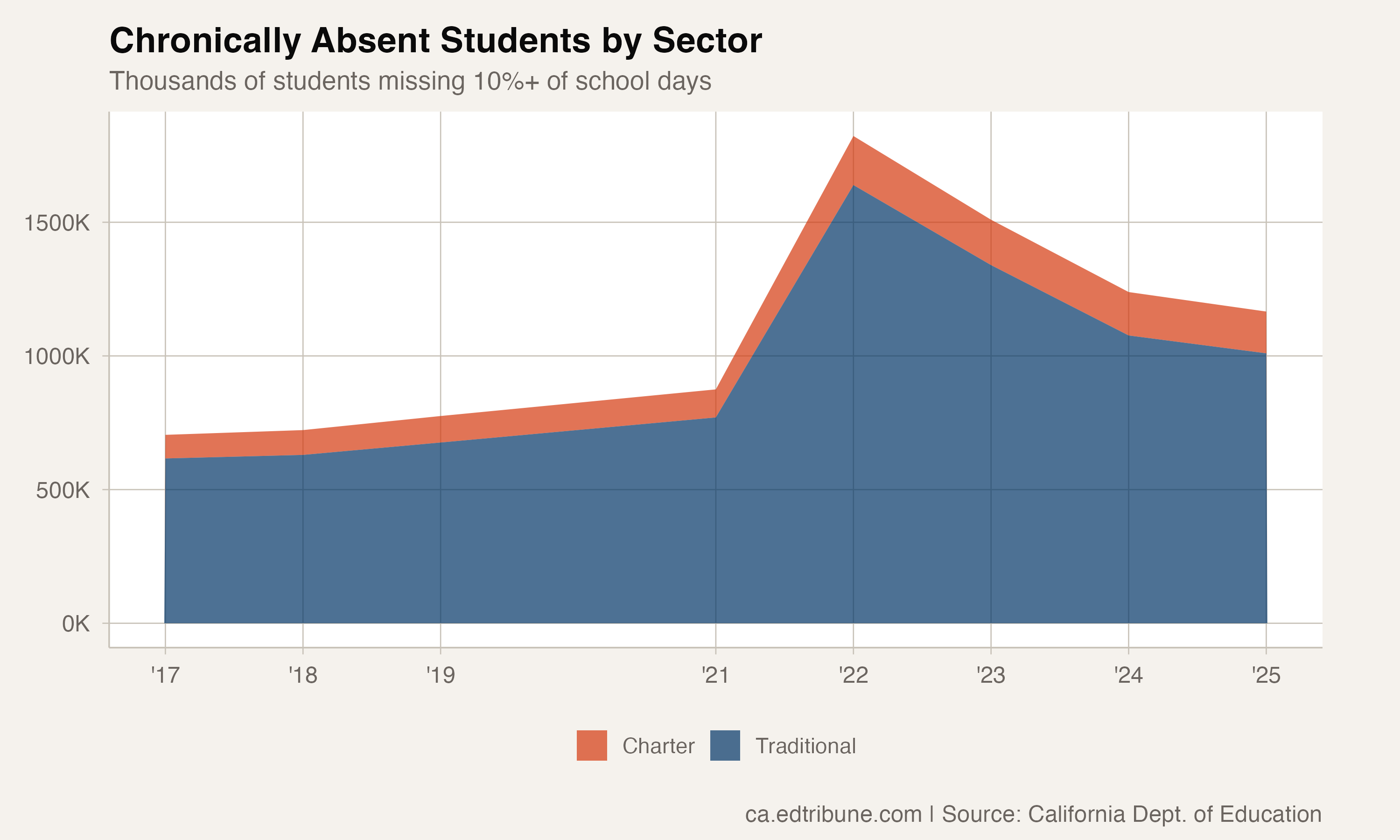
In absolute terms, traditional schools still account for the vast majority of chronically absent students: 1,009,695 in traditional versus 156,280 in charters in 2024-25. The charter sector is roughly 13% of California's enrollment. Any statewide attendance improvement strategy must focus primarily on traditional schools simply because that is where the students are.
The convergence also suggests that the post-pandemic attendance challenge is not fundamentally a school-type problem. The same forces -- housing instability, mental health, transportation, family economic pressure -- affect students at both charter and traditional schools. The brief period where charters outperformed may say more about the specific conditions of 2021-22 than about structural superiority.
The policy implication
For advocates on both sides of the charter debate, this data is more nuanced than either camp might prefer. Charter schools demonstrably handled attendance better during the pandemic's worst period. But the advantage was temporary and has now disappeared.
The convergence at 19-20% tells the simplest story: school type is not destiny. Whatever structural advantages charters had during the pandemic's chaos -- smaller buildings, faster pivots, more direct parent contact -- proved temporary. By 2025, a charter school and a traditional school in the same neighborhood, serving similar students, land at essentially the same chronic rate. The attendance crisis belongs to both sectors equally now.
Detailed code that reproduces the analysis and figures in this article is available exclusively to EdTribune subscribers.
Discussion
Sign in to join the discussion.
Loading comments...