In California's elementary classrooms, the attendance recovery is real. Grades 1-3 dropped 1.6 percentage points in chronic absenteeism last year. Grades 4-6 fell a full point. The students who were kindergartners during COVID are now second and third graders showing up more consistently than any cohort since the pandemic.
Then there are grades 9-12. The high school chronic rate fell 0.2 points, from 24.2% to 24.0%. One-fifth of a percentage point. Functionally zero. Nearly one in four California high school students is chronically absent, and the rate has barely moved in a year.
The grade-level hierarchy
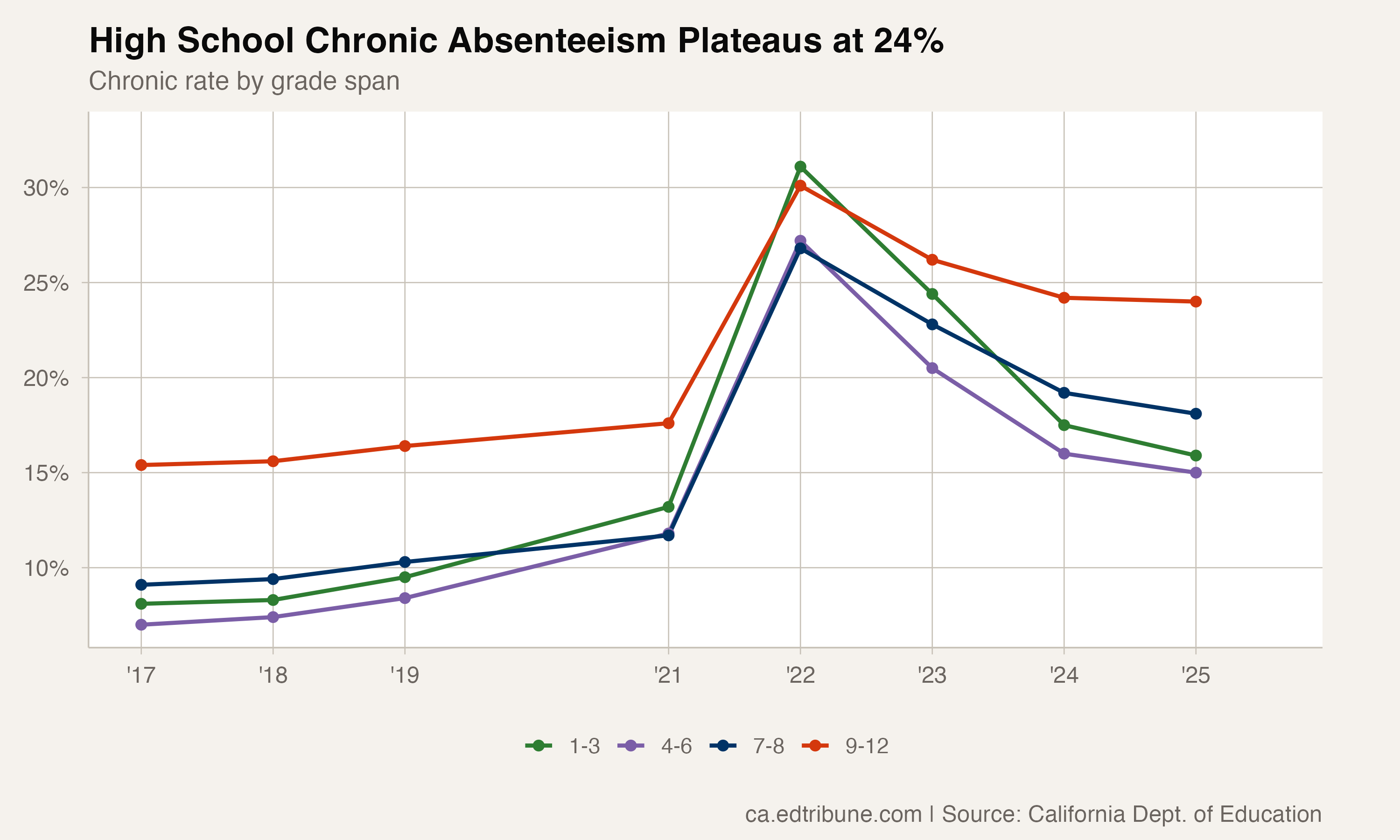
California's attendance crisis has a clear gradient by grade level. The youngest students have the lowest chronic rates and the fastest recovery. The oldest have the highest rates and the slowest.
In 2024-25: grades 1-3 at 15.9%, grades 4-6 at 15.0%, grades 7-8 at 18.1%, grades 9-12 at 24.0%. The rate holds roughly flat through elementary school, then climbs with each step into the middle and high school grades.
The pattern is not new. High school rates were above elementary rates before COVID. But the gap has widened. In 2018-19, the 9-12 rate was 6.9 points above grades 1-3. In 2024-25, the gap is 8.1 points. COVID hit all grade levels, but high school recovered least.
How far from normal
Every grade span remains above its pre-COVID baseline, but the overshoot varies.
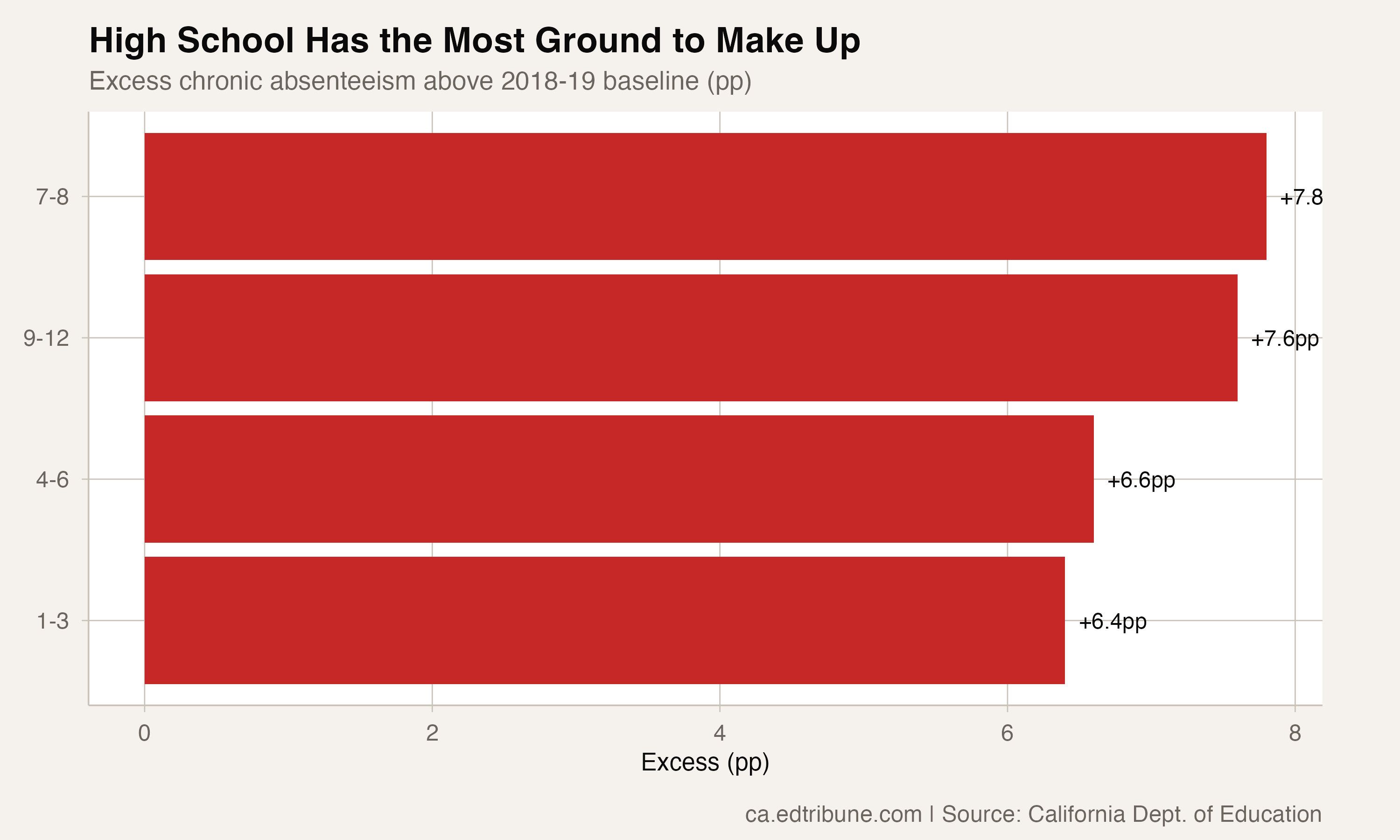
Grades 7-8 carry the largest absolute excess at 7.8 percentage points above their 2019 rate. Grades 9-12 are close behind at 7.6 points. Elementary grades are 6.4 to 6.6 points above. The middle and high school excess is roughly 15-20% larger than elementary.
The plateau problem
The most concerning signal is the year-over-year change. Last year, elementary grades continued to improve at meaningful rates. High school flatlined.
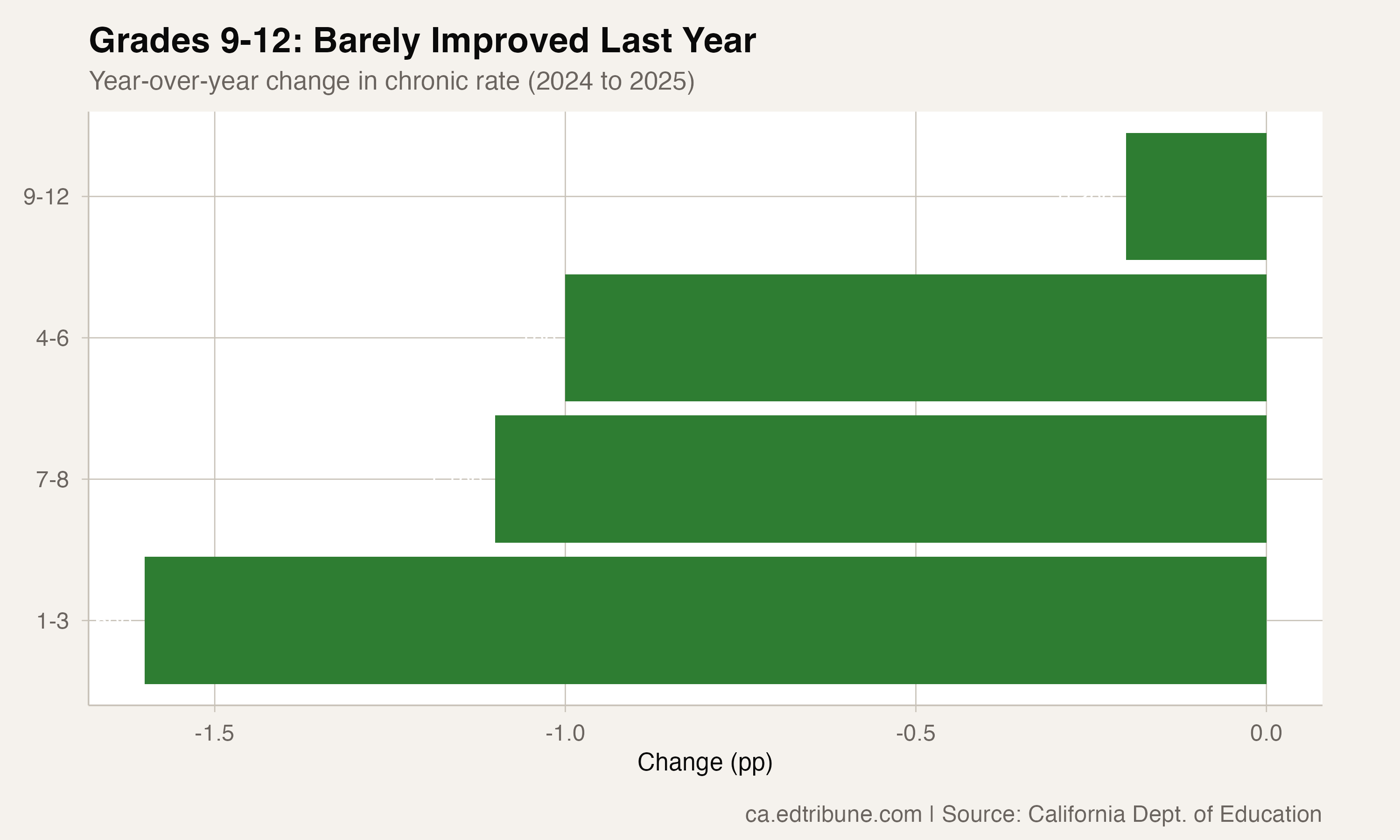
Grades 1-3 improved 1.6 points. Grades 7-8 improved 1.1 points. Grades 4-6 improved 1.0 point. Grades 9-12 improved 0.2 points. The high school improvement rate is one-eighth that of early elementary. At that pace, grades 9-12 would need 38 years to return to their pre-COVID rate.
The pattern suggests that the easy gains in attendance recovery (families returning to normal routines, schools re-establishing expectations) have already been made at the elementary level. Whatever is driving high school chronic absenteeism is more resistant to those natural recovery forces.
Why high school is different
Several factors converge at the high school level to make chronic absenteeism stickier.
Employment: High school students, especially those in low-income families, may work part-time or full-time jobs. California's minimum wage of $16/hour makes employment attractive, and work schedules often conflict with school attendance. The state's recent expansion of youth labor protections limits hours during school days, but enforcement varies.
Credit accumulation: Students who fell behind during COVID-era disruption may have given up on catching up. A 10th grader who is two years behind in credits faces a mathematical impossibility of graduating on time, and the correlation between credit deficiency and chronic absenteeism is well established.
Senioritis as chronic condition: The traditional "senioritis" phenomenon, reduced attendance in the final semester of 12th grade, appears to have expanded to cover more of the high school experience. Students with college acceptances in hand or who plan to enter the workforce directly may see diminishing returns to attendance.
Mental health: Adolescent mental health challenges peak in high school. The CDC's Youth Risk Behavior Survey found that 42% of high school students experienced persistent feelings of sadness or hopelessness in 2023, and mental health has been identified as the top driver of high school absenteeism by Attendance Works research.
The instructional consequence
A 24% chronic rate in grades 9-12 means that on any given day, a substantial fraction of students in a high school class have missed significant instruction. Teachers designing lessons for AP Chemistry or 11th-grade English must account for students who were not present for foundational material taught two weeks ago.
This creates a pedagogical spiral. Teachers slow down to accommodate students who missed material, which reduces the value of attending for students who are present, which may depress attendance further. Elementary attendance is recovering because the problem there is largely logistical: a parent gets the child to school or does not. High school attendance is stuck because the problem is motivational, economic, and psychological. A 16-year-old who has decided school is not worth the trip is a different challenge than a first-grader whose parent overslept.
Detailed code that reproduces the analysis and figures in this article is available exclusively to EdTribune subscribers.
Discussion
Sign in to join the discussion.
Loading comments...