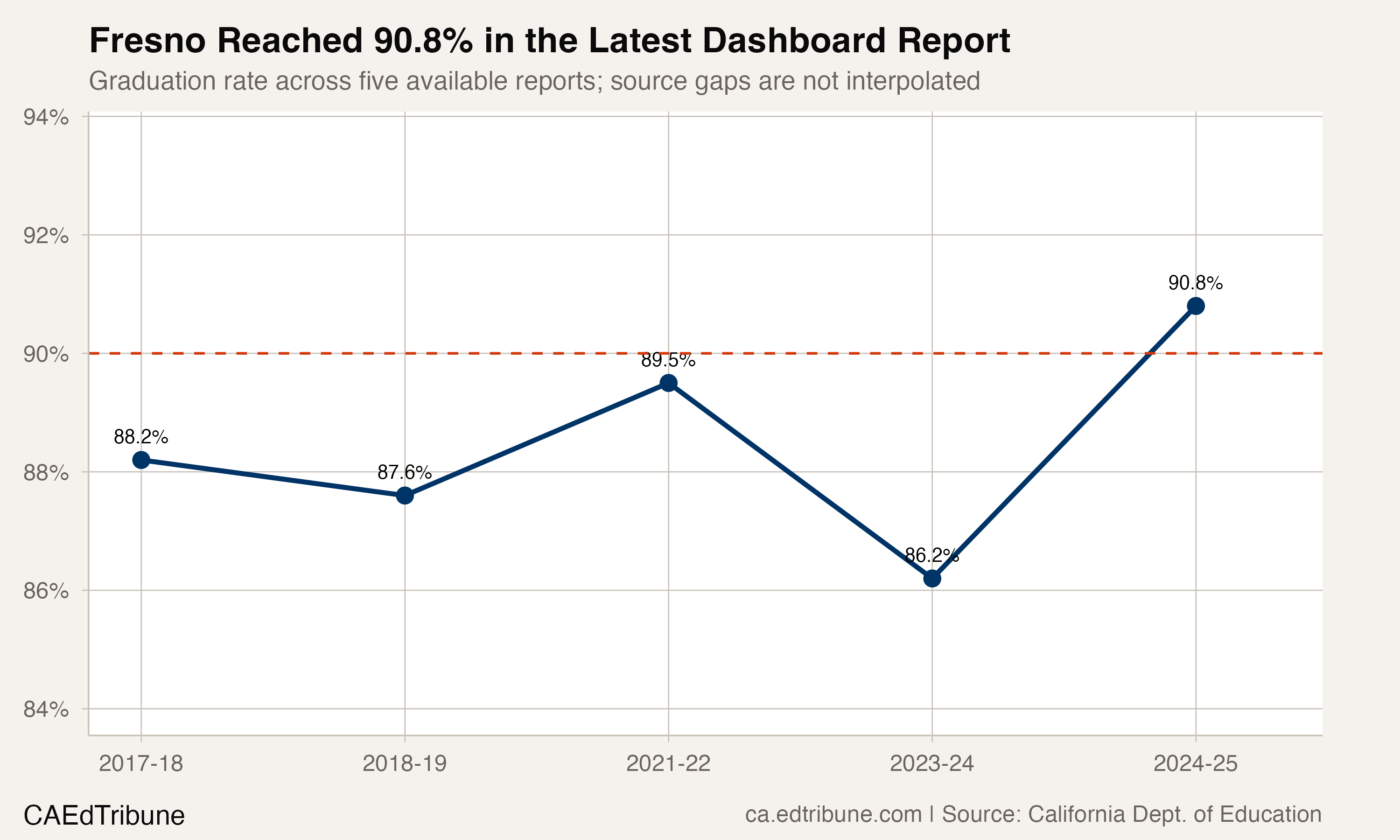
Fresno Unified↗ET reported a 90.8% graduation rate in 2024-25, its highest result in the five California School Dashboard reports available from 2017-18 through 2024-25. It was the only Fresno rate at or above 90% in that panel.
The district graduated 4,023 of 4,430 cohort members. Its rate was 3.0 percentage points above California's 87.8% rate.
A 4.6-point change in the latest year
Fresno's rate moved from 86.2% in 2023-24 to 90.8% in 2024-25, a 4.6-point increase. Compared with the first Dashboard report, the rate was 2.6 points above its 88.2% result in 2017-18.
The Dashboard series is not annual throughout. It contains reports for 2017-18, 2018-19, 2021-22, 2023-24, and 2024-25. The analysis does not fill the missing reports with a different graduation-rate measure.
Most cohort members were classified as low income
The Dashboard classified 4,076 Fresno cohort members as low income, 92.0% of the district's cohort. Their graduation rate was 90.7%.
Hispanic students made up 3,168 cohort members and graduated at a rate of 90.5%. The rate was 94.6% for Asian students, 89.3% for white students, and 88.9% for Black students.
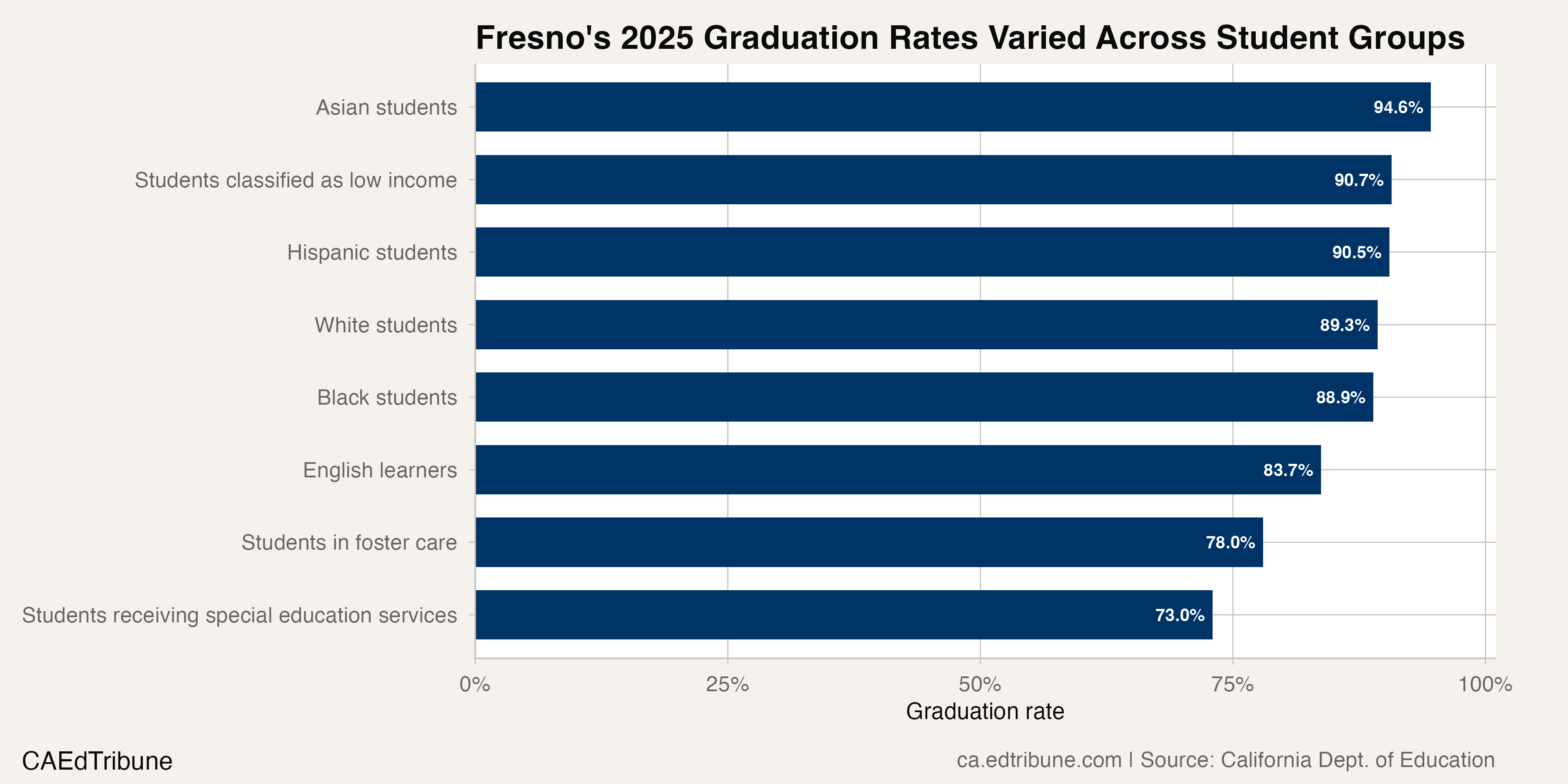
The Dashboard reports overlapping service groups as well as race and ethnicity groups. Those categories do not sum to one student body and are not presented as parts of a whole.
The overall rate masks gaps
Students receiving special education services graduated at a rate of 73.0%, 17.8 points below Fresno's overall rate. Students in foster care graduated at 78.0%, a 12.8-point gap. English learners graduated at 83.7%, 7.1 points below the overall rate.
The cohort count also puts the remaining distance in concrete terms: 407 Fresno cohort members did not graduate in the reported outcome.
Four-district Central Valley comparison
The fixed peer comparison includes four Central Valley districts with complete records in all five reports. Visalia Unified↗ET reported 94.7% in 2024-25, Modesto City High↗ET reported 92.9%, Fresno reported 90.8%, and Stockton Unified↗ET reported 88.9%.
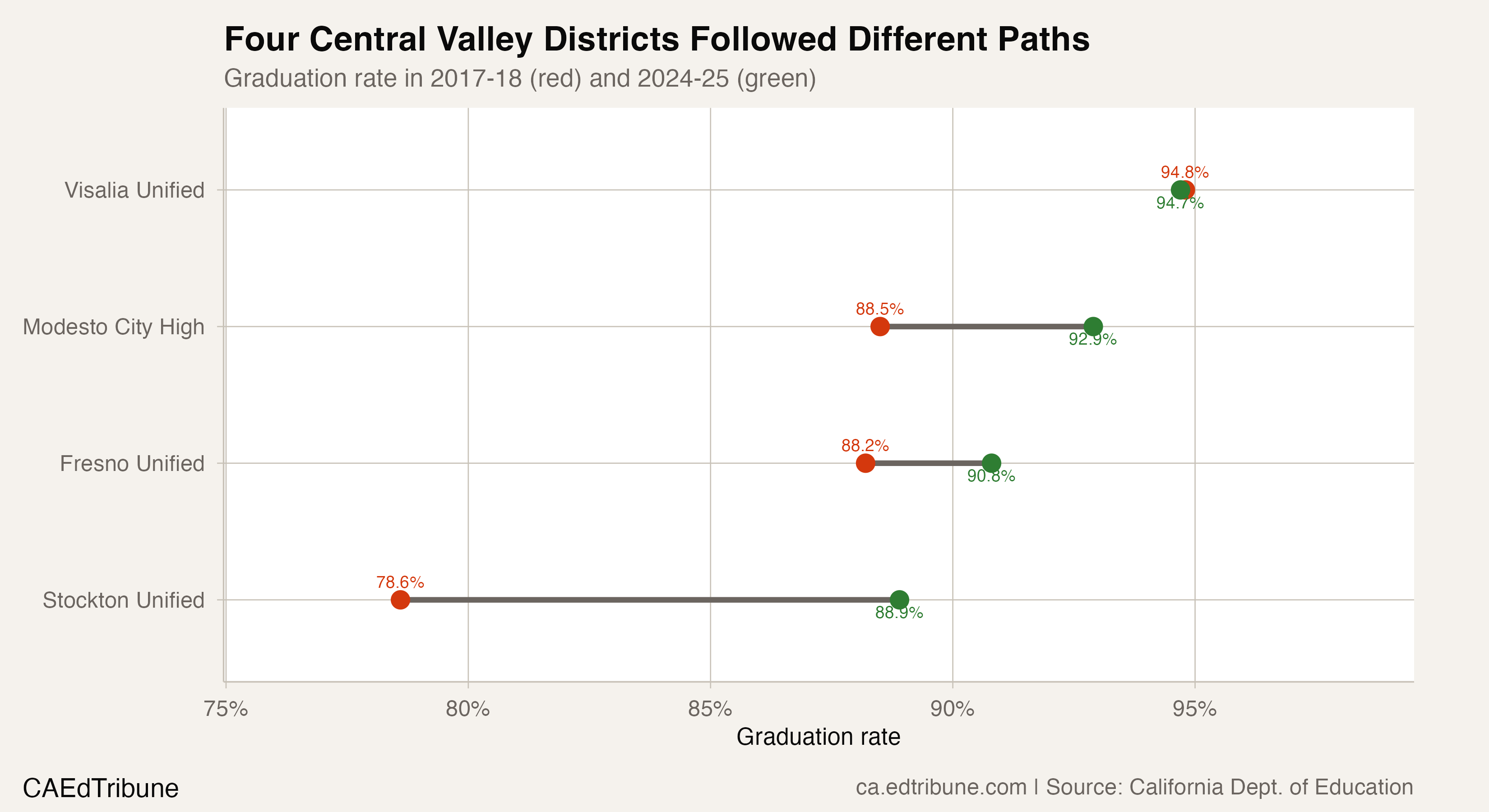
Stockton recorded the largest endpoint improvement in the group, rising 10.3 points from 78.6%. Modesto improved 4.4 points, Fresno improved 2.6, and Visalia's rate was 0.1 point lower than its 2017-18 result.
This is a defined four-district comparison, not a rank among every Central Valley district.
What the rate does not explain
The Dashboard establishes the rates, cohort counts, and student-group differences. It does not identify which district programs changed the outcome or whether cohort composition contributed to the latest increase. Those mechanisms remain unresourced in this analysis.
Detailed code that reproduces the analysis and figures in this article is available exclusively to EdTribune subscribers.
Discussion
Sign in to join the discussion.
Loading comments...