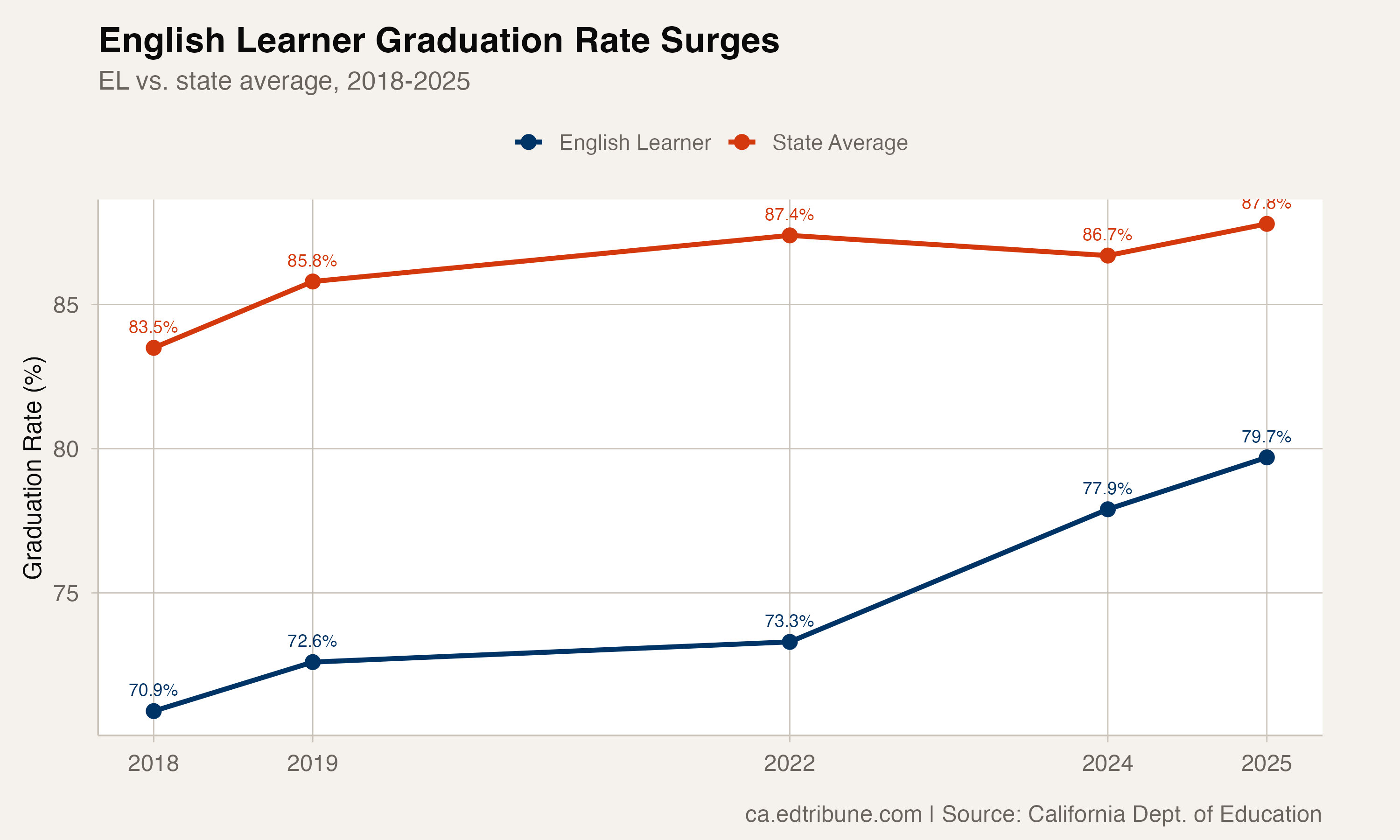
California's English learner graduation rate reached 79.7% in 2025, up from 70.9% in 2018 -- an improvement of 8.8 percentage points that ranks as the third-largest gain of any subgroup behind Black students (+10.5 points) and foster youth (+9.5 points).
The improvement matters at California scale. The 2025 EL graduation cohort alone includes 85,815 students. Each percentage point represents roughly 858 students.
The California Department of Education says the state has the nation's largest English learner population. suggestive context
The Gap
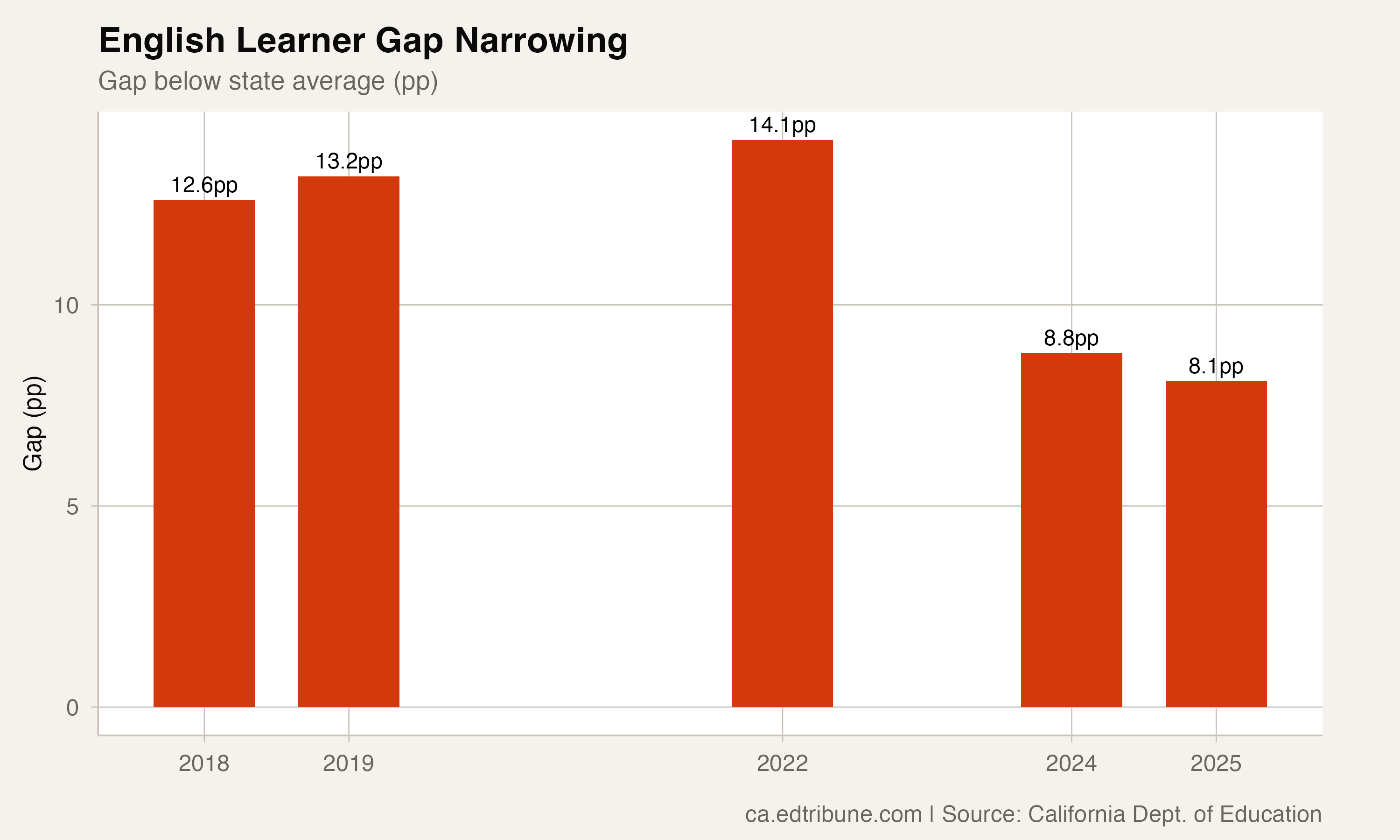
Despite the gains, a gap of 8.1 points remains between English learners (79.7%) and the state average (87.8%). That gap has narrowed from 12.6 points in 2018, a meaningful compression, but it still means more than 17,400 English learners in the 2025 cohort did not graduate.
The 79.7% rate also means that roughly one in five English learners in the cohort did not earn a diploma: 17,456 of 85,815 students.
Long-Term English Learners
California's graduation data first shows a long-term English learner subgroup in 2024.
CDE says long-term English learner definitions vary by report, but generally identify English learners who have not yet reached English proficiency after a specified number of years and have not been reclassified as fluent English proficient. direct evidence
In 2025, the state graduation file reports 58,328 long-term ELs in the cohort, with an 84.0% graduation rate. Because CDE defines long-term English learners as a subset of English learners, subtracting that subgroup from the broader current-EL cohort leaves 27,487 other current English learners, who graduated at 70.3%. The data show a 13.7-point gap between those two current-EL groups; they do not explain the cause.
The District Divide
The district-level variation in EL graduation rates is staggering. Among districts with 200 or more English learners in their cohort:
The lowest: Orange County Department of Education at 53.8%, Oakland Unified↗ET at 61.4%, Hayward Unified↗ET at 61.6%, San Rafael City High at 65.2%, and Los Angeles Unified↗ET at 66.8%.
The highest: Delano Joint Union High↗ET at 94.9%, Orange Unified at 94.9%, Central Union High at 93.9%, and Tulare Joint Union High at 92.9%.
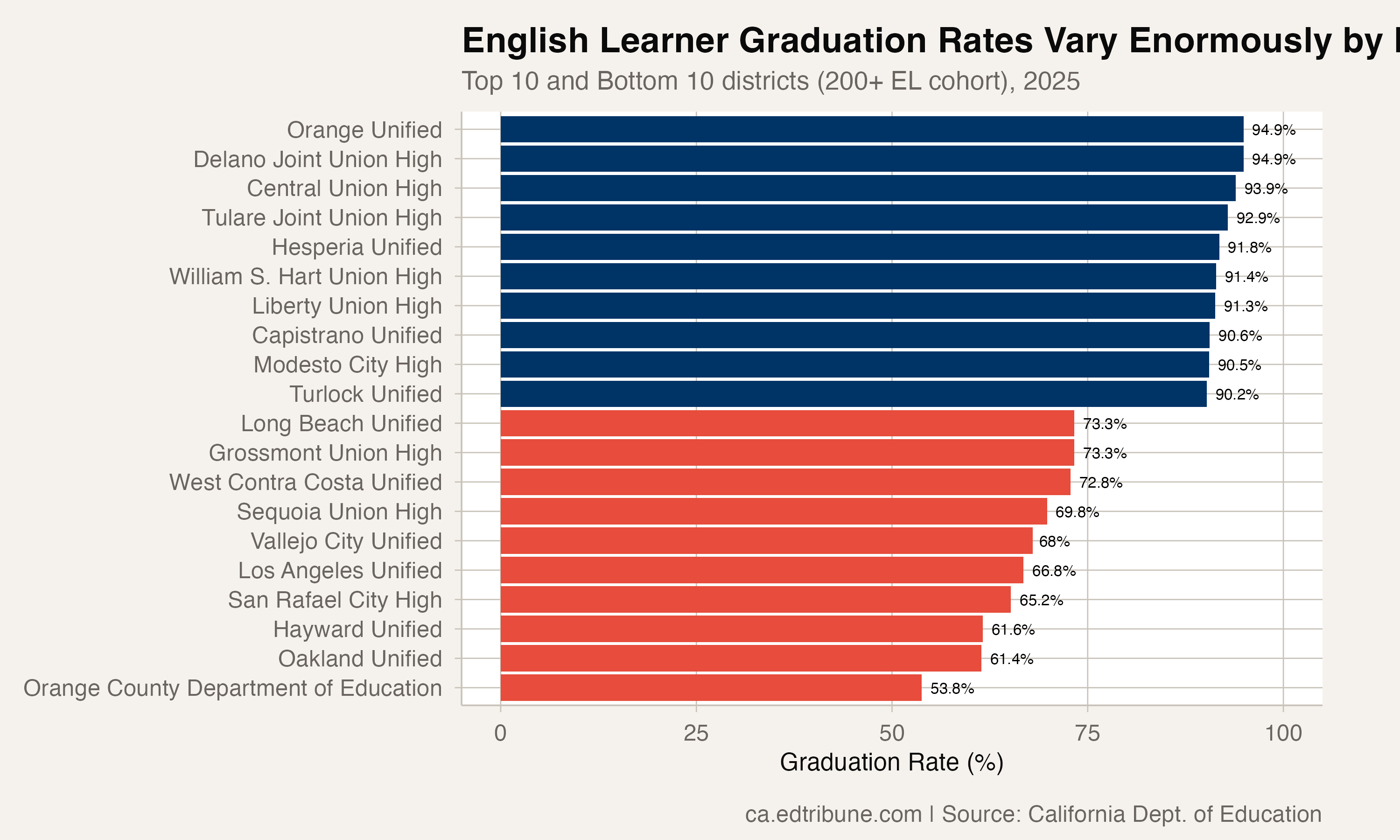
The spread between the top and bottom district-level records is 41.1 percentage points. Excluding the county office entry, the spread from Delano Joint Union High (94.9%) to Oakland Unified (61.4%) is 33.5 points.
The state graduation file does not explain why those district outcomes differ. It does show that district size and rate interact: Los Angeles Unified is not the lowest-rate district, but its cohort is large enough to drive a major share of statewide EL non-graduates.
LAUSD's Challenge
LAUSD's EL graduation rate of 66.8% represents the largest single concentration of EL non-graduates in the state. With 5,806 English learners in its cohort, 1,928 did not graduate.
The LAUSD figure also pulls the statewide EL average downward. If LAUSD's EL rate matched the state EL average of 79.7%, about 750 additional students would graduate. LAUSD, Oakland, and Hayward together account for 8.4% of the statewide EL cohort but 14.2% of statewide EL non-graduates.
The Trajectory
The 8.8-point improvement since 2018 has not been steady. The rate moved from 70.9% to 72.6% between 2018 and 2019, edged to 73.3% in 2022, then rose to 77.9% in 2024 and 79.7% in 2025.
The remaining 8.1-point gap is now concentrated partly in large districts with low EL graduation rates. LAUSD, Oakland, and Hayward are not the whole statewide story, but their combined 7,251-student EL cohort produced 2,485 non-graduates in 2025.
Detailed code that reproduces the analysis and figures in this article is available exclusively to EdTribune subscribers.
Discussion
Sign in to join the discussion.
Loading comments...