Every racial graduation gap in California narrowed between 2018 and 2025. Every special-population gap narrowed too, including the foster care gap, the special education gap, the English learner gap, and the low-income gap. Every gap except one.
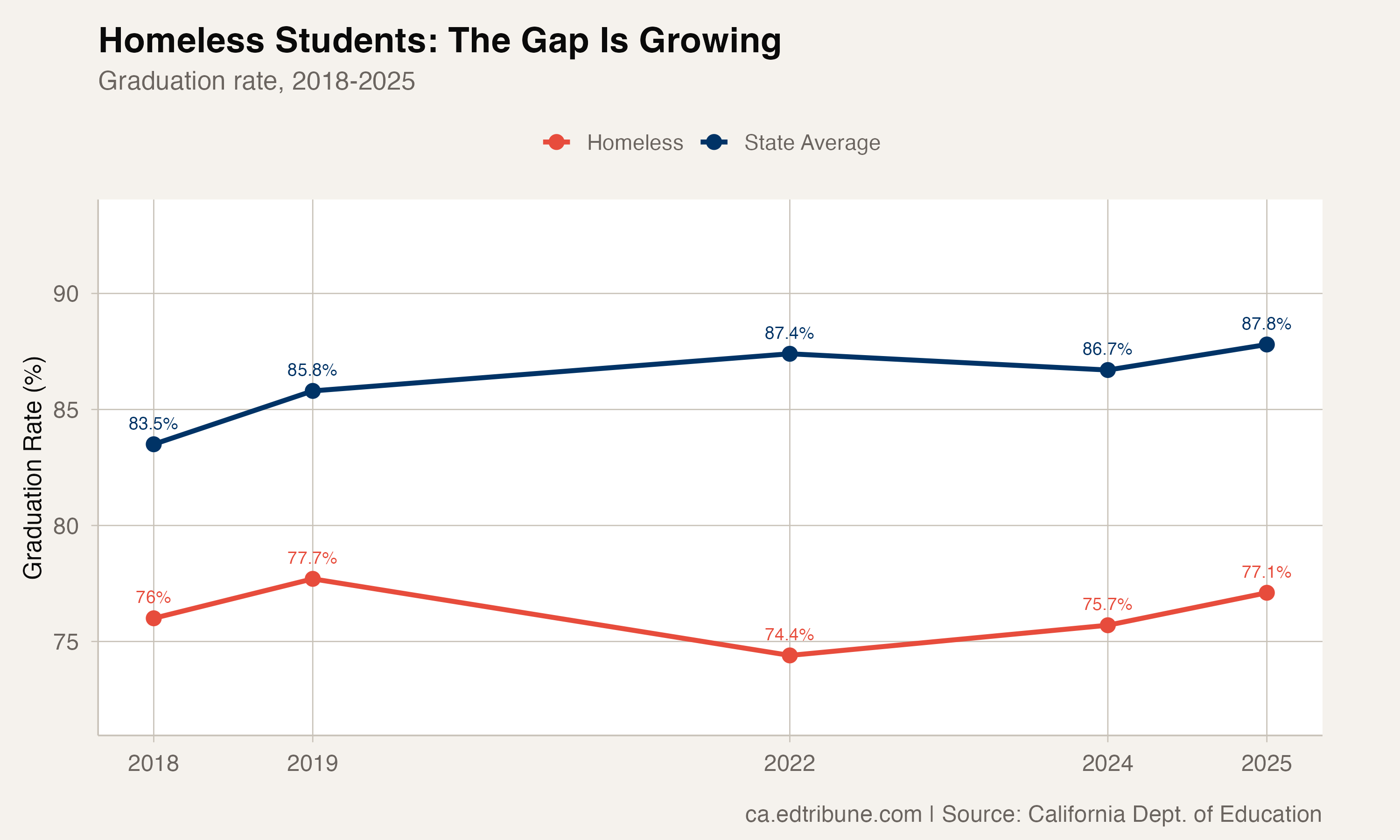
Students who are currently homeless graduated at 77.1% in 2025. That is barely changed from 76.0% in 2018, a gain of just 1.1 percentage points over seven years. Meanwhile, the state average rose 4.3 points. The gap widened from 7.5 points to 10.7 points, a 3.2-point expansion while every other gap shrank.
The Outlier
The gap chart tells the story. The white-Black gap shrank by 9.2 points. The foster care gap by 5.2. The English learner gap by 4.5. The white-Native American gap by 4.9. The white-Hispanic gap by 4.4. Even the stubborn special education gap narrowed by 1.4 points and the low-income gap by 1.1.
The gap for students who are currently homeless went the other direction: plus 3.2 points.
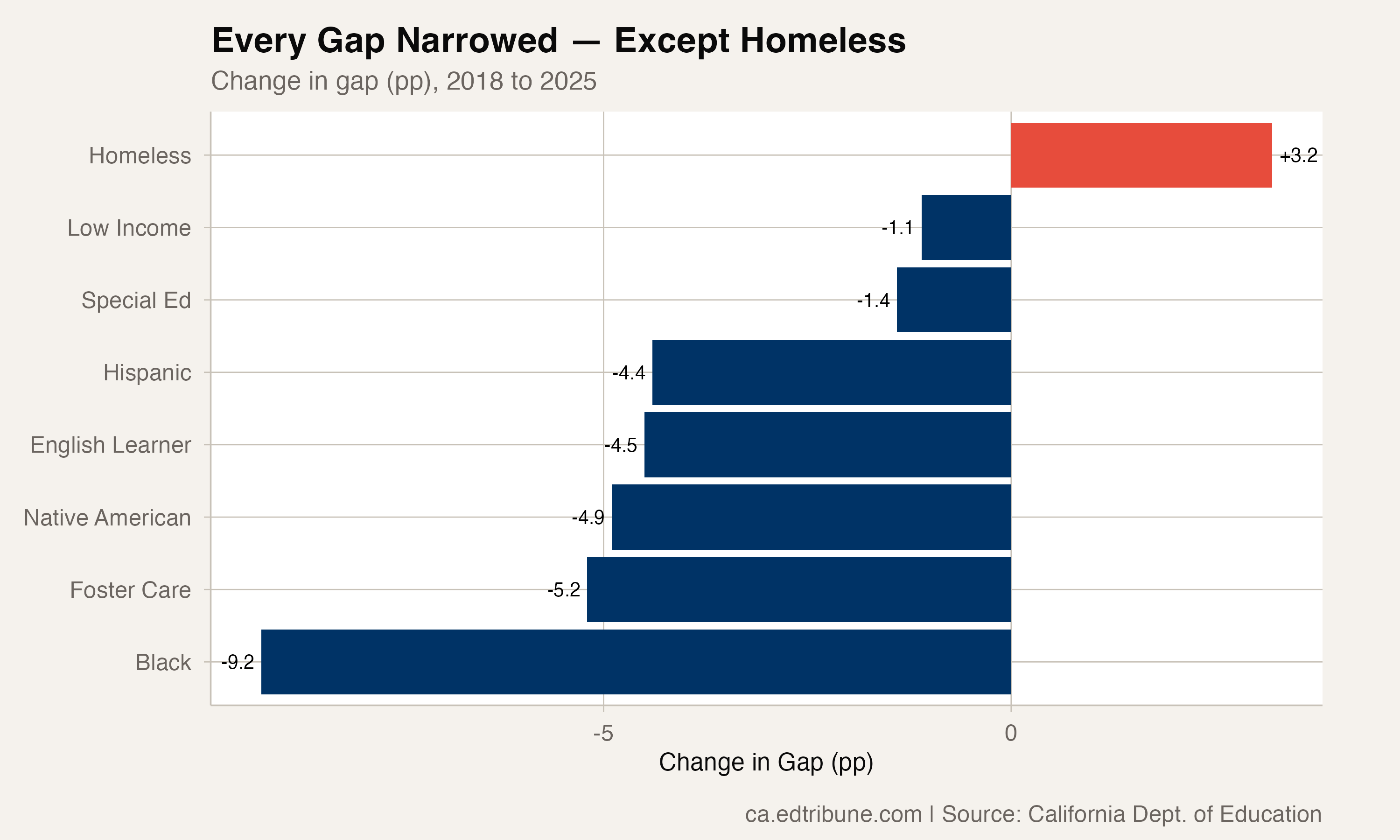
The divergence is not subtle. It is the only subgroup for which the gap widened by any amount, and it widened by the most of any subgroup's gap change in absolute terms except the Black gap closure.
A Growing Population
The graduation cohort of students who are currently homeless in California has grown from 30,288 in 2018 to 41,902 in 2025, an increase of 38.3%. This is not a shrinking population that statistics can explain away. It is a growing one.
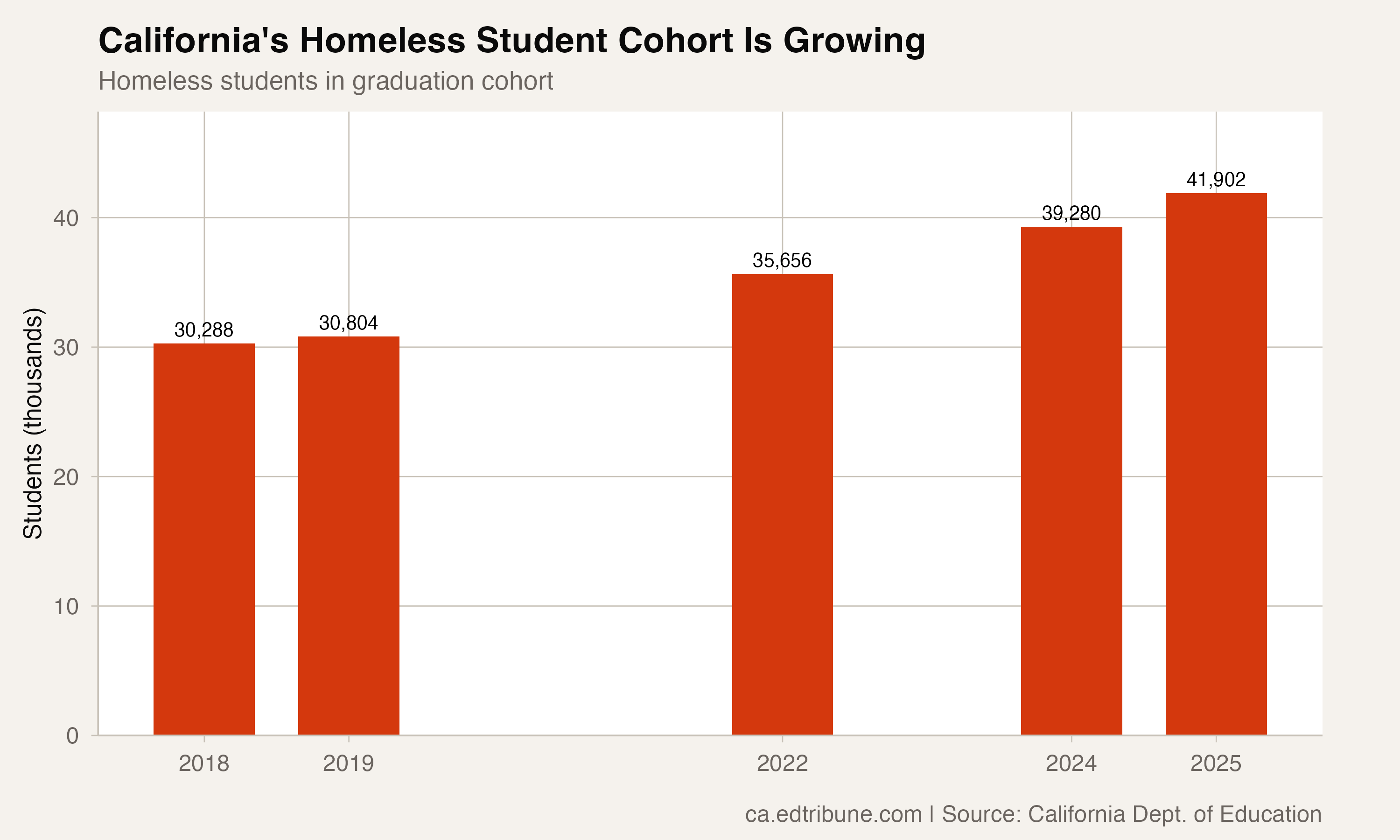
The growth reflects California's housing crisis. Students classified as homeless under the McKinney-Vento Act include those living in shelters, motels, doubled-up with other families, in vehicles, or unsheltered. As housing costs outpace wages and the shelter system strains, more families with school-age children meet the definition.
A 77.1% graduation rate applied to 41,902 students means roughly 9,600 students who are currently homeless in the 2025 cohort did not graduate. That is more non-graduates from this single subgroup than the entire graduation cohort of many California districts.
The Gap Trajectory
The path of this gap has been erratic. It was 7.5 points in 2018, then appeared to narrow to 8.1 points in 2019 as students who are currently homeless improved to 77.7%. But in 2022, the rate for students who are currently homeless plunged to 74.4%, even as the state average hit 87.4%, opening the gap to 13.0 points.
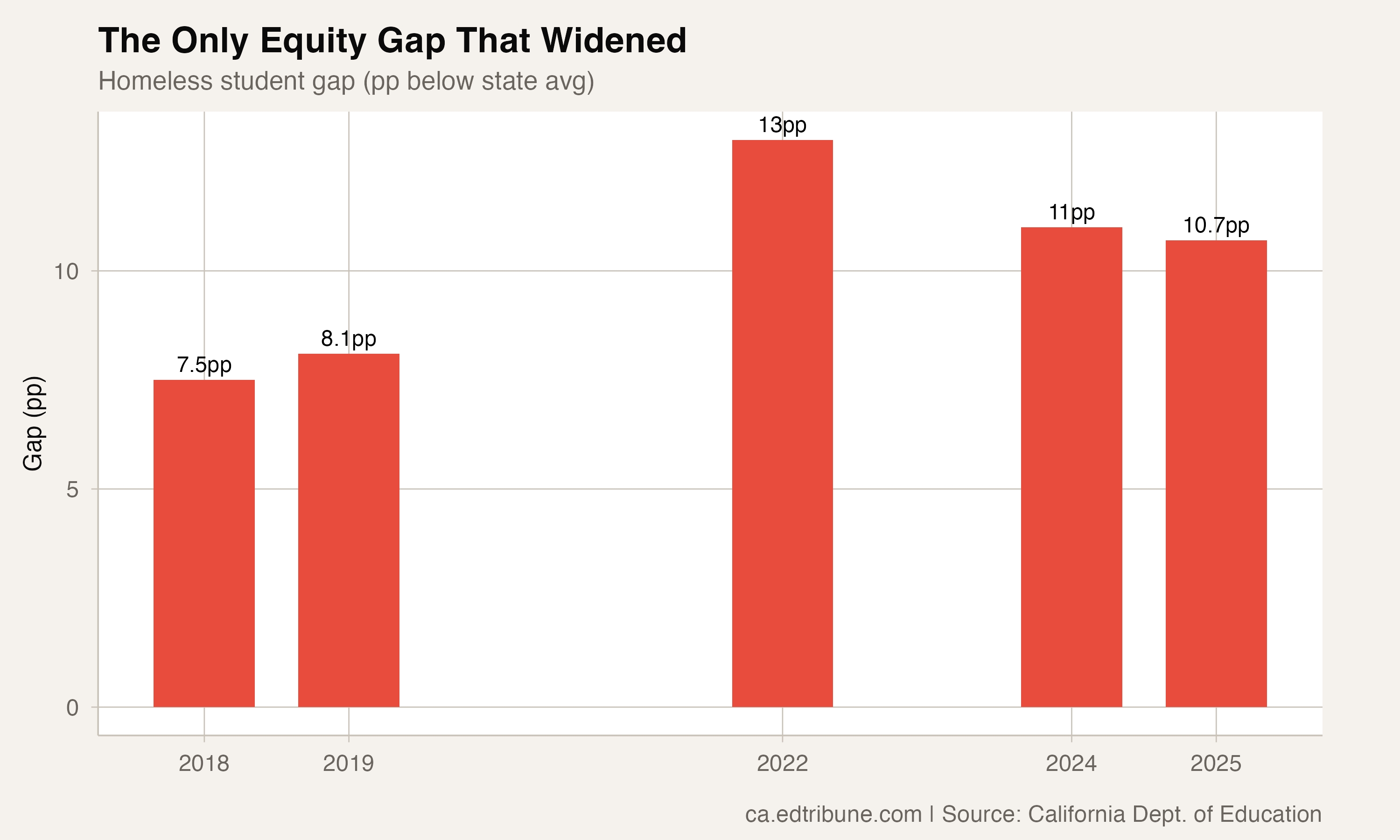
The partial recovery to 77.1% in 2025 narrowed the gap back to 10.7 points, but the trend is clear: the gap is larger now than it was seven years ago, and the 2022 trough suggests that this population is especially vulnerable to disruption.
The COVID pandemic hit students who are currently homeless from multiple directions: loss of shelters that doubled as study spaces, disruption of school-based services like meals and counseling, and the impossibility of remote learning without stable internet or a quiet place to work.
What Makes This Different
The distinction between students who are currently homeless and other subgroups is mobility. A foster youth may change placements but typically remains enrolled in a school system. A special education student has an IEP that follows them. An English learner has language services that transfer.
A student who is currently homeless may change schools multiple times in a single year. They may attend different schools in different districts. They may disappear from enrollment for weeks at a time. The graduation rate captures only those who were in a cohort long enough to be counted, meaning the true population of homeless young people who fail to graduate is almost certainly larger than the data shows.
The 10.7-point gap is, in this sense, a floor estimate.
The Policy Question
California has invested heavily in education equity over the past decade. The Local Control Funding Formula directs supplemental and concentration funds to high-need students. Community schools have expanded. The state increased funding for after-school programs, transitional kindergarten, and mental health services.
These investments appear to have worked for nearly every target population. Black students gained 10.5 points. English learners gained 8.8. Foster youth gained 9.5. The question is why students who are currently homeless were left behind, and whether the answer is that educational interventions cannot solve a housing problem.
A school can provide counseling, tutoring, and a free lunch. It cannot provide a stable address.
Detailed code that reproduces the analysis and figures in this article is available exclusively to EdTribune subscribers.
Discussion
Sign in to join the discussion.
Loading comments...