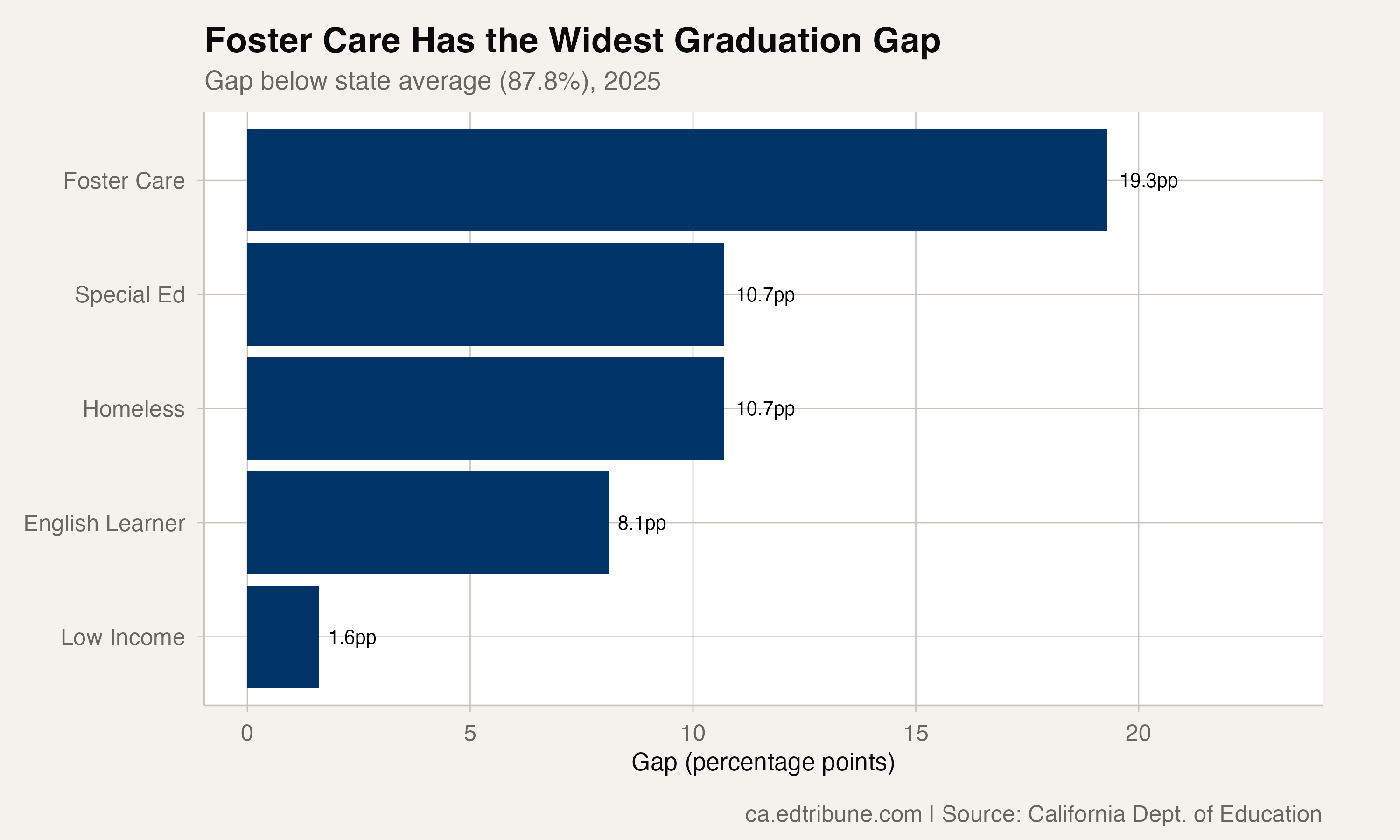
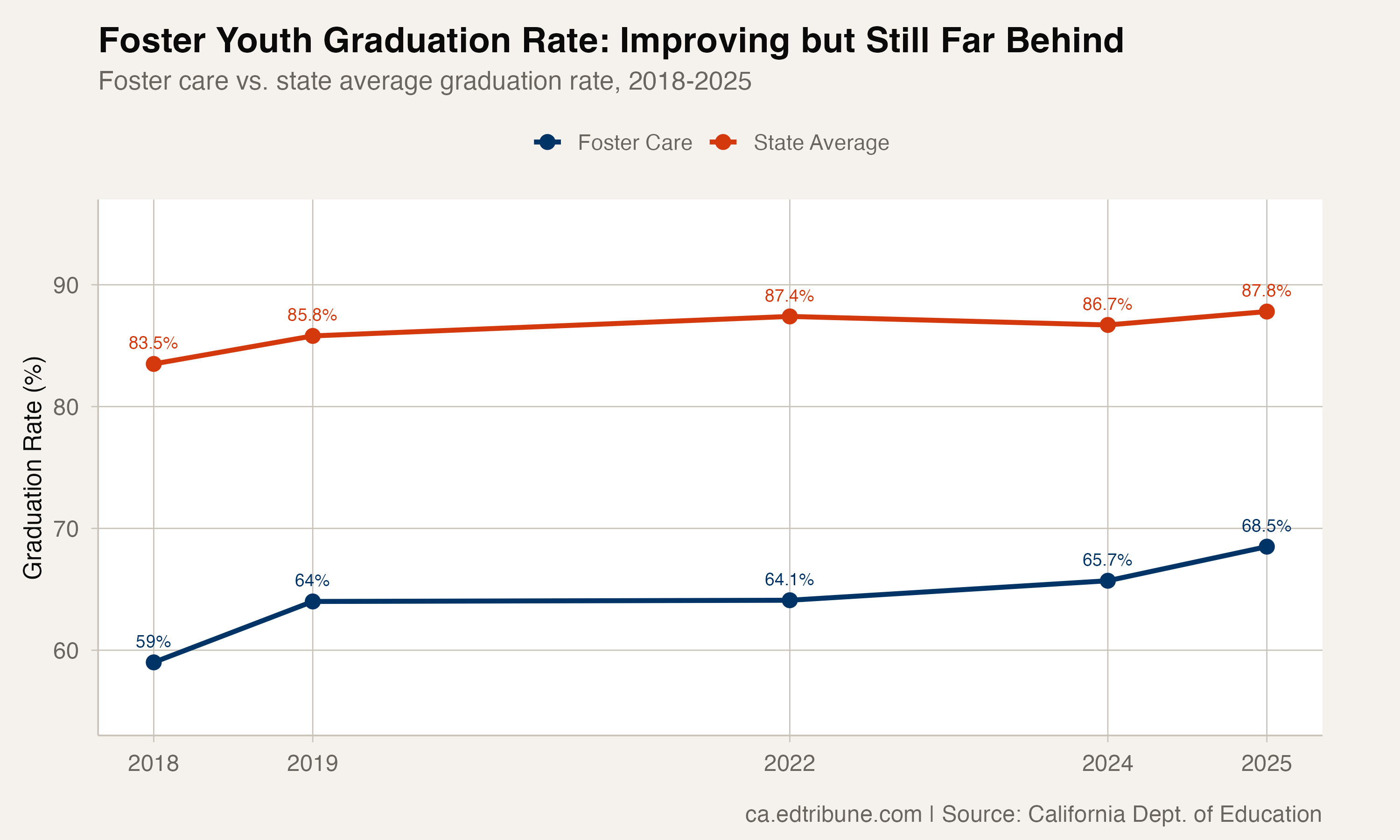
California tracks graduation rates for fifteen student subgroups. In 2025, one gap is wider than any other: students in foster care graduate at 68.5%, a full 19.3 percentage points below the state average of 87.8%.
No other group comes close. Students with disabilities and students who are currently homeless each trail by 10.7 points. English learners trail by 8.1 points. The racial gaps that once dominated equity conversations (white-Black at 6.4 points, white-Hispanic at 2.1) are now fractions of the foster care gap.
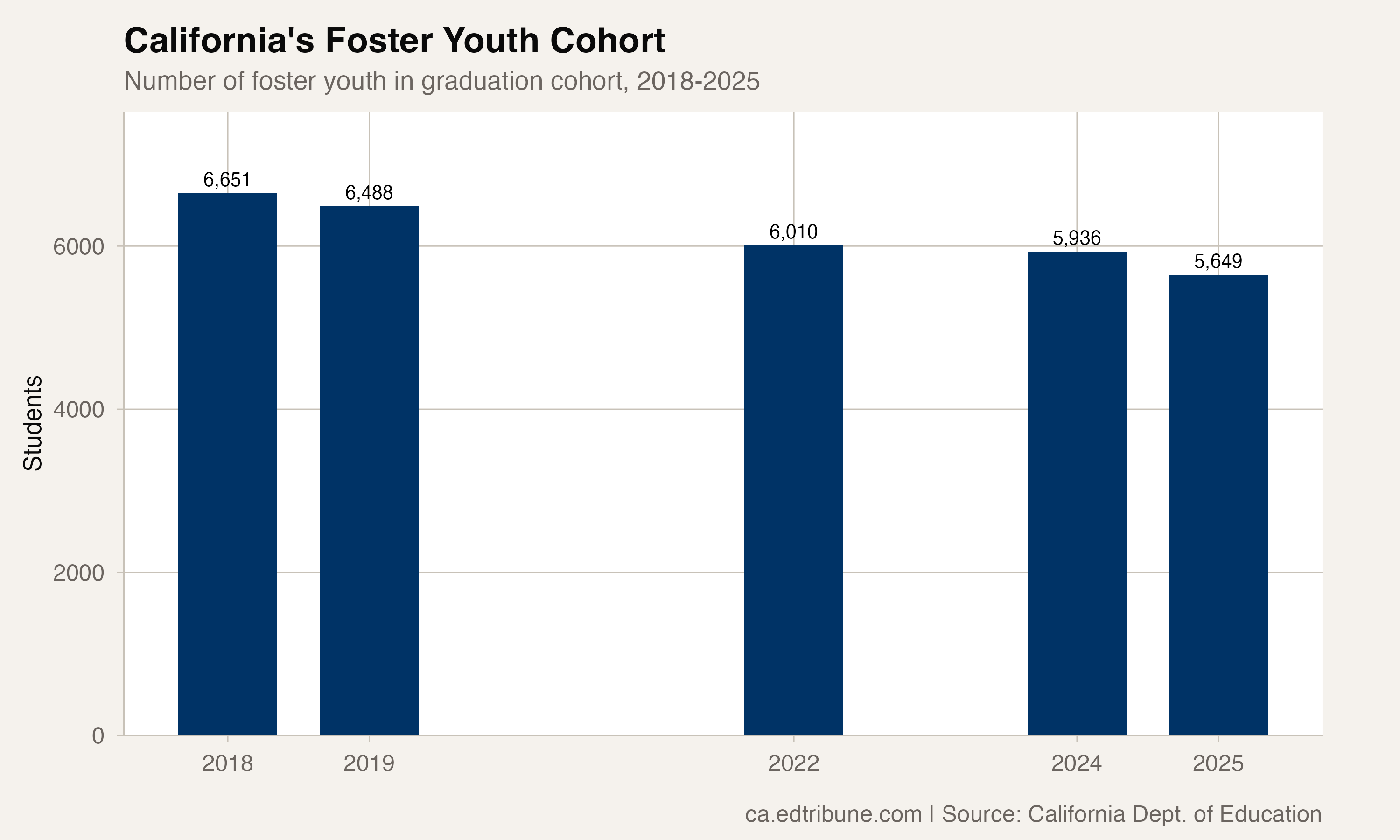
The number translates directly to young people. Of the 5,649 students in foster care in California's 2025 graduation cohort, roughly 1,780 did not graduate. These are students already navigating the child welfare system, already dealing with instability that most of their peers cannot imagine. A missing diploma compounds every disadvantage that brought them into care in the first place.
Progress That Is Not Enough
The foster care graduation rate has improved. In 2018, it stood at 59.0%, meaning more than four in ten students in foster care did not graduate. The 9.5-point gain to 68.5% is the third-largest improvement of any subgroup, behind only Black students (+10.5 points) and English learners (+8.8 points).
But the gap has not kept pace with statewide gains. In 2018, the foster care gap was 24.5 points. In 2025, it is 19.3 points. That is a meaningful narrowing, but the rate of closure has been uneven; the gap actually widened between 2019 and 2022 (from 21.8 to 23.3 points) before resuming its decline.
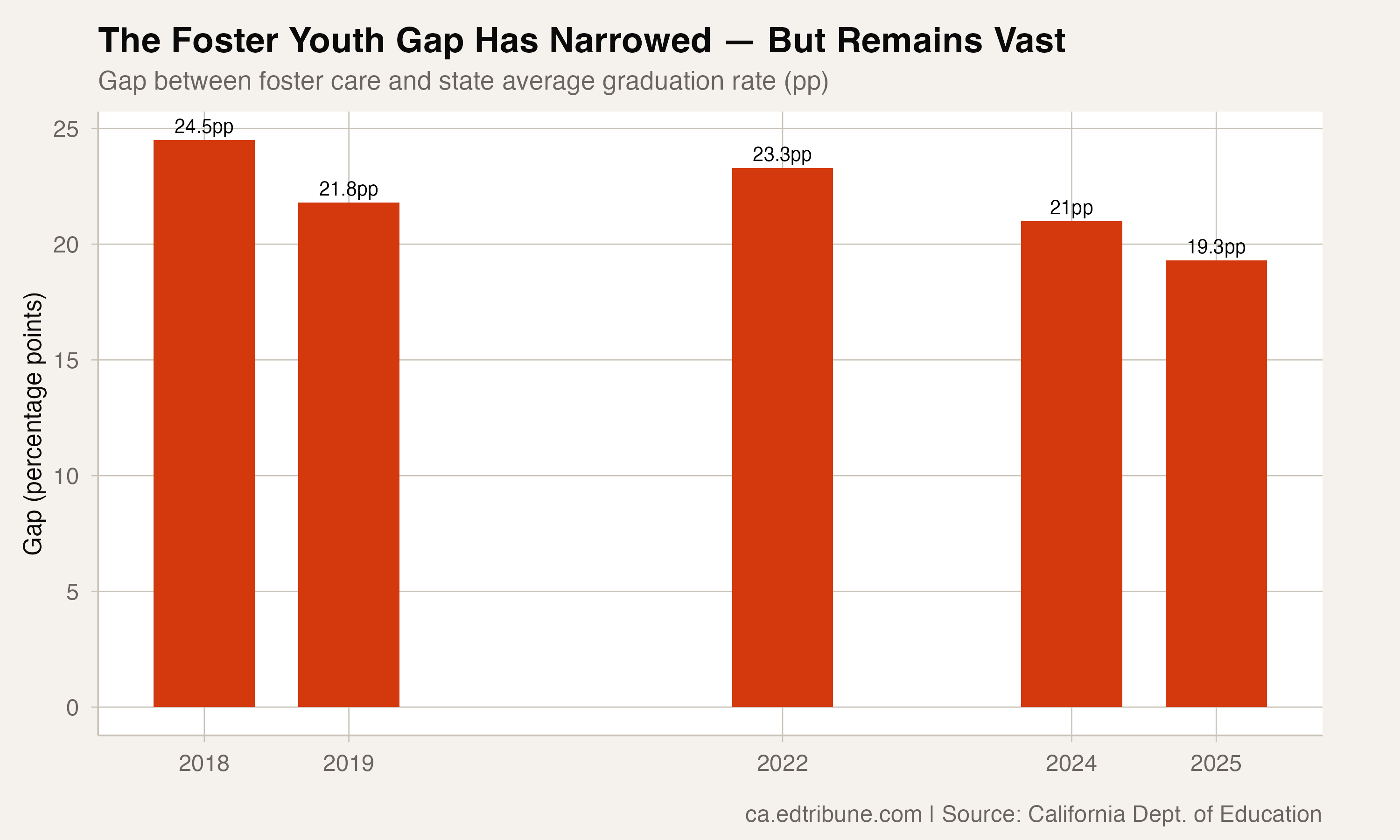
The trajectory suggests that whatever drove the improvement from 59% to 68.5% may not be sufficient to close the remaining distance. The last 19 points are the hardest. They represent the students facing the deepest instability.
A Cohort That Is Shrinking, Slowly
California's graduation cohort of students in foster care has shrunk modestly: 6,651 students in 2018 to 5,649 in 2025, a decline of about 15%. Some skeptics might argue the improvement reflects compositional change, but a 9.5-point gain across a cohort that still numbers more than 5,600 students is not explained by selection effects alone. The numbers reflect a persistently large child welfare system.
Where the Gap Hits Hardest
At the district level, the numbers are more sobering. Among districts with at least 50 students in foster care in their cohort, the Orange County Department of Education graduates just 50.0% and the Los Angeles County Office of Education 55.4%. These county offices serve the most transient students in foster care: those cycling through placements, attending continuation schools, entering and exiting juvenile facilities.
Los Angeles Unified↗ET, with 394 students in foster care in its 2025 cohort (the largest of any traditional district), graduates them at 74.6%. Fresno Unified↗ET at 78.0%. San Francisco Unified↗ET at 78.8%. Long Beach Unified↗ET at 81.0%.
The range, from 50% at county offices to 84% at San Bernardino City Unified↗ET, shows that where a student in foster care lands matters enormously. Placement stability, school-of-origin rights, and designated liaisons for students in foster care vary widely across districts.
The Funding Disconnect
A 2025 WestEd report found that California districts spend only a fraction of one percent of their targeted funds directly on services for students in foster care. The state's Local Control Funding Formula generates supplemental and concentration grants based on counts of high-need students, including students in foster care. But because they are a tiny share of most districts' enrollment, typically well under 1%, the funding generated on their behalf is often absorbed into broader programs rather than directed at their specific needs.
The paradox is that students in foster care are among the most expensive students to serve well, requiring case management, transportation to school of origin, counseling, and academic intervention, and yet they are the least likely to receive dedicated resources.
What 68.5% Means
A 68.5% graduation rate means that roughly one in three students in foster care in California leaves high school without a diploma. For a student who has already experienced family disruption, housing instability, and the trauma of the child welfare system, the absence of a diploma closes doors that were already narrowing.
The improvement from 59% is real and meaningful. The remaining gap of 19.3 points is the distance between a system that has begun to pay attention and one that has solved the problem. California is clearly not in the second category yet.
Detailed code that reproduces the analysis and figures in this article is available exclusively to EdTribune subscribers.
Discussion
Sign in to join the discussion.
Loading comments...