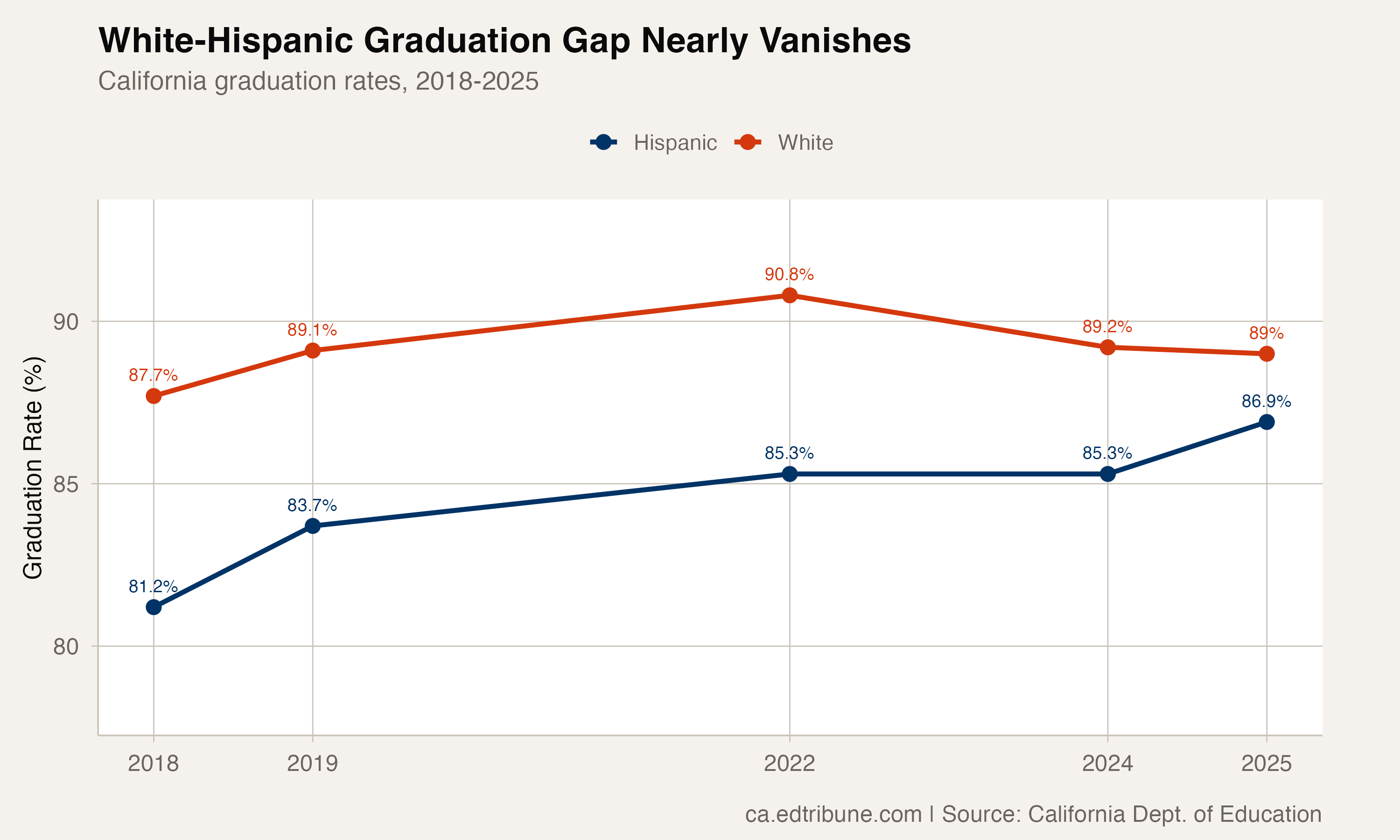
In 2018, white students in California graduated at 87.7% and Hispanic students at 81.2%, a gap of 6.5 percentage points. By 2025, the gap had shrunk to 2.1 points: 89.0% for white students, 86.9% for Hispanic students.
For a state where Hispanic students constitute 56.6% of the graduation cohort (287,352 students, more than double the white cohort of 104,906), approaching parity is not a footnote. It is a structural shift in who succeeds in California's education system.
The Convergence
The gap closed because Hispanic students improved faster. Their 5.7-point gain over seven years (81.2% to 86.9%) was more than four times the white gain of 1.3 points (87.7% to 89.0%).
The narrowing was not smooth. The gap dropped from 6.5 points in 2018 to 5.5 in 2022, then widened slightly to 3.9 in 2024 before contracting sharply to 2.1 in 2025. That final-year compression (from 3.9 to 2.1) suggests the 2025 gains were real, not a statistical artifact.
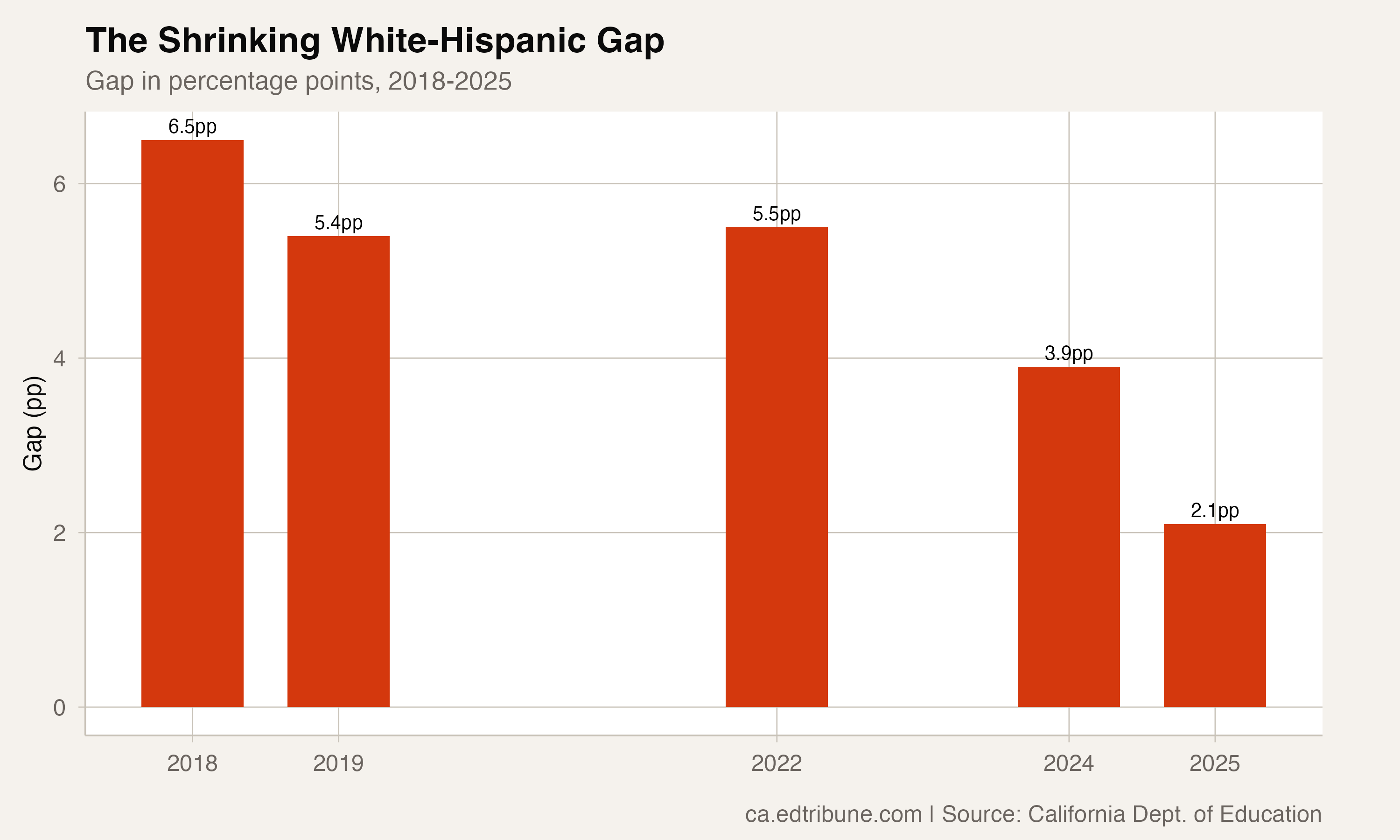
At 2.1 points, the gap is approaching a level that might be considered statistical noise in smaller samples. But California's samples are not small. With 287,352 Hispanic students and 104,906 white students, even a 2-point gap represents roughly 5,700 additional Hispanic students who did not graduate compared to if they graduated at the white rate.
California's Majority
Hispanic students have been California's largest demographic group in the graduation cohort for years. The numbers have been remarkably stable: 272,753 in 2018, peaking at 293,952 in 2024, settling at 287,352 in 2025.
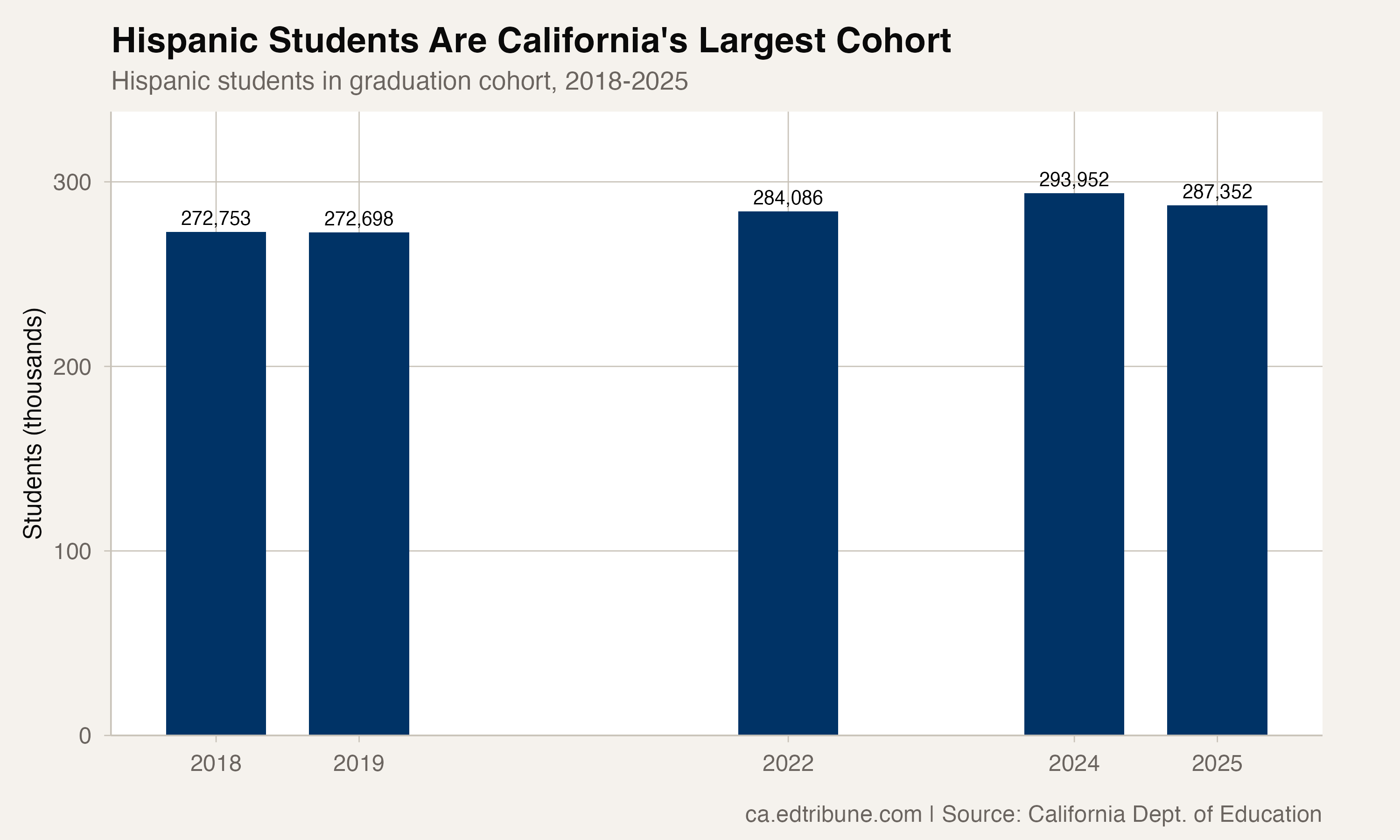
Meanwhile, the white cohort has declined from 124,294 to 104,906 over the same period, a 15.6% drop. Hispanic students now outnumber white students in the cohort by nearly 3 to 1.
The convergence is not just an equity story. It is an economic one. When the single largest group in the workforce pipeline graduates at essentially the same rate as the historically advantaged group, the implications for labor markets, tax revenue, and social services are substantial. Each percentage point of Hispanic graduation rate represents roughly 2,870 students.
Where Hispanic Students Already Lead
In 45 districts with at least 100 students of each group, Hispanic students already graduate at higher rates than white students. The most dramatic reversals:
- Marysville Joint Unified↗ET: Hispanic 93.3%, white 82.2% (+11.1 points)
- Palm Springs Unified↗ET: Hispanic 92.7%, white 85.5% (+7.2 points)
- Porterville Unified↗ET: Hispanic 91.0%, white 83.9% (+7.1 points)
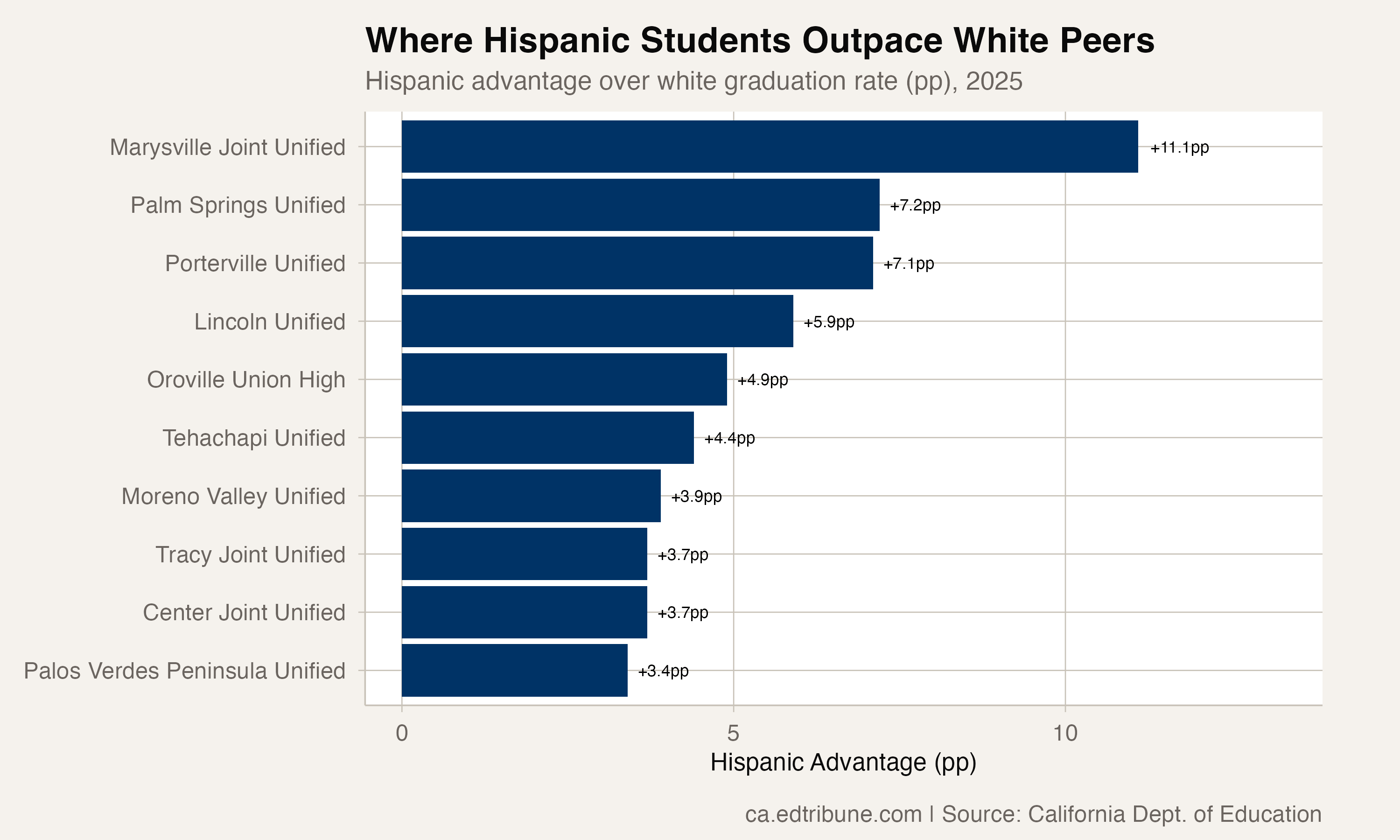
These are not affluent suburban districts. Marysville is in rural Yuba County. Palm Springs serves a resort community with deep economic stratification. Porterville is an agricultural hub in the Central Valley. The reversals tend to happen in places where the Hispanic community is well-established and majority, suggesting that when Hispanic families are the core constituency of a school system rather than a minority within it, outcomes shift.
What Remains
A 2.1-point gap is small. But it exists on top of a larger reality: 86.9% means roughly 37,600 Hispanic students in the 2025 cohort did not graduate. That is more non-graduates than the entire population of many California cities.
The gap also varies enormously by district. In Los Angeles Unified↗ET, which serves the largest Hispanic cohort in the state, Hispanic students graduate at 85.9%, below the state Hispanic average and 1.4 points below the LAUSD white rate of 87.3%. In Oakland Unified↗ET, Hispanic students are at 68.7% while white students are at 83.7%, a 15-point chasm that mirrors the statewide picture from a decade ago.
The statewide convergence is real and meaningful. It reflects a state where the largest demographic group is approaching the graduation rate of the historically most successful one. That 45 districts have already flipped, with Hispanic students graduating at higher rates than white peers, suggests this is not a temporary statistical alignment but a durable shift in educational outcomes.
Detailed code that reproduces the analysis and figures in this article is available exclusively to EdTribune subscribers.
Discussion
Sign in to join the discussion.
Loading comments...