Jennifer Hawn's first day as superintendent of Cupertino Union↗ET was also the district's first day of school. "Today is August 13th, the first day of school, and also my first day as your Superintendent," she wrote in a welcome letter posted on the district's website.
She had been preparing for that morning for months. "I spent months before my first day diving into the District data, watching Board meetings, and learning what makes CUSD tick," Hawn said in written responses provided to The CAEdTribune through the district's communications office. "I didn't want to show up as a stranger; I wanted to hit the ground running as a partner, fully ready to listen and work alongside staff and the community from day one."
Hawn is a veteran of the state's schools, with more than two and a half decades in California public education by her own account. What stood out to her here, she said, was "this community's dedication to learning and supporting the whole child." What drew her was "the District's incredible reputation for academic excellence and its genuine partnerships with parents and staff to support all students."
A trend line that just stopped falling
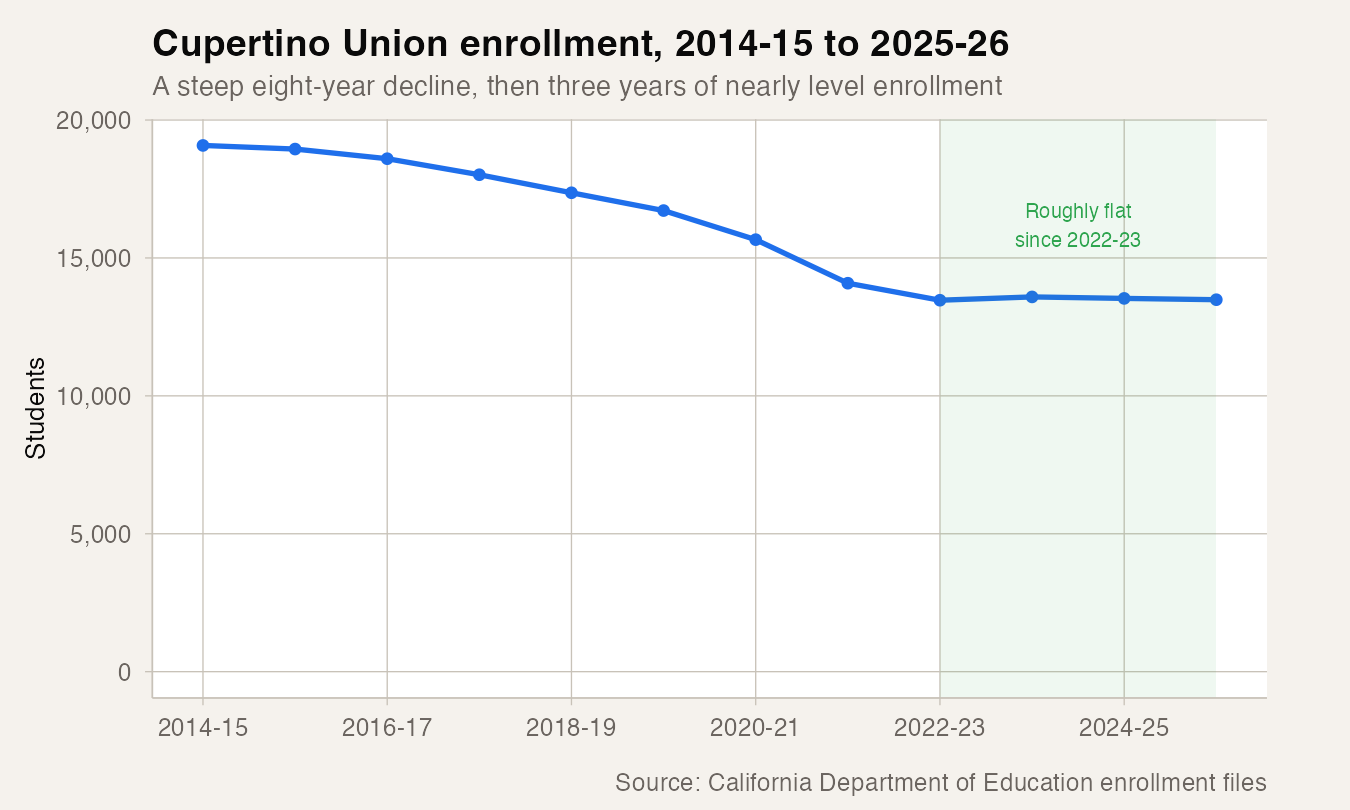
The district Hawn inherits looks different in its most recent data than in its recent history. Cupertino Union's schools enrolled 13,486 students in 2025-26, the most recent year in the state's published files. The current 2026-27 school year, her first, is not yet in the data.
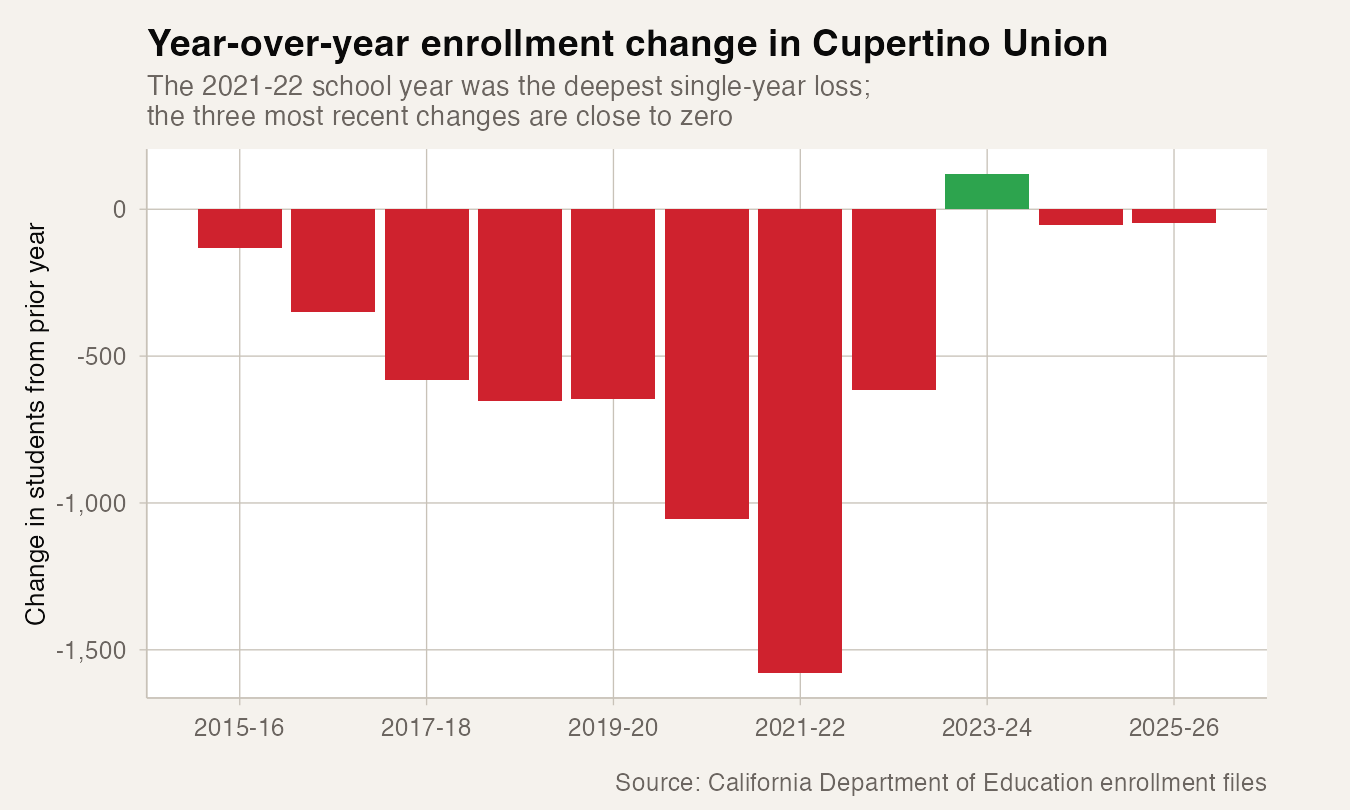
The decade before tells a harder story. From 19,079 students in 2014-15, enrollment fell to 13,467 by 2022-23, a decline of 29.4 percent, in a stretch when statewide enrollment fell 6.2 percent. The worst single year came in 2021-22, when the K-8 district lost 1,579 students, 10.1 percent of its enrollment, in one year.
Then the slide stopped. Across the three most recent published years, no annual change has exceeded one percent in either direction: up 120 students in 2023-24, down 54 the next year, down 47 in 2025-26. A district that spent eight years shrinking has spent the past three essentially level.
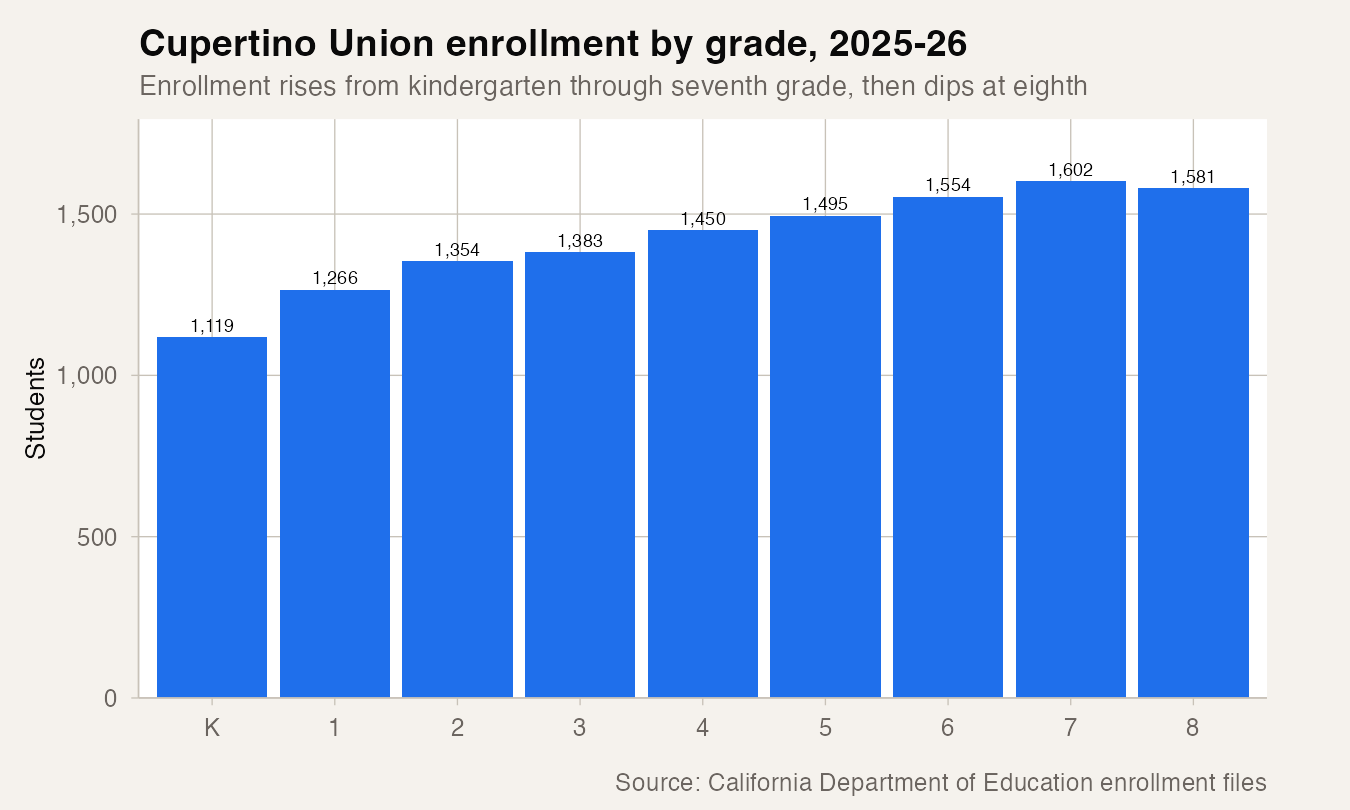
Level is not the same as recovered. The grade spine still leans the wrong way for a K-8 system: 1,119 kindergartners entered in 2025-26 against 1,581 eighth graders on their way out, or 70.8 entering students for every 100 leaving ones. Each grade from kindergarten through sixth is smaller than the grade above it. Whether the flat years mark a floor or a pause is a question the published data cannot answer yet.
Four priorities and a bond to deliver
Hawn frames her first year around four district priorities: future-ready learning, community-wide engagement, fiscal responsibility, and a sense of belonging. In her words, that means "helping our kids become resilient learners who bounce back from challenges and global contributors who care about the world around them," building "real, active partnerships with our families, staff, and Board," and "creating an environment where every single student, staff, and family feels truly valued and supported."
The fiscal priority gets the most concrete language. She describes it as "taking a fresh look at our budget and operations to make sure every dollar directly serves our students," and returns to it unprompted when asked what deserves attention this year: "Right alongside that crucial work, I'm taking a close, practical look at our budget so we can keep our instructional programs strong and financially secure for years to come."
The work she most wants noticed is the district's Measure Z bond program, approved by voters. "The work the District has begun for the recently voter-approved Measure Z Bond Program deserves a spotlight," she said. "Students, staff, families, and the greater community will see real changes across our campuses, including upgraded critical infrastructure, improved safety systems, and modernized classrooms."
A construction program is a distinctive assignment for a new superintendent in a district whose enrollment has fallen by 5,593 students since 2014-15: the buildings being modernized will serve a district that is smaller, but no longer shrinking, than the one that built its reputation. The students in them, in 2025-26, were 68.3 percent Asian, 20.5 percent economically disadvantaged, and 17.1 percent English learners.
The read she brings
Asked what she most wants the community to know, Hawn pointed at the people already there. "I want people to know how truly special CUSD is - the District has an incredible system of dedicated employees that continually place students at the heart of their work," she said. "Coupled with the support of our families, this consistently places CUSD schools among the very best in California."
Enrollment is not a measure of a superintendent, and the district says it did not hire Hawn to reverse a decline its own demographer had already projected. Where a district's students come from turns on birth rates, local employment, the cost of living, and the supply of affordable housing, and families move on their own circumstances, most often over the summer while school is out. The state enrollment file counts students and carries none of that, and neither does the analysis behind this article. The district publishes its own demographer's report on those longer-run trends.
What Hawn has set for herself is narrower, and in her own words: a budget review "to make sure every dollar directly serves our students," the Measure Z work that "deserves a spotlight," and "creating an environment where every single student, staff, and family feels truly valued and supported." When the state publishes the 2026-27 enrollment file, it will add one more year to a trend that long predates her, not a verdict on her first year.
How we reported this story
Enrollment, grade-level, and student-group figures come from California Department of Education enrollment data files covering the 2014-15 through 2025-26 school years. Quotes are from Dr. Jennifer Hawn's written responses to The CAEdTribune, provided through the district's communications office, and from her welcome letter on the district's website. Her role is listed on that same district page. The district's demographer's report, linked above, is Cupertino Union's own projection of its enrollment trend and is not state data; it is cited here as the district's context, not as a figure in this analysis.
Detailed code that reproduces the analysis and figures in this article is available exclusively to EdTribune subscribers.
Discussion
Sign in to join the discussion.
Loading comments...