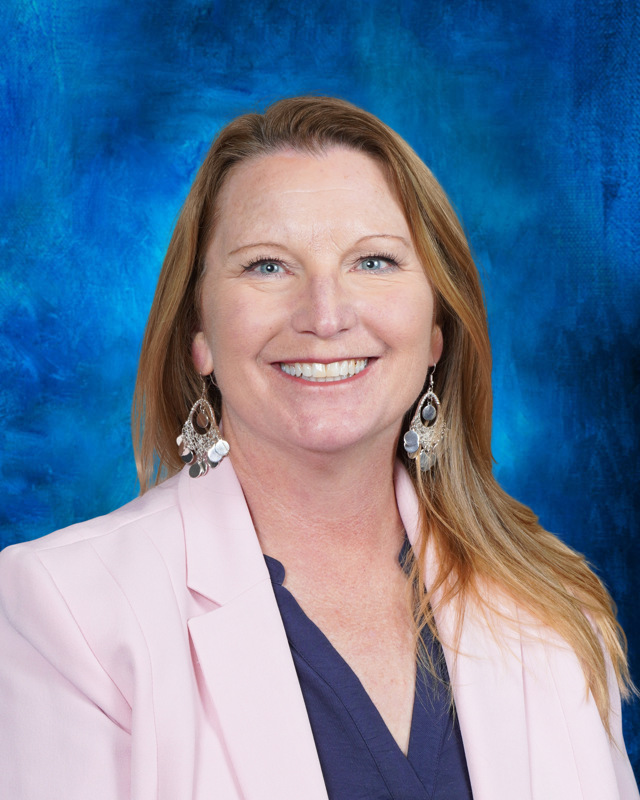
Angie Summers begins leading Standard School District↗ET with a clear pair of priorities: preserve the district's progress on attendance and accelerate its uneven literacy results.
California's published records show a meaningful attendance improvement already underway. Standard's chronic absence rate fell from 46.6 percent in 2022-23 to 32.4 percent in 2024-25, a 14.2-percentage-point decline. The number of chronically absent students fell by 416 during that span even as the number of students eligible to be measured increased by 163.
The improvement predates Summers's first year as superintendent. It is part of the landscape she inherits, not evidence about her performance or proof of what caused the change.
"My early priorities are to keep building on our two main goals: literacy and attendance," Summers said in written responses to The CAEdTribune.
The district's current superintendent page identifies Summers as its leader and names the same two priorities. It also describes an Early Release Wednesday schedule intended to give teachers recurring time to collaborate, analyze student data and plan instruction. The schedule is direct evidence of the district's operating approach, but not evidence that the schedule caused the results in the state data.
Attendance improved, but the gap remains
Standard's attendance gain is visible in both the rate and the count. The chronic absence rate moved down in each of the three reporting years examined, from 46.6 percent to 38.5 percent and then 32.4 percent.
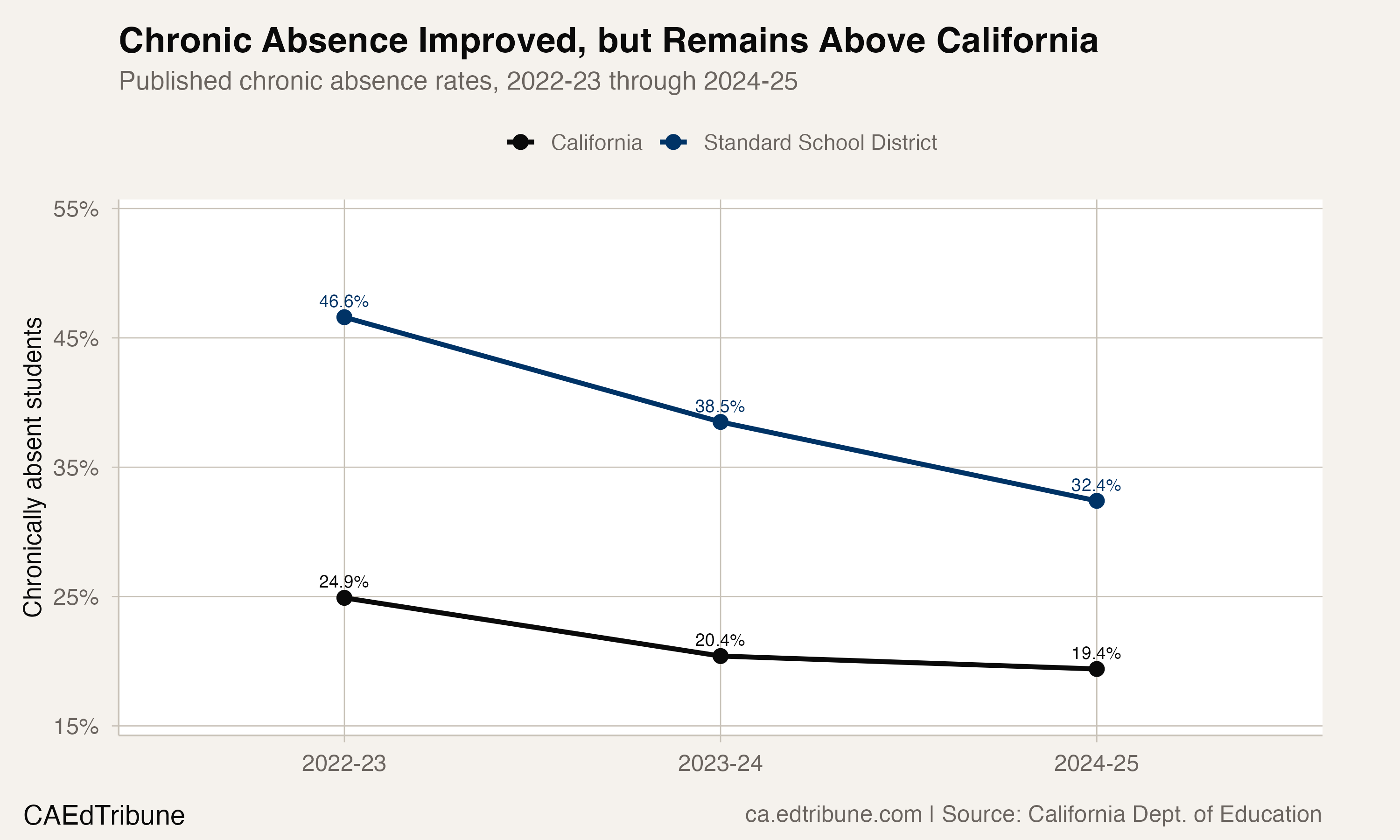
The count moved from 1,536 chronically absent students in 2022-23 to 1,120 in 2024-25. Because the attendance-eligible enrollment grew rather than shrank, a smaller denominator cannot explain the lower count or rate.
California's rate also improved during the period, a competing explanation for part of the change. Standard's latest rate nevertheless remained 13.0 percentage points above the statewide rate of 19.4 percent. That leaves the district with both real progress to protect and substantial distance still to close.
Summers described the work as relational as well as instructional. She wrote that "parents and families are a part of our team and we need to work together to achieve our goals."
Attendance records cannot show whether families feel like partners or identify which district practices changed individual decisions about coming to school. They can establish a baseline for evaluating whether the progress continues after the leadership transition.
Literacy rebounded without establishing a trend
The latest English language arts results explain why literacy remains prominent in Summers's agenda. The share of tested students meeting or exceeding the state standard rose from 20.1 percent in 2023-24 to 24.7 percent in 2024-25, a 4.6-percentage-point rebound.
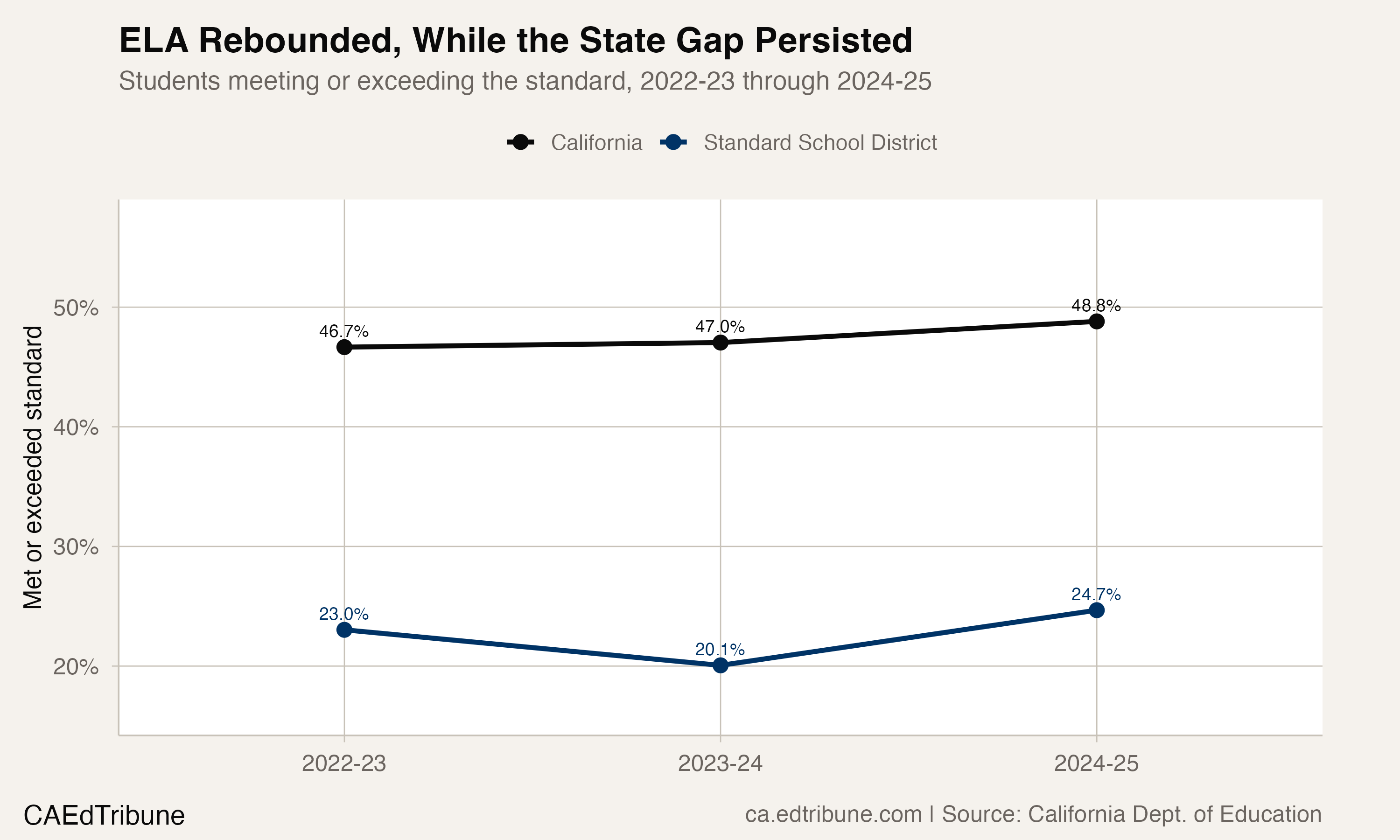
That latest increase needs a longer baseline. Standard's 2022-23 result was 23.0 percent, so the latest rate was only 1.6 points above the first year in the three-year panel. The pattern is one decline followed by one rebound, not evidence of sustained improvement.
The district's 2024-25 rate also remained 24.1 points below California's 48.8 percent. Those figures do not diagnose why the gap exists, whether instruction changed or which students need a different response. They show the scale of the literacy challenge Summers has chosen to emphasize.
A stable four-school system
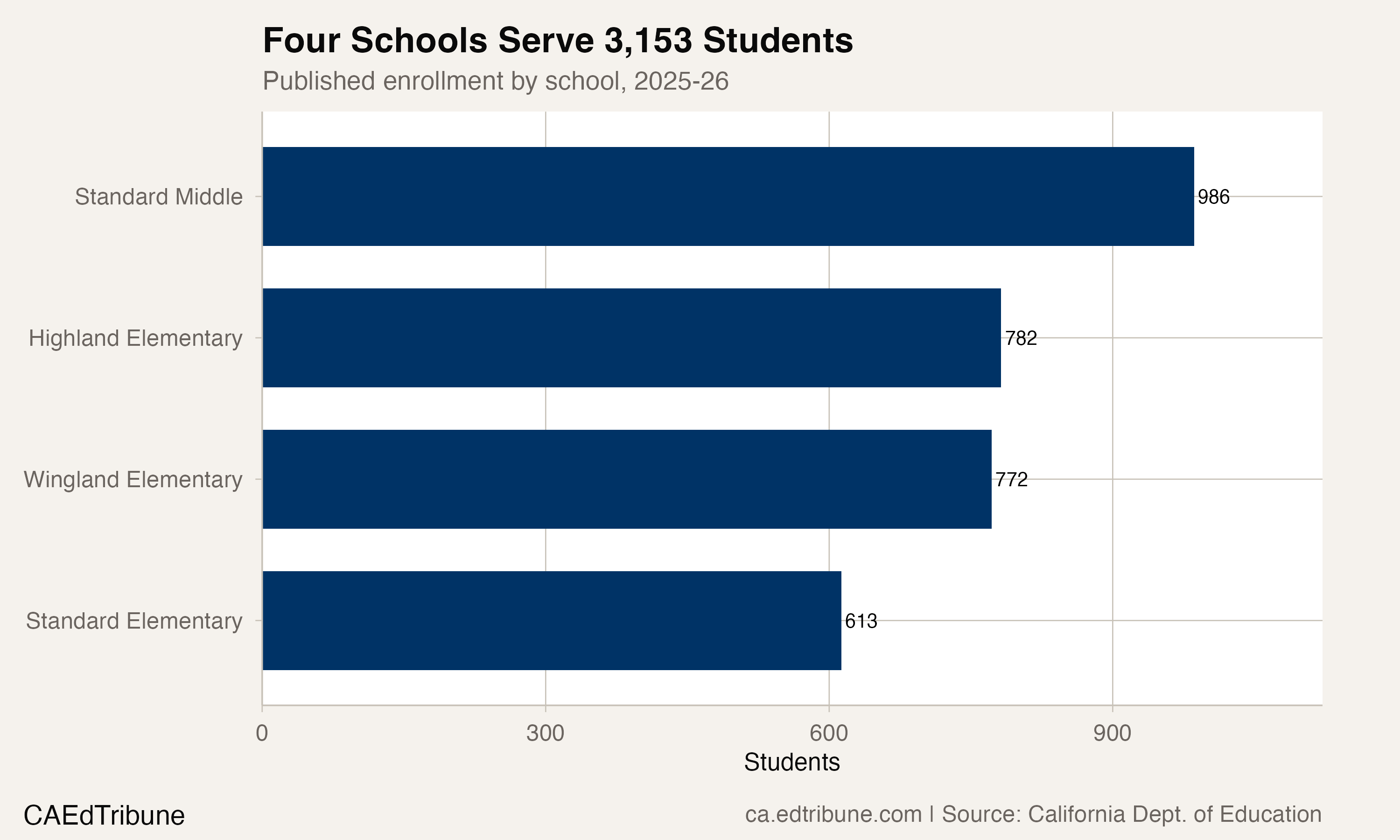
Enrollment gives Summers a comparatively stable operating base. Standard enrolled 3,153 students in 2025-26, up 32 students, or 1.0 percent, from 3,121 in 2014-15. California's public-school enrollment fell 8.1 percent over the same window.
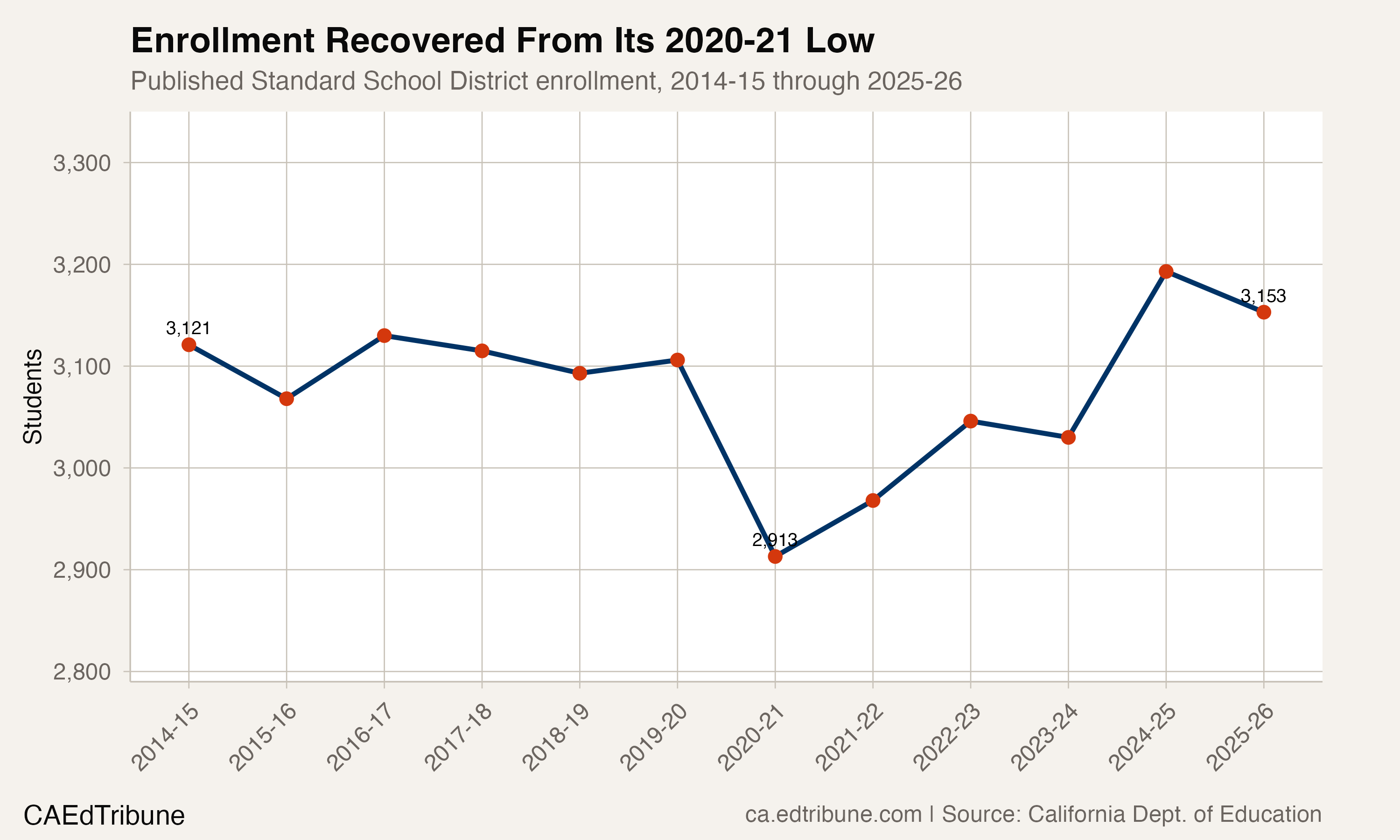
The endpoint comparison does not mean enrollment was flat every year. Standard reached a low of 2,913 students in 2020-21 before recovering 240 students by 2025-26. The latest year brought a decrease of 40 students, another reason not to describe the recovery as guaranteed to continue.
The district's four schools enrolled between 613 and 986 students in 2025-26. Together, those school totals reconcile to the district's published count.
Summers had already worked in the district before seeking the superintendency. She said that experience helped her build relationships with staff and understand the work she would be asking the system to continue.
"I have made good connections with the staff, built trust, and I am positive that we can continue to grow," she wrote.
She also identified unfinished cultural work. In Summers's account, Standard had not been sufficiently centered on education before the prior year, and the district still needs to strengthen trust with staff and the community. That is her assessment of the organization, not a conclusion drawn from enrollment, attendance or assessment records.
The measures point to a more precise starting position. Summers inherits a district that is serving roughly as many students as it did more than a decade ago, has sharply reduced chronic absence, still trails the state attendance rate and has a literacy rebound that needs to become durable progress.
Her stated approach begins with people rather than a promise that one program or leader can move every measure. "I will work on continuing to build the trust of the staff and community, so that we can accelerate growth," Summers wrote.
The next test is whether Standard can sustain its attendance gains while turning a one-year literacy rebound into a longer improvement, and whether staff and families recognize themselves as partners in that work.
Enrollment, chronic absence and English language arts figures come from the California Department of Education's annual enrollment files, chronic absenteeism files and assessment files. Summers's quotes come from written responses provided to The CAEdTribune.
Detailed code that reproduces the analysis and figures in this article is available exclusively to EdTribune subscribers.
Discussion
Sign in to join the discussion.
Loading comments...