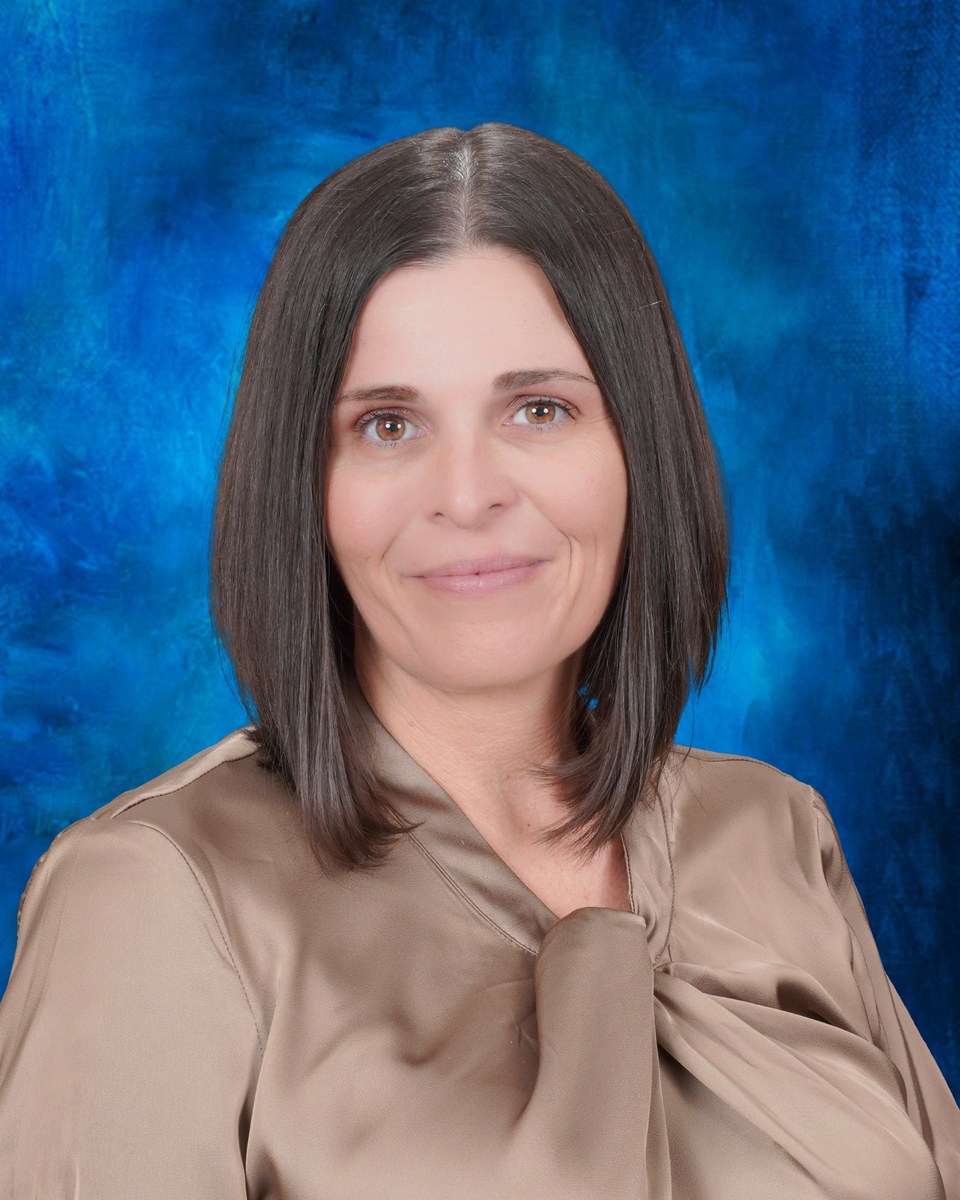
Kassandra Meeks did not arrive at the Calaveras Unified↗ET superintendency from outside the county. She graduated from the district's schools in 2002, taught in them, served as a principal in them, and her own children attend them now.
"I am happy to confirm that I am currently serving as Superintendent of Calaveras Unified School District," Meeks wrote in response to questions from The CAEdTribune. "I officially began in the role in July 2026, following my previous position as Assistant Superintendent/Director of Special Education for the District."
She goes by Kassie. The board approved her contract in February after what the district called a rigorous statewide selection process, and she succeeded Dr. Ronald J. Estes, who had been serving as interim superintendent and was retiring, according to the district's announcement.
"I am definitely a homegrown, local girl," she wrote.
Her description of how she got here is a list of jobs rather than a plan. "I began working in education as a paraeducator while I was still in college and eventually returned to CUSD as a teacher," she wrote. "Over the years, I have had the opportunity to serve our District in a variety of roles, including classroom teacher, principal, Director of Special Education, Assistant Superintendent, and now Superintendent."
The route in matters here
Meeks reached the superintendency through special education, and she says the route changed what she looks at first.
"My path through special education has absolutely influenced how I approach leadership," she wrote. "It reinforced the importance of looking at the individual needs of students, listening carefully to families and staff, and making sure our systems are actually working for the students they are intended to serve."
That background lands in a district where the service population is unusually large. In 2025-26, the most recent school year in California's published enrollment record, 544 Calaveras Unified students were counted as students with disabilities. That is 19.1% of the district's published total enrollment, against 14.8% across California, a gap of 4.3 percentage points. The state has published the subgroup for three years, and the district has sat above the statewide figure in every one of them.
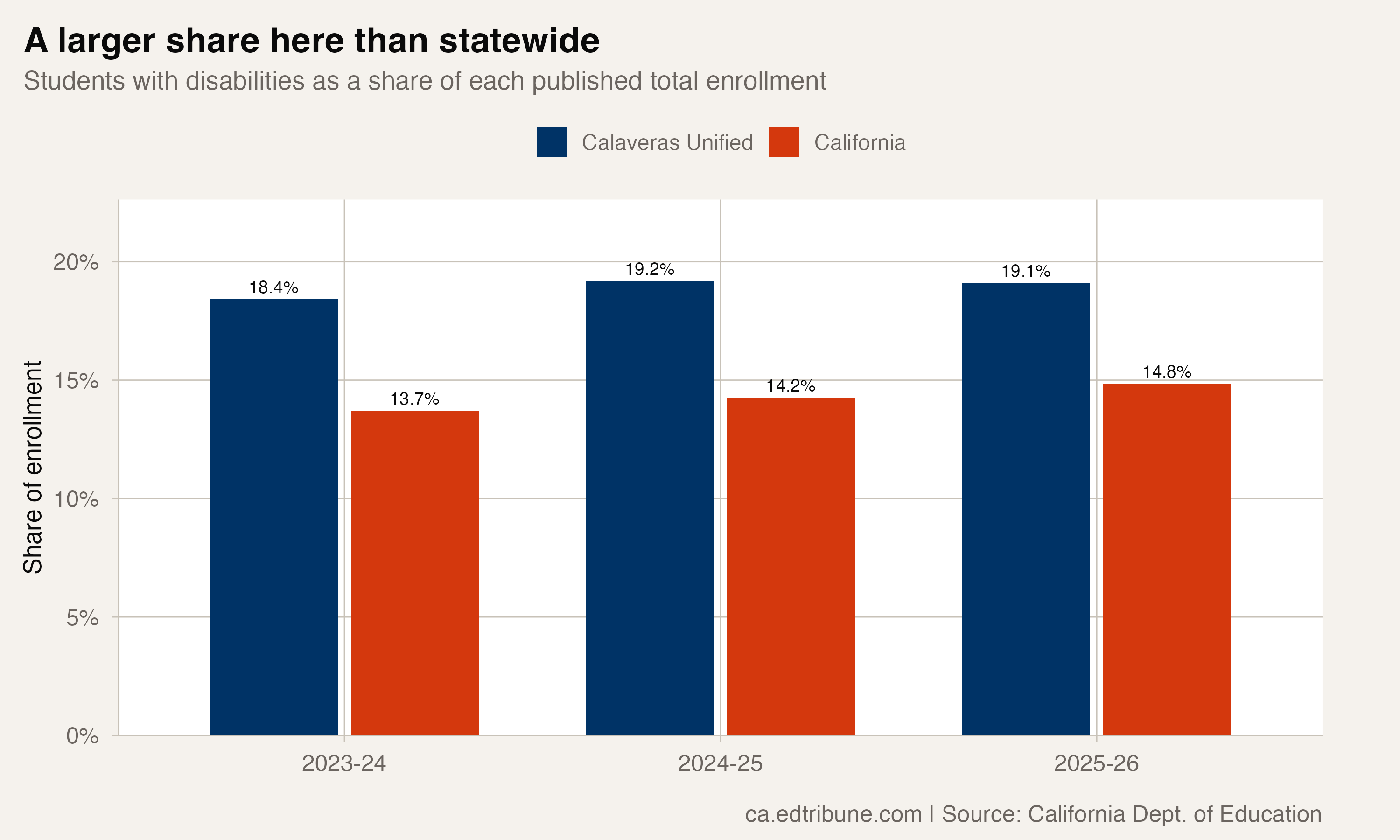
The record shows the size of that population. It does not show why it is larger here, and identification patterns, service capacity and county placement arrangements are separate questions that need separate evidence.
An enrollment record that stopped falling
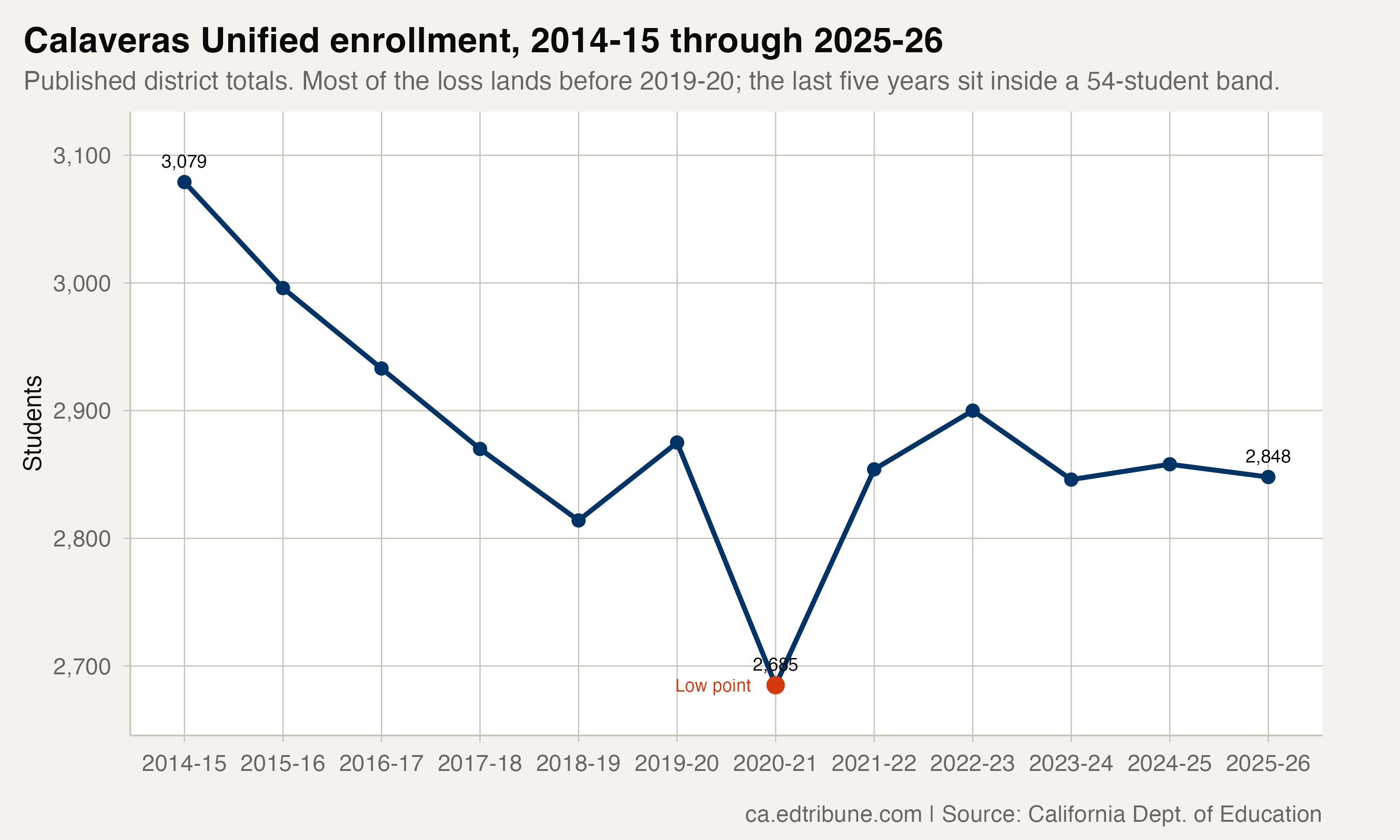
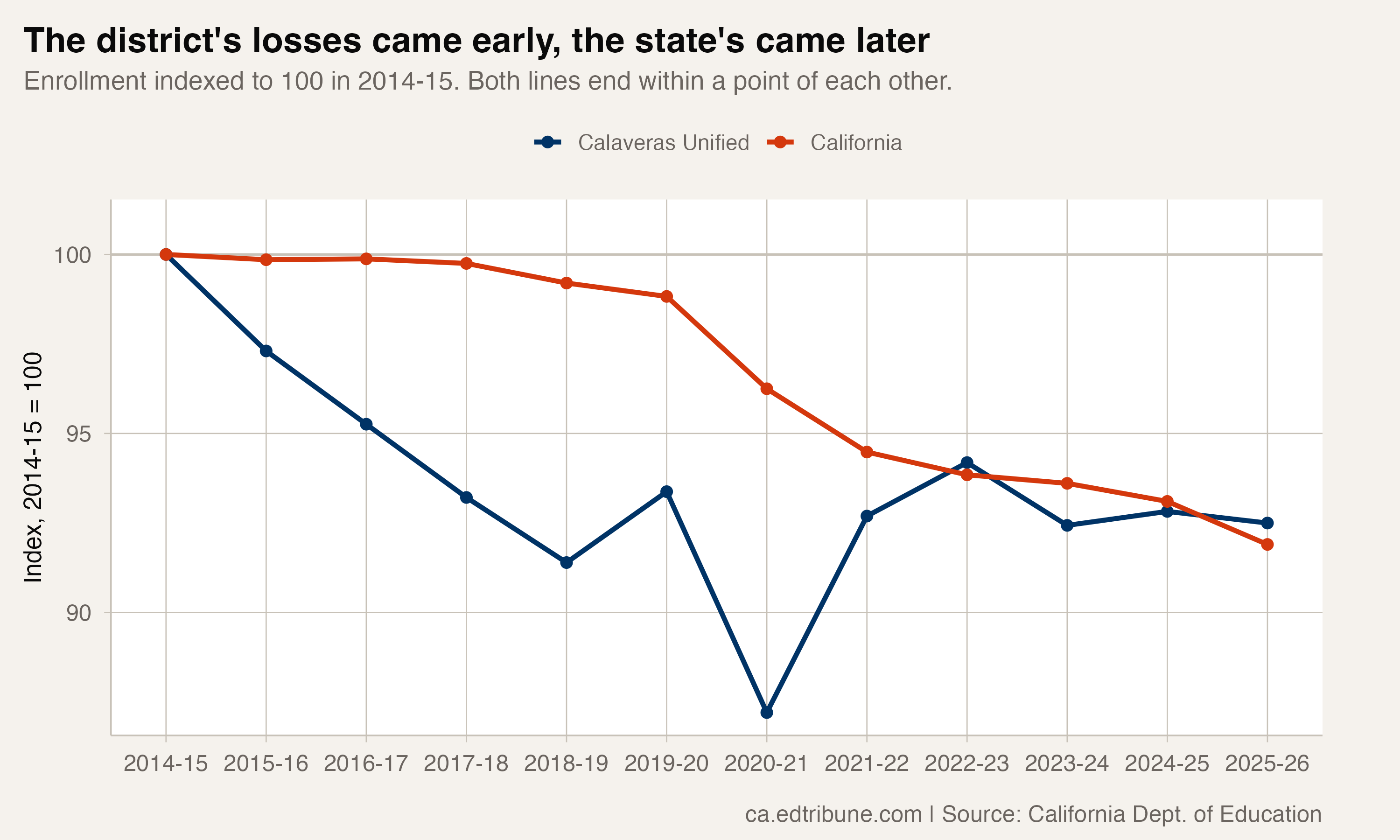
Calaveras Unified enrolled 2,848 students in 2025-26, down from 3,079 in 2014-15. That is a loss of 231 students, or 7.5%, across the available state record. California lost 8.1% over the same twelve years, so the district's decline ran slightly shallower than the state's rather than deeper.
The endpoints hide two different paths. Calaveras Unified did its shrinking early: by 2018-19, the last year before the pandemic, the district was already down 8.6% from its 2014-15 level while California was down 0.8%. The state's decline arrived afterward, and the two lines converge at the end of the window.
Locally the record reads as a district that stopped falling. Enrollment dropped in five of the six years through 2020-21, bottoming at 2,685 students. It has since added 163 students, 6.1% above that low. Across the five reporting years since 2021-22 the published totals have stayed inside a band of 54 students, and the most recent year moved down by 10 students, or 0.3%.
The state record establishes that movement and nothing about its causes. It does not show whether a program, a hire, a housing decision or a family's move produced any part of it.
Nine schools, one county
Meeks says the geography is the part outsiders miss.
"I think one thing people outside of Calaveras County may not fully understand is both the challenge and the strength that comes with being a small, rural school district," she wrote. "We cover a large geographic area and serve communities that each have their own identity and needs."
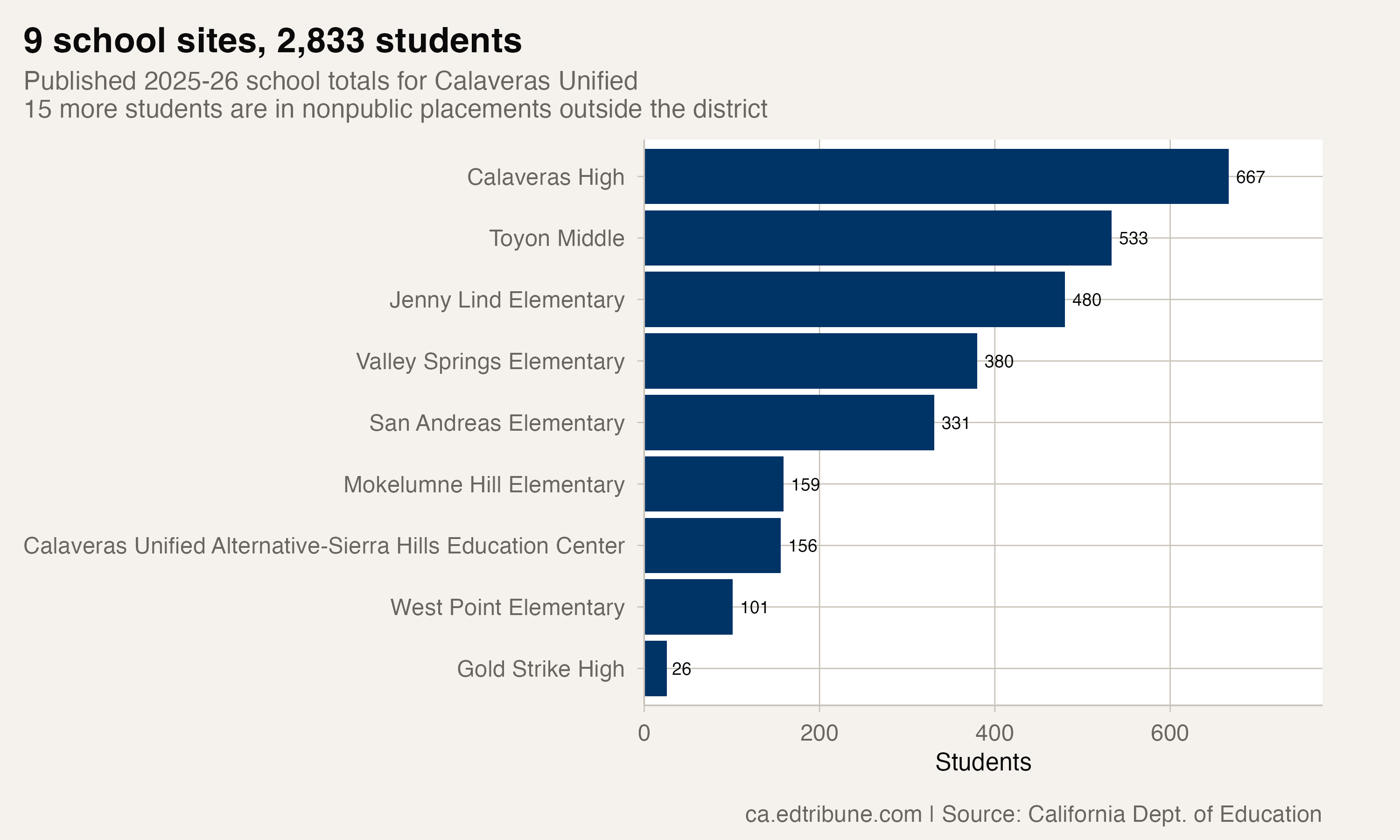
The published school records put numbers on that spread. Nine school sites carry the district's students in 2025-26. Calaveras High is the largest at 667. West Point Elementary, the smallest of the district's five elementary schools, has 101. A tenth row in the state file is not a district campus but a nonpublic, nonsectarian placement category holding 15 students.
"The non-public schools referenced is actually an option used for a very small percentage of our special education student population who require specialized programming that we do not offer within our District or county," Meeks wrote. "Those students attend a non-public school outside of CUSD in order to access the specialized programming and services they need."
That spread is the setting for the constraint she names next.
"We do not always have access to the same resources as larger districts, which means our staff often wear many hats and have to be creative problem-solvers," she wrote.
What she says she is working on
Her stated first-year agenda is a systems agenda rather than a program launch.
"In my first year as Superintendent, one of my biggest priorities is strengthening our systems while keeping our focus on students," she wrote. "That includes improving academic outcomes, supporting and retaining high-quality staff, strengthening communication and trust with our families and community, and making sure we are being responsible and strategic with our resources."
Her welcome letter to families for the current school year lists a similar set, adding college and career preparation and school environments where students feel safe and challenged.
Board President Bryan Porath, in the announcement of her selection, said her "proven leadership, deep commitment to student success, and collaborative approach reflect exactly what our district needs at this moment."
Staff retention is where the two halves of the job meet. A district serving 2,848 students across nine sites, with roughly one student in five counted as a student with a disability, needs credentialed special education staff spread across those sites. Meeks ran that department before she ran the district. She now owns the budget that pays for it, and she named retaining high-quality staff as one of her four stated priorities.
One planning number sits in the published grade counts. Calaveras Unified enrolled 217 kindergarten students in 2025-26 against 172 twelfth-graders. That is a same-year comparison of two different groups of children, not a forecast, and current-year counts will differ once the state publishes 2026-27 data. It is still the kind of number a superintendent watches when deciding how many sections a small district can carry.
Meeks frames the constraint and the asset as the same fact.
"At the same time, there is a tremendous sense of community here," she wrote. "People know one another, they care deeply about our schools, and when our community is faced with challenges, people step up for each other."
"Having grown up here and now having the opportunity to serve as Superintendent is incredibly meaningful to me," she wrote.
Enrollment, grade-level, and student-group figures come from California Department of Education enrollment data files covering the 2014-15 through 2025-26 school years; Meeks responded in writing and supplied the professional headshot used with this profile.
Detailed code that reproduces the analysis and figures in this article is available exclusively to EdTribune subscribers.
Discussion
Sign in to join the discussion.
Loading comments...